A charge nurse on a twenty-eight bed progressive care unit walks in at 0645 and finds two admissions holding in the emergency department, one nurse called out, and a telemetry box that has been missing since Friday. That is the raw material of NR-587, and the opening stage of the course is where you learn to convert it into something a grader can score: a stated decision, owned by a named role, bounded by a real constraint. The complaint is not the assignment. The decision is. Your section may print this as NR 587 or NR587; it is the same course. Chamberlain publishes no syllabi outside Canvas. The placement here is our teaching judgment from the course's catalog arc; your section's rubric decides what your week actually asks.
What NR-587 Week 1 asks for
An opening leadership stage is a framing stage. The course runs on decisions made inside limits, and before you can argue for one you have to establish that a decision exists, that somebody in particular has to make it, and that the situation will not resolve itself if everyone keeps working the way they work now. Most first drafts skip all three and open instead with a paragraph about how leadership is essential in modern healthcare. That sentence is true, unscorable, and interchangeable with every other paper in the section.
The writing move that separates a graduate leadership paper from a well-meaning one is the shift from condition to choice. A condition is that the unit is short staffed. A choice is whether to hold the two admissions in the emergency department until a float arrives at 1100, flex the unit to a lower census and accept the diversion, or run the shift with a six-patient assignment on the telemetry side and reassign the least acute pair to the observation nurse. Three named options, each with a cost that lands on somebody. That is a page a rubric can grade.
Deliverables at this stage of an eight-week session tend to be moderate in length and heavy in setup, because faculty want to see whether you can scope a problem before they let you solve one. Many sections also open with a posted classroom introduction or a short response thread. Treat any posted work as final copy from the first keystroke. Posts do not reopen after submission in Canvas, and an opening post that describes a frustration instead of a decision sets the reading expectation your grader will carry for seven more stages.
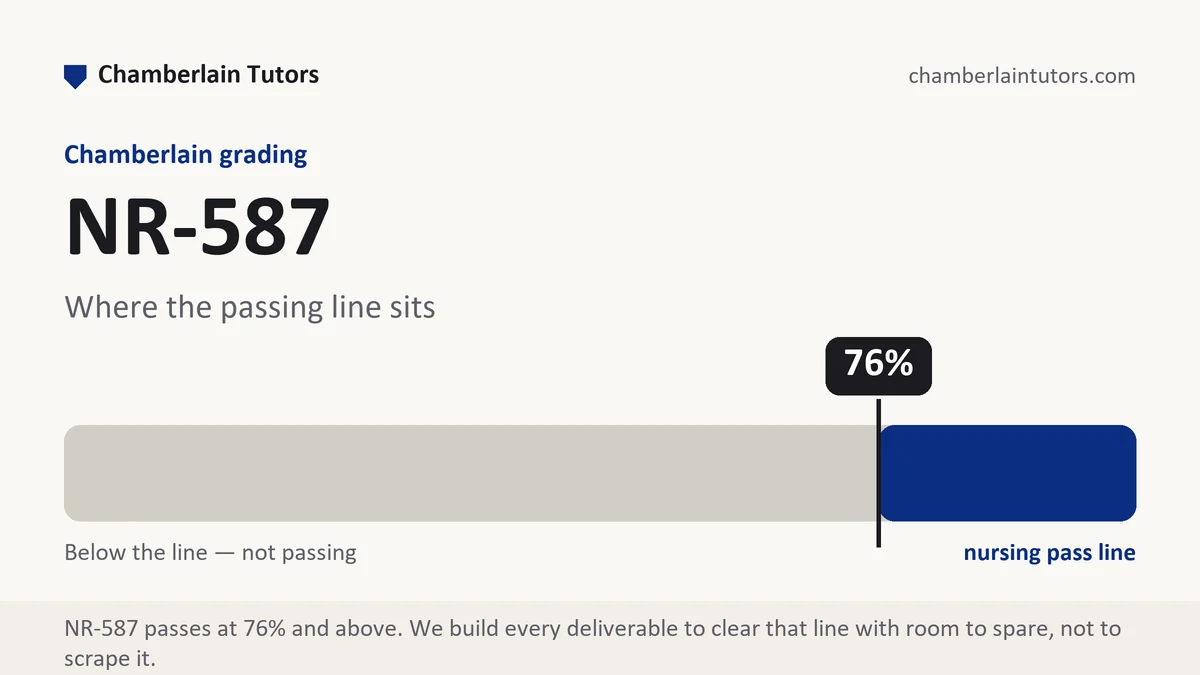
One more feature of this course belongs in your head from the first day. NR-587 carries four theory credits, which is a heavier load than most of the courses sitting beside it in an eight-week session, and core nursing courses pass at 76. Supplemental work cannot lift a weak weighted average. The opening stage is the cheapest place in the whole term to bank a strong score, because the content is scoping rather than analysis and the effort required is planning rather than research.
The NR-587 Week 1 method, step by step
Six moves that turn a working frustration into a framed leadership problem.
-
Read the rubric rows first and reduce each to a verb
Copy the scoring rows into a blank file as headings and strip each to the action it demands. Identify, analyze, evaluate and justify are four different depths. A row carrying justify is telling you that a comparison of alternatives has to appear on the page, not in your head.
-
Write the decision sentence before anything else
One sentence naming what must be decided, who decides it, and by when. If you cannot fill all three slots, you have chosen a topic rather than a problem, and the paper will drift into description no matter how well you write the paragraphs.
-
Fix the constraint that makes the decision hard
Every scorable leadership case has a limit inside it: a fixed budget, a vacancy nobody is going to fill this quarter, a shared piece of equipment, an accreditation deadline. Name yours in the opening section and hold it. A recommendation that quietly assumes the constraint away has answered a different question.
-
Establish the baseline in countable terms
Volume, acuity, timing, hours, skill mix, or whatever the decision actually turns on. Say how you know the number and over what window you observed it. Busy is not a baseline. Nineteen of twenty-eight beds occupied by telemetry patients across a fourteen-day stretch is.
-
Map who is affected outside the unit
Leadership decisions leak. Holding admissions moves pressure to the emergency department; flexing a nurse moves it to the float pool; a new escalation rule moves work to the rapid response team. List the roles your choice touches, because the coordination content of this course is graded on exactly that leakage.
-
Set the register in paragraph one and hold it
Decide from your rubric whether first person is permitted, then keep the prose declarative and sourced either way. Graduate leadership writing is short sentences carrying evidence, not warm sentences carrying conviction. Exclamation marks, contractions and inspirational closers each cost you in the writing row.
A layout and word budget for a framing paper
The frame our tutors keep beside a first submission in this course, sized for roughly 1,200 to 1,500 words. It is our own outline rather than anything the university issues, and your week's rubric outranks it wherever the two disagree. Scale the targets proportionally if your assigned length is different.
| Section | What belongs in it | Word target |
|---|---|---|
| The decision, stated | What has to be decided, by which role, inside what window, in the first three sentences of the paper. | 90 to 120 |
| Setting and baseline | Unit type, census, acuity mix, skill mix, and the observation window that produced those figures. | 200 to 240 |
| The constraint | The limit that makes the decision genuinely difficult, with evidence that it is fixed rather than negotiable. | 160 to 200 |
| Stakeholders and spillover | The roles inside and outside the unit whose work changes, and how each learns that it changed. | 200 to 250 |
| Why it matters clinically | The patient-level consequence of leaving the situation alone, supported rather than asserted. | 220 to 260 |
| Scope statement | What this paper will decide and what it deliberately leaves out, so the reader knows the boundary. | 100 to 130 |
Evidence craft for a framing paper
Support the consequence, not the frustration. Nobody needs a citation for the claim that your unit felt short handed. What needs support is the link between the staffing pattern and the outcome you say follows from it. Published work on nurse staffing, missed care and failure to rescue exists in quantity, and one well-chosen study attached to your specific consequence is worth more than four references decorating a background paragraph.
Date and attribute every professional document. Scope statements, leadership competency frameworks and standards for the nurse administrator are issued by organizations and revised on their own schedules. Name the issuing body and the year inside the sentence rather than leaving the reader to reconstruct it from the reference list. A competency quoted without an edition is a claim about the present made from an unknown date.
Give every number a base and a window. Six missed turns is meaningless. Six missed repositioning events out of forty-two scheduled across a seven-day audit on one hallway is evidence a reader can weigh. When you do not have an audit, say so and describe how you would collect one, which is itself a leadership competency and usually scores better than a fabricated figure.
Keep local experience as illustration and published work as proof. The order that scores is claim, published support, then the scene from your unit that shows the claim operating. Reversed, the paragraph reads as a story with a citation stapled to the end. Graders in leadership courses mark that ordering consistently, because the whole point of the degree is generalizing beyond one hallway.
De-identify anything that came from a real setting. No patient names, no room numbers tied to dates, no colleague identifiable by role and shift. Write the unit generically and the incident specifically. This is a professional expectation, not a stylistic one, and violating it is one of the few things that can cost more than a grade.
Five mistakes that cost points in this week's territory
- A topic instead of a decision. Nurse burnout on my unit is a subject. Whether to fund a second float position out of the education line is a decision, and only one of those can be justified.
- The constraint quietly removed. If your recommendation needs two more nurses, you have not solved the problem, you have restated it as a budget request nobody has approved.
- Background that outruns the analysis. Six hundred words on the history of transformational leadership leaves nothing for the rows that pay.
- Stakeholders listed but never traced. Naming five roles is inventory. Saying what each one has to do differently on Monday morning is analysis.
- Bedside register carried upward. Confident, warm prose reads as clinical presence in person and as unsupported assertion on a graduate scoring guide.
Before you submit
- The decision, the decider and the window appear in the opening paragraph
- The constraint is named and still standing at the end of the paper
- Every figure carries a base and an observation window
- At least one published professional document is named with its year in the sentence
- Each stakeholder named has a stated change to their own work
- Nothing in the paper could identify a patient, a colleague or a specific incident
Starting NR-587 this week?
Send the instructions and the rubric out of Canvas along with the constraint you are working inside. A premium original draft comes back in 24 to 48 hours with the decision framed and the options already costed, and revisions run until the grade lands.