Assume you have eight minutes at the end of an operations meeting and a director who has already read the first page. That is the audience the closing stage of NR-587 is written for. Everything the session has built, the framed decision, the counted demand, the costed options, the coordination effects and the congruence mechanism, now has to arrive in one document that leads with the recommendation instead of arriving at it. This is executive-facing writing, and its defining feature is that the answer comes first and the reasoning follows. Your section may print this as NR 587 or NR587; it is the same course. Chamberlain publishes no syllabi outside Canvas. The placement here is our teaching judgment from the course's catalog arc; your section's rubric decides what your week actually asks.
What NR-587 Week 8 asks for
Final stages in an eight-week leadership session are usually synthesis: a culminating written deliverable, sometimes a presentation, sometimes a shorter reflective component alongside. Whatever the format, the graded content is integration. Earlier stages examined pieces in isolation. This one asks whether you can hold them together in a single argument without the seams showing, and whether the argument reaches a conclusion somebody could act on.
The structural inversion is the thing most students get wrong. Academic writing trains you to build toward a conclusion; leadership writing puts the conclusion in the first paragraph and spends the rest of the document defending it. A reader in an operating role wants to know what you are asking for, what it costs, and what happens if they say no, in that order, before they will invest attention in your evidence. Papers that keep the recommendation until page seven lose the reader and often lose the row that asks for a clear recommendation, because the grader has to hunt for it.
Integration also means the strands have to talk to each other. A recommendation that solves the resource problem and creates a new handoff has to say so. A change that improves throughput for the majority and disadvantages patients who need interpretation has to name that trade explicitly rather than leave it to be discovered. The strongest closing papers we see are honest about second-order effects, because naming a downside you have anticipated is far more persuasive than presenting a change with no cost at all.
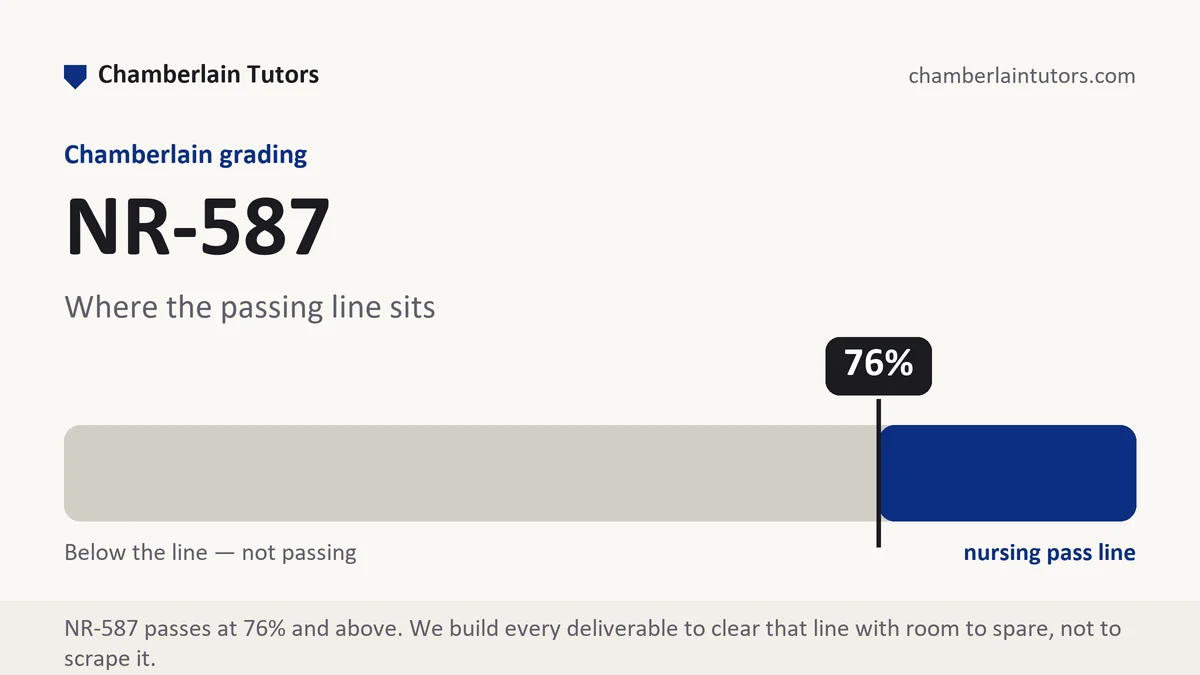
If your section closes with a reflective element, write it as analysis rather than as gratitude. What you now do differently, what evidence changed your mind during the term, and what you were wrong about at the start. A closing reflection built from specific reversals reads as learning. One built from appreciation reads as a card. Remember also that the arithmetic of a short session is unforgiving: core nursing courses pass at 76, and the final deliverable often carries the heaviest weight in the gradebook, so the last week is not the week to be economical with effort.
The NR-587 Week 8 method, step by step
Six moves for assembling a defended recommendation.
-
Write the recommendation as a single sentence and put it first
Action, owner, resource, timeframe. If it takes you three sentences, the recommendation is still two decisions wearing one coat. Split it and choose the one you can defend.
-
Add the three-line summary a busy reader needs
What it costs, what it buys, and what happens if nothing changes. Those three lines sit directly under the recommendation and do most of the persuasive work in any real leadership document.
-
Rebuild the evidence chain in the order that supports the claim
Problem, magnitude, options, choice, implementation, evaluation. Discard anything from earlier stages that does not serve the recommendation, however much work it took. A synthesis is not an anthology.
-
Reconcile the strands against each other
Walk your recommendation through coordination, congruence and cost and say where it creates a new problem. One honest paragraph naming a second-order effect is worth more than three paragraphs of benefit.
-
Specify the evaluation before the conclusion
What will be measured, by whom, at what interval, against what baseline, and what result would count as success or as failure. This is the section that distinguishes a plan from a proposal.
-
Do a citation and consistency pass across the whole document
Every in-text citation in the list, every list entry in the text, every figure identical in the table and the prose, headings in the format your rubric uses. In a heavier four-credit deliverable, mechanical drift is the most common avoidable loss.
A layout and word budget for a culminating decision paper
Our frame for a closing deliverable, sized for roughly 2,000 to 2,500 words, which is the range a four-credit course tends to run at the end of a session. It is our own outline rather than anything the university issues, and your week's rubric outranks it wherever they disagree.
| Section | What belongs in it | Word target |
|---|---|---|
| Recommendation and summary | The one-sentence recommendation plus cost, benefit and the consequence of inaction. | 180 to 220 |
| Problem and magnitude | The situation in counted terms, with the window and source, condensed from your earlier analysis. | 300 to 360 |
| Options considered | The alternatives with their costs and the criteria used to choose, compressed but not flattened. | 350 to 420 |
| Second-order effects | Coordination changes, equity effects and workload shifts the recommendation creates. | 300 to 360 |
| Implementation | Sequence, owners, resources, and the two most likely points of failure with responses. | 350 to 420 |
| Evaluation and decision point | Measures, baseline, interval, and the result that would trigger modification or withdrawal. | 300 to 360 |
Evidence craft for a synthesis document
Reuse your own analysis, but rewrite it. Pasting paragraphs from earlier submissions creates a document with visible seams and can raise similarity questions against your own prior work. Rewrite each condensed section so it points at the recommendation, and check your program's policy on reusing your own writing before you rely on it.
Prune the reference list to what carries weight. A closing paper does not need every source you have read this term. It needs the ones that establish magnitude, the ones that support the chosen intervention, and the ones that inform implementation. Sources that appear once in a background sentence can usually go.
State the strength of your evidence honestly. Say where the support is strong, where it is a single-site improvement report, and where you are reasoning from mechanism because no study exists for your exact situation. Graders reward calibrated confidence, and an overclaimed evidence base is easy to expose.
Give the evaluation a baseline it can be measured against. An indicator with no starting value cannot show change. If you have no baseline, say that establishing one is the first step of implementation, which is both true and a better answer than a target with nothing behind it.
Run the mechanical pass on a printed copy or a different screen. Heading levels, page numbers, reference formatting and the title page are the cheapest rows in the whole term and the ones most often lost at the end of a long session when the writing is finished at midnight.
Five mistakes that cost points in this week's territory
- The recommendation buried at the end. A reader in a leadership role should know what you are asking for inside the first thirty seconds.
- The stapled anthology. Earlier sections reproduced intact, in their original order, with no argument running through them.
- No second-order effects. Every real change moves work somewhere. A paper where nothing is displaced has not been thought through.
- Evaluation as an afterthought. Two sentences promising to monitor outcomes leaves the row that asks how you will know it worked essentially unanswered.
- Mechanics abandoned at the finish. A strong argument delivered with mismatched citations and drifting headings loses points that cost nothing to keep.
Before you submit
- The recommendation appears in the opening paragraph as a single actionable sentence
- Cost, benefit and the consequence of inaction sit directly beneath it
- Every retained section serves the recommendation rather than the term's history
- At least one second-order effect is named and addressed
- Evaluation names a measure, an owner, a baseline, an interval and a decision point
- Citations, figures, headings and formatting have had a dedicated final pass
Assembling the final case?
Send the rubric out of Canvas with whatever you have from earlier stages. A premium original draft comes back in 24 to 48 hours with the recommendation leading and the evidence chain rebuilt behind it, and revisions run until the grade lands.