NR-583 is three theory credits on healthcare informatics, emerging technologies, and the ethical and legal side of managing health information. The writing is not technical in the way students fear. It is analytic: take a tool or a data flow, show what it does to clinical work, and say what obligations follow. Feature descriptions score low; workflow consequences score well.
What NR-583 actually grades
The trap in an informatics course is that the subject invites description. A system has modules, screens, alerts and interfaces, and it is easy to fill a page listing them. None of that answers the question the rubric is asking, which is what changes for the person doing the work and for the patient whose record it is.
Rows in this course usually cluster around three demands. They want the data followed, from the point where a human enters something to the point where somebody else acts on it. They want the ethical and legal obligations attached to specific points in that path rather than gathered into a closing paragraph. And they want a judgment: whether the tool is worth its cost in clicks, attention and risk.
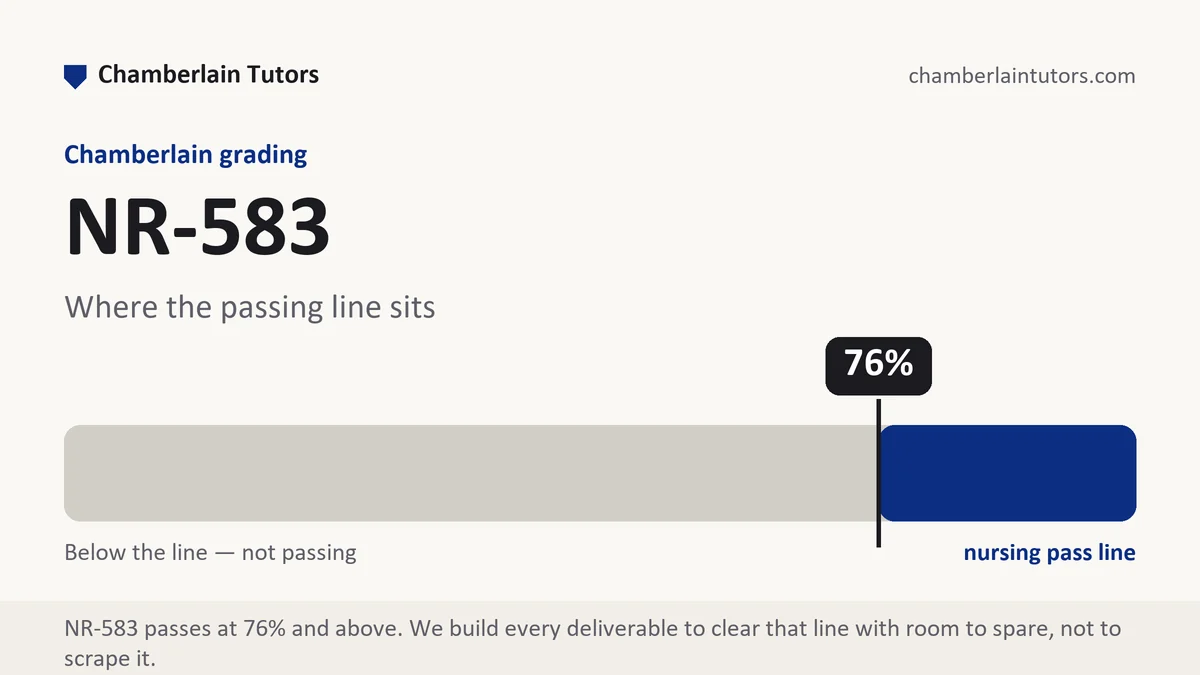
You are also being trained in a habit that later courses assume. Once you can describe a data flow precisely, quality work, population work and research work all become easier, because each of them depends on knowing where a number came from. Chamberlain's passing floor in core nursing courses is 76, and students taking this course inside a nurse practitioner specialty run a scale with no C where 84 is the last passing number, so an early course is a poor place to build a thin average.
How we help in this course
Send the prompt and the rubric from Canvas, plus one sentence about the system or the process you want to write about. It can be an electronic record you use, a documentation step that annoys you, a monitoring tool, a patient portal function, or something you have only read about. We build the draft with a traceable data path in it and keep the legal and ethical analysis attached to the points where it actually bites.
Students who work in settings with tight information policies sometimes worry about what they can describe. The answer is that process can be described generically and specifics can be replaced by type and size, which we do as a matter of course.
Stuck on the informatics deliverable?
Send the rubric and the system you have in mind. We will map the data flow and scope the draft today.
Read the rubric before the prompt
Informatics rubrics are often written by people who have watched students describe software instead of analyzing it, so the rows carry defensive language: evaluate, appraise, examine implications. Pull the rows into a blank document and sort them into two piles, one for rows that can be satisfied with information and one for rows that need a judgment. The second pile is where the marks are.
Then price the rows in words. Imagine a 1,600-word cap and four rows weighted 35, 30, 20 and 15 percent. The arithmetic gives 560, 480, 320 and 240 words. In this course the 560-word row is almost always the implications row and the 240-word row is the description row, which is the exact inverse of how the average draft is written. Put those four numbers next to your headings before you type a sentence and the shape of the paper corrects itself.
Reference list and appendices sit outside the count unless your guide says otherwise, and a workflow diagram, where permitted, buys back a surprising number of words from the description section.
The parts of a technology evaluation
The dominant deliverable here is an evaluation of something that handles clinical information. Each part earns its place.
| Part | What it has to establish | The description-only version |
|---|---|---|
| The clinical problem | What goes wrong now, expressed as an event that can be counted or timed. | A statement that documentation is burdensome. |
| The tool, briefly | What the system does in three or four sentences, at the level a clinician needs. | A feature list transcribed from marketing material. |
| The data path | Who enters what, where it is stored, who sees it, and what decision it drives. | An assurance that data is captured in the record. |
| Workflow effect | What the clinician does differently, including the steps added as well as removed. | Efficiency claimed without a step being named. |
| Privacy and security | Where the information is exposed in that path, and the safeguard that applies at each point. | A general paragraph on the importance of confidentiality. |
| Legal and ethical duties | Consent, access rights, retention and the duty owed when the system is wrong, tied to the specific step. | A list of regulations named but not applied. |
| Failure modes | What happens during downtime, bad data or alert fatigue, and who absorbs the risk. | Silence, as though the system always works. |
| Evaluation plan | The measure that would tell you it worked, with its source and interval. | A promise to monitor outcomes. |
Evidence craft in informatics writing
The sourcing problem in this field is that the most available material is the least neutral.
Vendor documentation is a source for claims, not for results. Cite it when you need to say what a product asserts it does. Do not cite it for whether the product works. Peer-reviewed evaluations, implementation reports and independent assessments carry that.
Standards and terminologies carry versions. Naming a coding system, an interoperability standard or a security framework without the version or the year leaves a grader unable to check whether you read a current document, and this field revises quickly.
Design and sample before the finding. "In a before-and-after study on four medical units covering 6,800 orders" tells the reader how much weight a number carries. Informatics literature leans heavily on uncontrolled before-and-after work, so the honest verbs are "was followed by" and "was associated with". Reserve "reduced" and "prevented" for controlled evidence.
Rates need a denominator and a window. "Alerts fired on 3,100 of 12,400 orders in one quarter, and 9 in 10 were overridden" is a usable fact. "Alert fatigue is widespread" is a sentiment, and in a course that grades data literacy the difference is visible immediately.
Passing and strong in an informatics course
A passing paper explains a system correctly and mentions the right regulations. It is accurate and impersonal, and it could describe the same product at any hospital in the country. On the specialty scale, where nothing below 84 passes, a run of accurate and impersonal work drifts under the line faster than students expect, and supplementary work cannot rescue a weak weighted average.
One symptom is easy to spot in your own draft. If the words nurse, clinician and patient appear only as categories, with no moment where a specific person is doing a specific thing at a specific point in the shift, the paper is still describing software. The fix is usually a single well-chosen scenario, written in two or three sentences, that the rest of the analysis can then refer back to.
A strong paper is grounded in one workflow and follows one piece of information all the way through it. It counts something, even roughly. It names the trade-off rather than hiding it, because every informatics gain costs somebody clicks, attention or autonomy. And it takes a position on whether the trade is worth making, which is the judgment the heaviest row is usually asking for and the one most drafts decline to give.
Six habits that cost marks in NR-583
- Listing features instead of tracing a workflow. Screens and modules are not analysis. What a nurse does at 3 a.m. because of them is.
- Parking the ethics in the conclusion. Privacy and consent belong at the step where the exposure happens, not in a closing paragraph.
- Citing the vendor for outcomes. Use vendor material for what a system claims, and independent evaluation for whether the claim holds.
- Ignoring downtime and bad data. A paper that assumes the system always works has skipped the part a grader is most interested in.
- Naming your employer or its instance. Describe the setting by type and size. Product categories are fine; identifying your site is not.
- Posting a board response before it is finished. Posts do not reopen once submitted at Chamberlain, so the first paste is the graded version.
Questions NR-583 students ask
How technical does this writing have to be?
Can I write about a system I have never used?
The rubric says analyze but my draft keeps coming out as description. How do I tell them apart?
Where NR-583 sits in Chamberlain's programs
Open the exact program map for sequence, credit, and option context. The current student schedule and syllabus remain authoritative after transfer evaluation, electives, state rules, and approved plan changes.
The weeks, one by one
Week 1
A four-year-old comes in for a well-child visit and her weight is recorded three separate times before anyone prescribes anything: once on the intake flowsheet, once in the growth chart module, and once by hand on a paper dosing card taped to the exam room wall. Read the full Week 1 manual.
Week 2
Count how many times a family practice patient is asked about a penicillin reaction between the parking lot and the prescription: the online pre-visit form, the front desk, the medical assistant rooming script, and the provider confirming before writing. Read the full Week 2 manual.
Week 3
A six-year-old transfers into a family practice from another state, and her immunization history arrives three ways: a parent's photograph of a yellow card, a registry feed that lists product names, and a transferred chart that lists antigens. Read the full Week 3 manual.
Week 4
Every weight-based liquid antibiotic order in a busy pediatric clinic trips the same dosing warning, and by ten in the morning the clinician clicking through it has stopped reading the text. Read the full Week 4 manual.
Week 5
A parent uploads eleven days of home peak flow readings for a school-age child with asthma, and the practice has no agreed answer to a simple question: who looks at them, how quickly, and what happens if nobody does. Read the full Week 5 manual.
Week 6
A fifteen-year-old is seen alone for ten minutes at the end of a sports physical, the visit note carries a sentence she asked to keep private, and the portal account attached to her chart still belongs to her mother. Read the full Week 6 manual.
Week 7
A family practice pulls a list of children overdue for a routine immunization so the panel can be called, and somewhere between the query and the phone the list acquires a second job: it becomes the basis for deciding which families are difficult. Read the full Week 7 manual.
Week 8
A family joins a new family practice panel carrying a printed stack from three previous settings, and an intake nurse has twenty minutes to convert it into a problem list, a medication list and an immunization history that the clinician will trust for the next decade. Read the full Week 8 manual.