A four-year-old comes in for a well-child visit and her weight is recorded three separate times before anyone prescribes anything: once on the intake flowsheet, once in the growth chart module, and once by hand on a paper dosing card taped to the exam room wall. That is the subject of NR-583 Week 1. An opening informatics stage asks you to stop treating clinical information as something that simply exists and start describing it as a system with origins, custodians, transformations and failure points. The written work is a map with an argument attached. Your section may print this as NR 583 or NR583; it is the same course. Chamberlain publishes no syllabi outside Canvas. The placement here is our teaching judgment from the course's catalog arc; your section's rubric decides what your week actually asks.
What NR-583 Week 1 asks for
The catalog frames this course around healthcare informatics, emerging technologies, and the ethical and legal dimensions of managing information. Courses built on that frame nearly always spend their opening stage establishing what the discipline is and why an advanced practice nurse should own it rather than delegate it. The graduate version of that question is not what informatics means. It is what changes about your clinical judgment once you accept that every number you act on arrived through a chain of hands, screens and defaults that somebody designed.
Expect the opening deliverable to be modest in size and heavy in framing. Opening stages in an eight-week session commonly carry a short written piece, a posted introduction, or both, because faculty want a baseline read on your writing before the applied stages arrive. Whatever shape yours takes, the graded move is the same: define the discipline from the literature, then demonstrate it operating on one concrete piece of clinical information you handle regularly.
The framework most opening informatics stages lean on is the progression from data to information to knowledge to wisdom, and it is worth using well rather than reciting. In a family practice setting the ladder is easy to walk with a single value. A hemoglobin A1c of 8.4 is data. Placed beside the last four results it becomes information about a trajectory. Read against a medication list, a refill history and a note about the patient's night shift schedule it becomes knowledge. The decision to change the regimen rather than repeat the lecture is the top rung, and it is the only rung the patient experiences.
What distinguishes graduate writing here is attention to the failure modes. Every rung of that ladder can break. Data can be entered in the wrong field or in the wrong units. Information can be assembled from a chart that does not contain the outside records. Knowledge can be built on a problem list nobody has reconciled in two years. Write about the breaks and you are doing informatics. Write only about the ladder and you have summarized a reading.
The NR-583 Week 1 method, step by step
Six moves that turn a definitions assignment into an analysis of a real information system.
-
Reduce your week's rubric to its graded verbs first
Open the scoring guide in Canvas and copy each row into a blank document as a heading, then strip it to the verb it is asking for. Define, describe, analyze and evaluate sit at four different depths, and an opening stage that answers describe when the row said analyze loses points that no amount of extra reading recovers.
-
Choose one piece of clinical information as your specimen
Not a topic, a specimen: one immunization record, one growth percentile, one allergy entry, one blood pressure taken on a squirming toddler with a cuff that may have been the wrong size. A single item you can follow end to end will carry the whole piece, and it keeps the writing out of the abstraction that sinks most opening submissions.
-
Trace where your specimen was born and who touched it
Name the point of capture, the person or device that captured it, the field it landed in, and every system it moved through afterward. Most clinicians discover in this step that they do not actually know where half the numbers on their screen originated, which is itself worth a sentence of analysis.
-
Walk the specimen up all four rungs in your own words
Give each rung a short block: the cited definition, then your specimen at that level. Keep the same specimen throughout. Switching examples between rungs is the most common way an otherwise sound piece stops demonstrating the framework and starts merely mentioning it.
-
Name one break in the chain and say what it cost
A weight in pounds entered into a field expecting kilograms, an allergy recorded as a free-text comment rather than a coded entry, a result routed to a clinician who left the practice. State the break, the mechanism, and the clinical consequence in that order. This is the sentence that separates a graduate opening piece from an undergraduate one.
-
Close on the advanced practice implication
Say what the map changes about how you will practise, not how you feel about technology. If the map shows that your diagnostic reasoning depends on records you cannot see, that is a claim about your own accuracy and it belongs in the final paragraph.
A layout and word budget for an opening informatics piece
The frame our tutors keep beside a first informatics submission, sized for roughly 900 to 1,100 words. It is our own outline rather than anything the university issues, and your week's rubric outranks it wherever the two disagree. If your section assigns a discussion post instead, shrink every row by the same factor and keep the proportions intact.
| Section | What belongs in it | Word target |
|---|---|---|
| The claim about information | One sentence asserting what informatics changes about clinical judgment, written before any definition appears. | 60 to 80 |
| The discipline, defined and attributed | Nursing informatics defined from a professional source with the issuing body named in the sentence, not from a dictionary. | 130 to 160 |
| Your specimen introduced | The single item of clinical information you will follow, described with its capture point, its field and its custodian. | 140 to 170 |
| The four rungs, applied | The specimen carried from raw value to decision, one short block per level, same specimen throughout. | 280 to 330 |
| The break and its cost | One documented failure point in the chain, its mechanism, and the clinical consequence it produced or could produce. | 180 to 220 |
| Practice implication | What the map changes about your own diagnostic or prescribing behaviour going forward. | 90 to 110 |
Evidence craft for foundational informatics writing
Define the discipline from a body that owns it. Professional nursing organizations publish scope and standards documents for informatics, and quoting one puts a named authority behind your opening paragraph. Name the organization and the edition year inside the sentence. A definition floating free of its owner reads as your opinion about a field that has spent decades defining itself precisely.
Give the framework its authorship. The data to wisdom progression has origins in the informatics literature and did not appear in your course materials by magic. Cite the source your readings point to, or the review article that traces it. Using a named framework without attribution is the single most common citation failure in an opening informatics submission, and it is easy to fix.
Keep the course text as one voice among several. An opening stage tolerates textbook citation more than any later stage, but pair it with at least one peer-reviewed article from the last five years so the habit installs early. By the applied stages of this course a paper built on a textbook alone will not carry the evidence row.
De-identify every clinical detail you borrow from practice. Real examples make this writing better, and they carry an obligation. No names, no dates that pin to a visit, no facility detail specific enough to locate a chart. A four-year-old presenting for a routine well-child check with a weight recorded in the wrong units is clinically complete and identifies nobody.
Reconcile citations in both directions before you submit. Every in-text citation appears in the reference list and every reference appears in the text. It takes four minutes and it protects a row you have already earned with the writing.
Five mistakes that cost points in this week's territory
- A stack of definitions with nothing applied. Four cited definitions and two lines of example fills the word count and leaves the analysis rows empty. Reverse the proportion.
- Data and information used as synonyms. The entire opening stage exists to separate those rungs, so blurring them in the second paragraph undercuts everything after it.
- Writing about technology instead of information. An essay about how software has changed nursing is not an informatics analysis. The subject is the information itself and what happens to it.
- The specimen that changes halfway through. A growth percentile at the data rung and a sepsis alert at the wisdom rung demonstrates nothing about how one item travels.
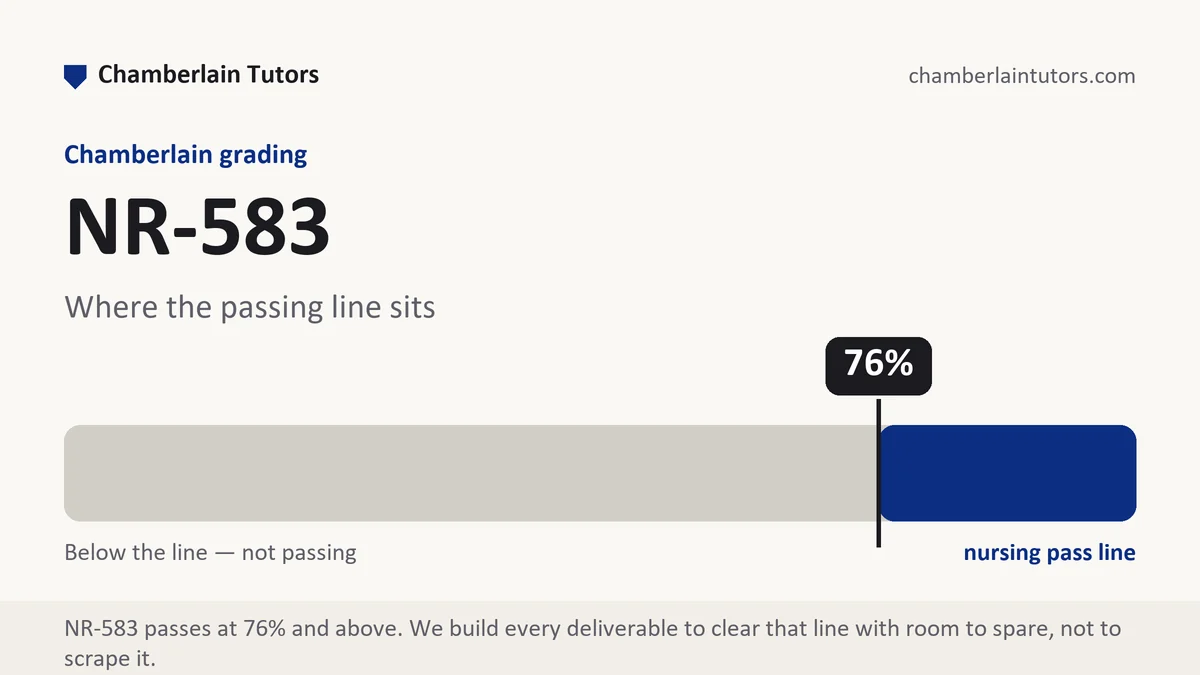
- Treating the opening submission as a warm-up. There are eight stages in the session, the first one lands before you know how your grader reads, and graduate nursing courses carry a grade floor that leaves no cushion week.
Before you submit
- Your claim about clinical judgment appears before any definition does
- The discipline is defined from a named professional source with a year in the sentence
- One specimen of clinical information carries all four rungs without substitution
- At least one break in the information chain is named with its mechanism and its cost
- Every clinical detail is de-identified, including facility and date specifics
- The closing paragraph states a change in your practice, not a feeling about technology
Starting NR-583 this week?
Send the instructions and the rubric out of Canvas. A premium original draft comes back in 24 to 48 hours with the framework applied to one worked clinical specimen rather than recited, and revisions run until the grade lands.