NR-565 Week 8 closes the session by asking the same prescribing question at four different ages, then asking you to write the answer as one plan a colleague could execute. Your section may print this as NR 565 or NR565; it is the same course. Chamberlain publishes no syllabi outside Canvas. The placement here is our teaching judgment from the course's catalog arc; your section's rubric decides what your week actually asks. Closing work is graded on integration: kinetics, receptor action, variation and safety carried into one regimen.
What NR-565 Week 8 asks for
Age changes pharmacology in ways that are physiological rather than incidental. In infants and young children, organ systems that clear drugs are still maturing, body water proportion is higher, and dosing runs by weight or by surface area, which makes an arithmetic error a clinical event. In pregnancy and lactation the questions multiply: plasma volume and filtration rise, a second patient is exposed, and the decision has to weigh the risk of the medication against the risk of leaving the condition untreated. In older adults, filtration falls with age even when creatinine looks reassuring, body composition shifts, sensitivity to central agents rises, and prescriptions accumulate across several prescribers.
That accumulation is why deprescribing belongs in a closing stage. Reviewing a long list for agents whose indication has passed, for one drug treating the adverse effect of another, and for cumulative burden is prescribing work of the highest order, and it is written the same way a new prescription is: with a reason, a schedule and a follow-up.
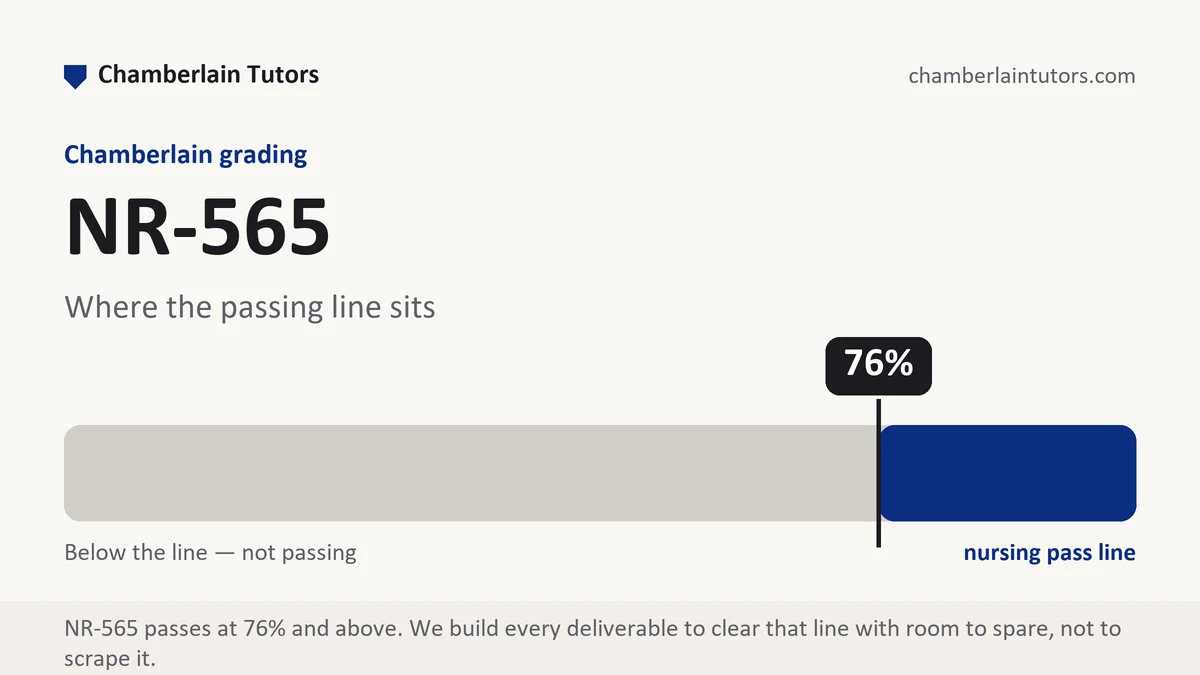
Around the clinical material sits the professional frame. Prescriptive authority is granted by a state and varies, controlled substances carry their own registration and record-keeping duties, and documentation is what makes reasoning visible to the next clinician. Final deliverables tend to be longer and more integrative, and they often decide a borderline grade on a scale where 84 is the last passing number.
The NR-565 Week 8 method, step by step
Six moves for a closing paper that has to hold a whole regimen and a whole lifespan at once.
-
State the physiological difference before the dose
Immature clearance, expanded plasma volume, reduced filtration, altered body composition. Naming the mechanism first makes the adjustment that follows an argument rather than a rule you remembered.
-
Show the dosing arithmetic where weight or surface area applies
Write the calculation out and state the maximum. In pediatric prescribing the working is part of the answer, and a checked figure with its units visible is what a rubric row asking for accuracy is looking for.
-
Weigh treatment against non-treatment in pregnancy and lactation
The comparison is never drug against nothing. Say what the untreated condition does to both patients, what is known about exposure, and what timing or route reduces it, then make the recommendation and name what you would monitor.
-
Start low and defend the ceiling in older adults
Give the reduced starting dose, the slower titration interval and the reason drawn from the physiology you already named. Then state the maximum you would not exceed and what would make you stop climbing.
-
Run a deprescribing review as a section, not an aside
Take the list agent by agent: is the indication current, is the benefit still likely at this age, is anything treating another drug's effect, what is the cumulative sedative or anticholinergic load. Propose withdrawals with a taper and a follow-up window.
-
Close with the professional frame
Note where authority and any collaborative requirement come from for your setting, what documentation supports the decisions you made, and what a controlled substance adds in record-keeping. Keep it specific and short; two paragraphs of general regulation earn nothing.
A layout and word budget for an integrative prescribing paper
Built for a final piece in the range of 1,500 to 1,800 words that has to carry a regimen and a life stage together. The frame is ours, assembled from work our tutors do on closing prescribing papers, and anything your scoring guide specifies replaces it.
| Section | What belongs in it | Word target |
|---|---|---|
| Patient, age and question | The presentation, the life stage and the prescribing question the paper will answer. | 120 to 160 |
| Physiology of this life stage | What is different about absorption, distribution, clearance or sensitivity, and why it matters here. | 250 to 300 |
| Regimen with arithmetic | Agent, dose with any calculation shown, route, interval and the adjustment the physiology demands. | 300 to 350 |
| Risk weighing | Treatment against non-treatment, including exposure of a second patient where that applies. | 250 to 300 |
| Regimen review and deprescribing | The existing list examined for redundancy, cumulative burden and expired indications, with proposals. | 280 to 330 |
| Documentation, frame and close | What is recorded, what the authority rests on, then the single sentence the paper supports. | 180 to 220 |
Evidence craft for lifespan prescribing claims
Say when you are extrapolating. Much pediatric and pregnancy prescribing rests on evidence gathered in other populations. Name the population that produced the finding and state plainly that you are extending it, with the reason you believe the extension is reasonable.
Estimated filtration behaves differently in older adults. A creatinine within range can accompany substantially reduced clearance where muscle mass is low. Say which equation your source used and what it may be overestimating in this patient.
Prefer criteria and consensus lists for burden judgments. When you argue that an agent is best avoided at an advanced age, cite the published criteria that say so rather than asserting it, and note that criteria are guidance to be applied to a patient rather than rules that decide alone.
Lactation and pregnancy sources are revised often. Labeling formats and specialized references in this area have changed within recent years, so anything past five years needs its reason stated. Developmental physiology can rest on an established text.
Five mistakes that cost points in this week's territory
- Age noted with no consequence. Observing that a patient is elderly or pediatric, without naming what is physiologically different and what dose it changes, adds words and no analysis.
- Weight-based arithmetic hidden. A final number with no calculation and no maximum cannot be checked, and accuracy rows in this territory exist to check it.
- Pregnancy reduced to avoid where possible. The untreated condition carries risk too, and a paper that never states it has only done half the comparison.
- The existing list left untouched. Adding an agent to a long regimen without reviewing what is already there misses the section that most distinguishes advanced practice writing.
- Regulation copied in bulk. Paragraphs of general scope-of-practice text crowd out the clinical reasoning the heavier rows are weighted for.
Before you submit
- The life stage is described as a physiological difference with a prescribing consequence
- Any weight or surface area calculation is shown with its units and its maximum
- Treatment and non-treatment are compared where a second patient is exposed
- Starting dose, titration interval and ceiling are all stated for the older adult
- The existing regimen is reviewed and at least one proposal carries a taper and a follow-up
- The professional frame is specific to the setting and kept to a short closing section
Closing out NR-565?
Send the final prompt and the scoring guide from Canvas. A premium original draft comes back in 24 to 48 hours with the lifespan reasoning integrated into one regimen, revised free until the grade lands.