NR-553 Global Health carries three theory credits and covers globalization and global health systems along with the nurse's policy role in promoting the health and safety of populations. Two words in that description control the grading. Systems means your paper has to explain how care is financed, staffed and delivered somewhere specific, and policy means your recommendation belongs to a government or an institution rather than to a visiting clinician.
What NR-553 actually grades
Specificity of place, first. Global is the subject of the course but never the unit of analysis. A paper about a condition worldwide can only make general statements, while a paper about that condition in one country with a named financing arrangement and a named workforce shortage can make arguments. Rubric rows asking you to analyze a global health issue are really asking you to hold a system still long enough to examine it.
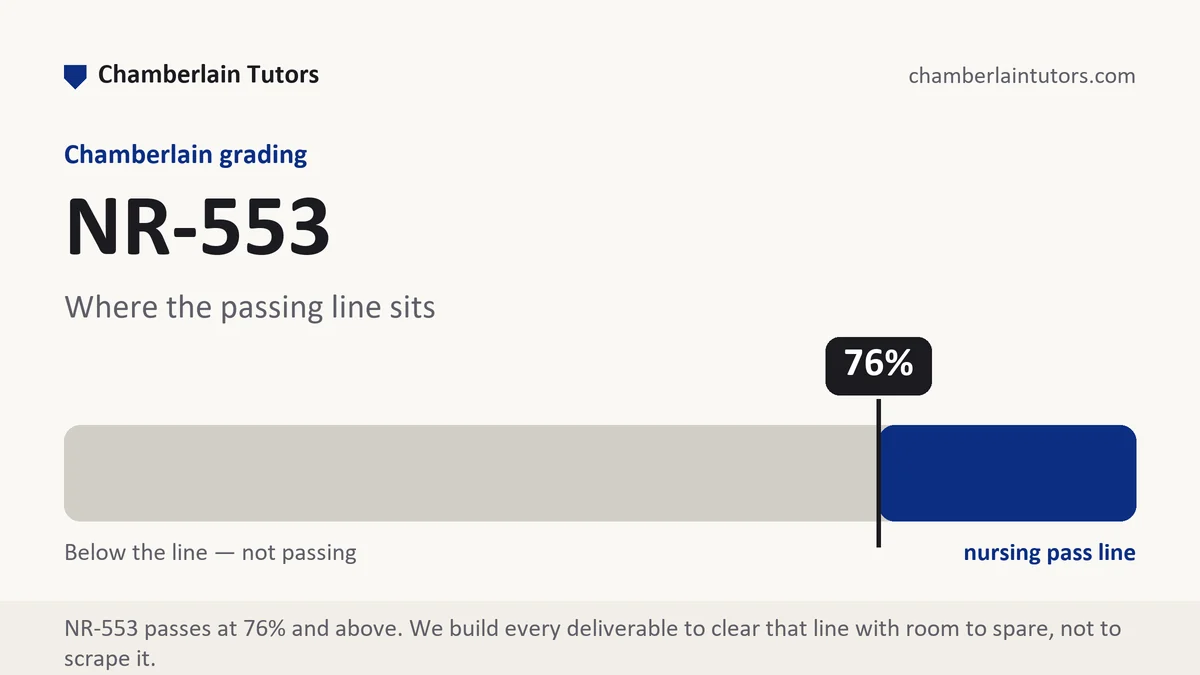
The second axis is what kind of number you are holding. Much international health data is modeled rather than counted, because many countries lack complete death and birth registration, and estimates carry uncertainty ranges that student papers routinely drop. Chamberlain's 76 percent floor for core nursing courses applies here too, and inside an eight-week session with weekly deliverables an unfocused first paper is on the average before the second one is due. Supplementary work will not repair a weighted average that has already formed.
How we help in this course
We draft global issue analyses, health system comparisons, determinants papers, policy role write-ups, program critiques, discussion responses and the session project. Our drafts anchor every claim to a place and a year, and they keep the recommendation inside the authority of whoever is being addressed.
We work from published international sources you can cite and from the scenario your prompt describes. We do not contact ministries, agencies or non-governmental organizations, collect field data, or arrange any international placement or travel. Where your section involves a partnership or a site, that relationship stays entirely yours.
In NR-553 right now?
Send the country or issue you are working on and the rubric from Canvas. First premium sample free, floor-checked, back in 24 to 48 hours.
Read the rubric before the prompt
Global health prompts invite sprawl, and the guide is the only thing that will stop it. Lift the criterion rows into a blank file and reduce each to its verb: analyze, compare, evaluate, apply, recommend. Then ask of each row whether it can be satisfied without naming a country. Usually only one row can, which tells you that the general material belongs in a paragraph and the specific material belongs everywhere else.
Now price the rows. Take a 1,900 word paper with three rows weighted 45, 35 and 20 percent. That gives 855 words to the first, 665 to the second and 380 to the third. Three-row guides are common in this course and they are unforgiving: a row worth 855 words is nearly half the paper, and if it is the system analysis then the system analysis is the paper. Students who allocate by section title rather than by weight often give the background 800 words and the system analysis 300, which inverts the guide precisely. Title page and references sit outside the count unless yours says otherwise.
Keep the three numbers next to the headings and check them once the background is drafted. Background that has outgrown its share is the most reliable early warning sign in this course.
The shape of a global health analysis
Whatever your section calls the deliverable, it examines one health problem inside one system and says who should act. These are the parts that get scored.
| Part | What it must establish | What a weak version does |
|---|---|---|
| Issue with a burden measure | The problem stated in a standard metric, with the country, the year and the source named. | Describes a condition as a major worldwide burden. |
| Where it concentrates | Which regions, ages or groups carry it, and how unevenly. | Treats an entire income group of countries as one place. |
| System context | How care is financed, who delivers it, how supplies and workforce actually reach patients. | Mentions a shortage of resources with no mechanism. |
| Determinants outside the system | Water, roads, schooling, conflict, migration, trade or climate exposure, tied to the outcome. | Lists determinants without linking any to the metric. |
| What has been tried | A named program or policy, the evidence about it, and the setting it worked in. | An intervention described only in principle. |
| Actors and mandates | Who has authority to act: ministry, district, multilateral body, funder, professional council. | Recommends that the world should prioritize the issue. |
| The nurse policy role | What a nurse contributes as an advisor, regulator, planner or advocate rather than as a provider. | Describes bedside care in a low-resource clinic. |
| Ethical footing | Whose priorities the recommendation serves and how that was decided. | Assumes the writer knows what the country needs. |
Evidence and citation craft at this level
International data carries traps that domestic data does not, and four habits handle most of them.
Currency, plus the revision you are quoting. Where your guide sets no rule, five years is the working limit, and global estimates add a second requirement: the same indicator for the same year gets revised as methods change, so name the source and the edition or release you used. A figure from an older release quoted next to a current one produces a trend that exists only in your bibliography.
Say whether the number was counted or modeled. This is the central discipline of the course. Countries with complete civil registration produce measured mortality; many others produce estimates built from surveys and statistical models, published with uncertainty intervals. Eight words of setup, such as a modeled estimate with a wide uncertainty range, keeps your argument honest, and reporting the interval alongside the point estimate marks you immediately as a careful reader.
Verbs the evidence can pay for. Cross-country associations are ecological: they describe places, not people, and a correlation between national income and an outcome cannot be transferred to an individual. Use was lower in countries with, tracked alongside and followed the introduction of. Reserve causal verbs for evaluations with a comparison group, and be especially careful with program reports written by the organization that ran the program.
Denominator, window and the right base for each metric. Global indicators use specific denominators and mixing them is a visible error: child mortality is expressed per 1,000 live births, maternal mortality per 100,000 live births, most disease burden per 100,000 population, and life expectancy at a stated age. Write the full form, as in per 1,000 live births in the year reported, and never place a rate built on live births beside one built on total population as though they were the same scale.
What separates a passing analysis from a strong one
A passing paper picks a serious global problem, cites international sources, and calls for increased funding, education and collaboration. It scores in the high seventies to low eighties because nothing in it is anchored: the same paper would be true of a dozen countries and actionable in none.
Strong papers do three things. They commit to one country or district and keep every figure inside it, so the reader can see a system rather than a theme. They explain delivery, which is the part almost all student papers skip: not that a treatment exists, but how it reaches a person, who dispenses it, what it costs a household at the point of use, and which step fails most often. And they route the recommendation through an actor with the authority to carry it, naming the ministry, the district health office, the regulator or the professional council, and stating what a nurse contributes to that decision as an advisor or advocate. A recommendation with an owner and a delivery path is the graduate-level move in this course.
Mistakes that cost points here
- Treating an income group as a country. Low-income countries differ from each other more than they differ from anywhere else. Name the place.
- Mixing a modeled estimate with a measured statistic. They have different reliability and different meanings, and a comparison between them is not a comparison.
- Rescue framing. Writing as though outside expertise is the missing ingredient costs marks on the analysis rows and misdescribes how national health systems actually change.
- An intervention with no delivery path. If nobody in the paper stocks it, transports it, prescribes it or is paid to give it, the recommendation is a wish.
- Ignoring the policy framing. The prompt asks about the nurse's role in policy. A description of clinical care abroad answers a different question.
- Posting an unverified international figure. Discussion responses do not reopen once submitted at Chamberlain, and a mismatched denominator stays visible for the week. Check the base before you paste.
Questions NR-553 students ask
Which international data sources should I use, and how do I cite them?
How do I write about low-resource settings without sounding like a rescue mission?
What does the nurse policy role actually mean in these assignments?
Where NR-553 sits in Chamberlain's programs
Open the exact program map for sequence, credit, and option context. The current student schedule and syllabus remain authoritative after transfer evaluation, electives, state rules, and approved plan changes.
The weeks, one by one
Week 1
NR-553 Week 1 defines the field before it asks you to work in it, and the definition is contested on purpose. Read the full Week 1 manual.
Week 2
Before you can argue about a population's health you have to be able to count it, and global health counts with a specific toolkit: incidence and prevalence, crude and age-standardized rates, life expectancy, maternal and under-five mortality, and composite measures that combine years of life lost. Read the full Week 2 manual.
Week 3
NR-553 Week 3 asks how health risk travels. Read the full Week 3 manual.
Week 4
NR-553 Week 4 looks at how countries organize the delivery of care rather than at how they pay for it. Read the full Week 4 manual.
Week 5
NR-553 Week 5 covers communicable disease at population scale and the machinery built to contain it. Read the full Week 5 manual.
Week 6
NR-553 Week 6 turns to the conditions that now account for most death and disability worldwide: cardiovascular disease, diabetes, chronic respiratory disease, cancer and mental illness. Read the full Week 6 manual.
Week 7
Global health has no government, so it is governed by a mixture of treaty-based agencies, bilateral donors, private foundations, public and private partnerships, non-governmental organizations and national ministries, each with its own funding, mandate and accountability. Read the full Week 7 manual.
Week 8
NR-553 Week 8 closes the session by asking you to act on everything the previous stages established. Read the full Week 8 manual.