NR-553 Week 3 asks how health risk travels. Globalization moves goods, people, capital, food systems, information and pathogens across borders faster than the institutions built to govern them, and each of those flows has a documented health consequence. The stage also introduces social determinants at an international scale: income, education, housing, water and sanitation, occupation, environment and conflict. The written work usually asks you to take one determinant or one flow and trace it from a global process to a health outcome in a defined population. Your section may print this as NR 553 or NR553; it is the same course. Chamberlain publishes no syllabi outside Canvas. The placement here is our teaching judgment from the course's catalog arc; your section's rubric decides what your week actually asks.
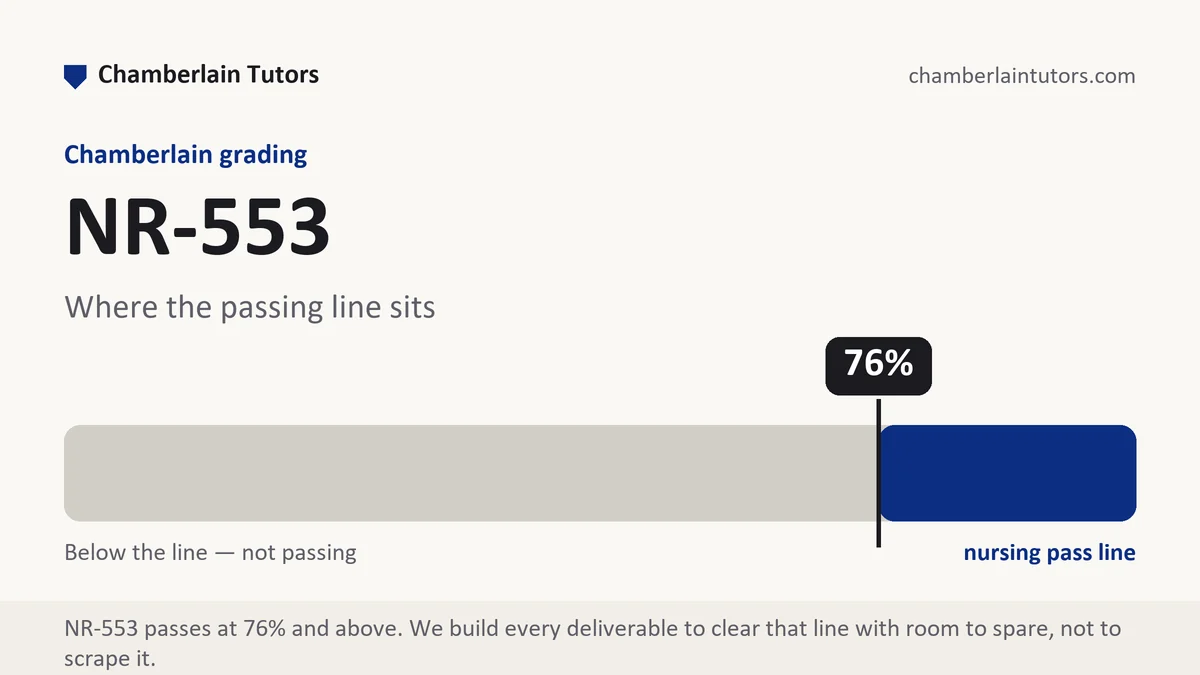
What NR-553 Week 3 asks for
Heat admissions arrive in clusters. An emergency department in a city with an aging housing stock will see them in the same three-day windows every summer, and they are not distributed evenly across the city: they concentrate in neighborhoods with less tree canopy, older buildings, higher rates of unair-conditioned housing and populations who work outdoors. The heat is a planetary process. The admissions are a local consequence, sorted by determinants that were set decades earlier by housing and infrastructure decisions. Between those two facts is the entire subject of this stage.
The analytic demand is causal chain writing. A weak paper says globalization affects health, which is true and unscoreable. A strong paper names a specific mechanism and walks it down: a trade arrangement changes the relative price and availability of processed food, dietary patterns shift over a decade, obesity and type two diabetes prevalence rise in a defined population, and the health system that was configured for infectious disease now carries a chronic disease load it was not built for. Every link in that chain is separately citable, and the citation of links is what the support row is measuring.
You are expected to handle several flows. People move through migration, displacement and labor recruitment, and health workers move as part of that, which is a global health issue in its own right. Goods move, including food, tobacco, alcohol and pharmaceuticals, and marketing moves with them. Pathogens move on the same routes as commerce and travel. Capital moves, shaping what a country can spend on health and what conditions attach to that spending. Environmental change moves risk without regard to any border at all.
The determinants layer sits underneath all of it. Where a person is born, what they can earn, what they breathe, whether their water is safe and whether their work is protected explain more variation in health outcomes than clinical care does, and the course expects you to write that as evidence rather than as sentiment. Deliverables are commonly an analysis paper with a traced chain and a discussion post, which does not reopen after submission in Canvas.
The NR-553 Week 3 method, step by step
Six moves for writing a causal chain that holds together.
-
Choose one flow and one population
Not globalization and not health. One process, one place, one outcome. The narrower the pairing, the more evidence exists for each link and the more the paper can actually demonstrate.
-
Write the chain as numbered links before writing prose
Four to six links, each a single sentence, from the global process to the clinical outcome. Any link you cannot support with a citation is the link that needs either evidence or removal.
-
Cite each link separately
One source establishing that the trade or migration change occurred, another establishing the intermediate shift, another establishing the health outcome. Chains supported by a single overview article are the most common weak structure in this stage.
-
Place the determinants layer explicitly
Say which social determinant modifies the chain and for whom. The same global exposure produces different outcomes across income, housing, occupation and documentation status, and naming that variation is the equity content of the week.
-
Name a counterargument and answer it
Globalization has also moved vaccines, treatment protocols, surveillance capacity and income. A paper that acknowledges the countervailing effect and then explains why the net picture in its population still runs the direction it claims is far stronger than one that ignores it.
-
End at the bedside
Close with what a nurse sees because of this chain: the presentations, the language and interpretation needs, the interrupted treatment histories, the screening that should be routine and is not. That is where nursing expertise enters the analysis.
A layout and word budget for a causal chain analysis
Our frame for tracing a global process to a local outcome, sized for roughly 1,300 to 1,600 words. It is our own outline rather than anything the university issues, and your week's rubric outranks it wherever they disagree.
| Section | What belongs in it | Word target |
|---|---|---|
| The pairing | The global process, the population, the outcome, and the claim about how the first reaches the third. | 140 to 180 |
| The global process | What changed, when, driven by which actors and agreements, described with sources rather than in general terms. | 220 to 260 |
| The intermediate links | Each step in the chain, one paragraph or one compact sequence, with separate support for each. | 300 to 350 |
| The determinants filter | Which social conditions amplify or buffer the exposure, and which subgroups therefore carry the outcome. | 240 to 280 |
| The counterargument | The benefit or offsetting effect, taken seriously, and why your claim survives it. | 180 to 220 |
| Clinical consequence | What this produces in a care setting, and what nursing practice or policy should change in response. | 200 to 240 |
Evidence craft for determinants writing
Support each link with the discipline that studies it. Trade and labor changes are documented in economic and policy literature, dietary and behavioral shifts in nutrition and epidemiology, outcomes in clinical and public health research. Using one general article for all three links weakens every claim.
Keep association and causation distinct in your verbs. Was associated with, coincided with, and preceded are honest where the evidence is observational. Caused and led to require a design that supports them, and the difference is graded closely at graduate level.
Watch the ecological fallacy. A country-level correlation between a national indicator and a national health outcome does not establish that the individuals with the exposure are the individuals with the outcome. Say when your evidence is population-level and what that limits.
Attribute environmental and climate health claims to health-sector sources. Assessments linking environmental change to health outcomes are published by health agencies and in the health literature, and citing those rather than general reporting keeps the argument inside the evidence base your rubric expects.
Five mistakes that cost points in this week's territory
- A chain with a missing middle. Jumping from a global process straight to an outcome skips the mechanism, which is the only part of the paper that demonstrates analysis.
- Determinants listed, not applied. Naming the recognized categories in a paragraph and then never using them to explain who was affected is description dressed as framework.
- Globalization treated as uniformly harmful. The same flows carry vaccines, protocols and income, and a one-directional argument fails the evaluation row.
- Individual behavior blamed for a structural exposure. Writing that a population made poor dietary choices, when the analysis is about what became available and affordable, contradicts your own chain.
- Population-level data used for individual claims. National correlations do not identify who within the population carries the risk.
Before you submit
- One flow and one population are named in the first paragraph
- The chain has no unsupported link between process and outcome
- Each link carries its own citation from an appropriate discipline
- Causal verbs match the strength of the evidence behind them
- At least one determinant is used to explain differential impact
- A genuine counterargument appears and is answered
Tracing the chain this week?
Send the prompt and the rubric out of Canvas. A premium original draft comes back in 24 to 48 hours with every link separately supported and the determinants layer doing real work, and revisions run until the grade lands.