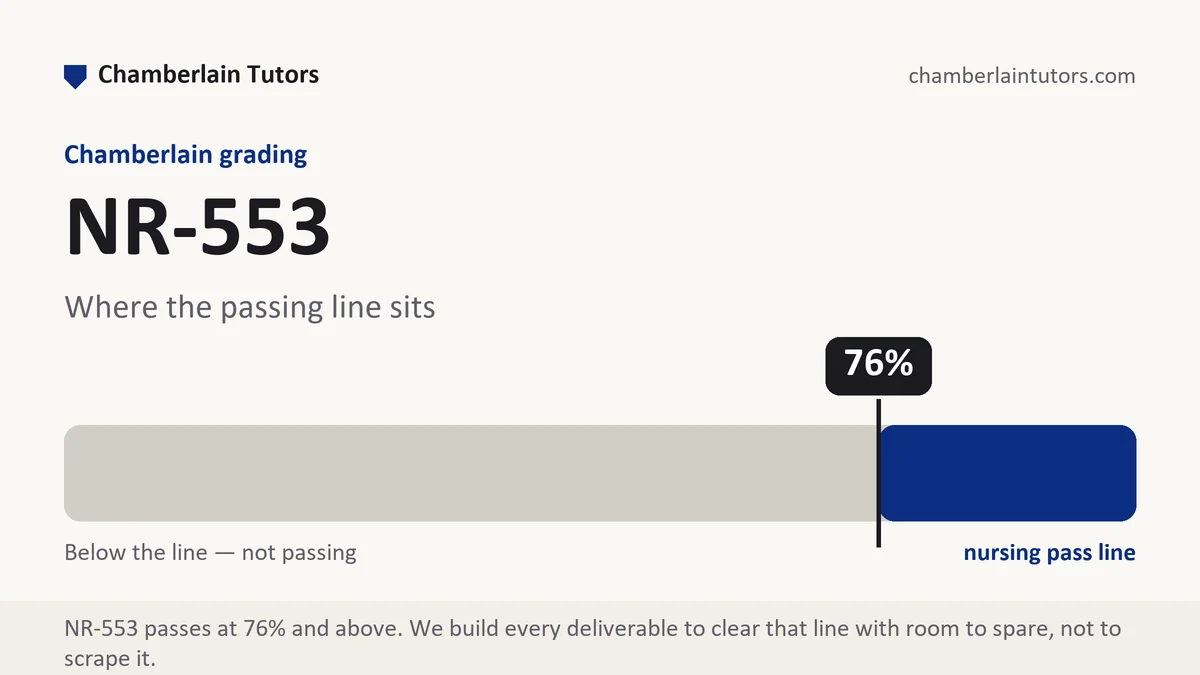
NR-553 Week 7 asks who decides. Global health has no government, so it is governed by a mixture of treaty-based agencies, bilateral donors, private foundations, public and private partnerships, non-governmental organizations and national ministries, each with its own funding, mandate and accountability. The stage joins that structural question to an ethical one: what makes a partnership legitimate, who sets priorities, who owns data, what obligations follow from working in someone else's system, and what the evidence says about short-term service trips. The written work is usually an analysis of an actor or a partnership. Your section may print this as NR 553 or NR553; it is the same course. Chamberlain publishes no syllabi outside Canvas. The placement here is our teaching judgment from the course's catalog arc; your section's rubric decides what your week actually asks.
What NR-553 Week 7 asks for
A surgical team goes abroad for ten days and operates on more patients than the receiving hospital would normally see in a month. The scenes are compelling and the intent is genuine. Then the team flies home, and the postoperative complications present to a district facility with no record of the procedures, no relationship with the operators and no budget line for the follow-up. Read as a series of individual acts, the trip is care delivered. Read as a system intervention, it is care delivered to some patients and a burden transferred to a system that did not choose it. Holding both readings at once is what this stage is training.
The governance content comes first and needs to be handled structurally. Different actors are accountable to different constituencies. A treaty-based agency answers to member states, which makes it legitimate and slow and subject to the politics of its funders. A private foundation answers to its own board, which makes it fast and unelected and capable of moving a global agenda without any public mandate. A bilateral donor answers to a national legislature, which means its priorities can shift with an election. A non-governmental organization answers to its donors, whose preferences are not necessarily those of the population served. Earmarked funding produces vertical programs that deliver on their target and can leave the general system weaker. None of this is scandal; it is structure, and a graduate paper describes it as such.
The ethics content is a set of testable criteria rather than a set of sentiments. Legitimate partnership work asks who set the priority, who holds the money, who is employed and at what level, whose name is on the resulting publications, what happens when the funding ends, and who owns and can use the data collected. The literature on decolonizing global health has made these questions concrete and citable, and using them as an analytic instrument rather than as vocabulary is the difference between the top band and the middle.
Deliverables are typically an analysis of an organization, a partnership or an ethical case, sometimes with a recommendation. Posts do not reopen after submission in Canvas.
The NR-553 Week 7 method, step by step
Six moves for writing governance and ethics analysis with teeth.
-
Map the actors and their accountability lines
For your case, list who funds, who decides, who implements and who is served, then draw the line from each actor to whoever can hold it accountable. Where a line is missing, you have found the paper's subject.
-
Follow the money and its conditions
Say where funding originates, whether it is earmarked, what reporting it demands and what it may not be spent on. Conditions attached to money shape programs more reliably than stated priorities do.
-
Apply a named ethical framework
Use published partnership principles or an established ethics framework, cite it, and work through its criteria one at a time. Ethical analysis without a framework becomes personal opinion, which no rubric can score highly.
-
Ask the ownership questions explicitly
Who set the priority, who is employed and in which roles, who authors the outputs, who holds the data, and what remains when the funding stops. Answer each in a sentence rather than gesturing at partnership in general.
-
Weigh the benefits honestly
Vertical programs have achieved enormous documented reductions in specific disease burdens. Say what your case accomplished before you say what it cost, and use evidence for both. A one-sided critique is as weak as uncritical praise.
-
Recommend a structural change, not a better attitude
Conclude with something that could be written into an agreement: local co-leadership, funding routed through national systems, data governance terms, a defined transition plan. Changes to intention are not policy.
A layout and word budget for a governance and ethics analysis
Our frame for analyzing an actor or partnership, sized for roughly 1,400 to 1,700 words. It is our own outline rather than anything the university issues, and your week's rubric outranks it wherever they disagree.
| Section | What belongs in it | Word target |
|---|---|---|
| The case and the question | The actor, partnership or practice under examination, and the governance or ethical question you will answer. | 150 to 190 |
| Structure and mandate | How the actor is constituted, what it is authorized to do, and to whom it answers in practice. | 230 to 270 |
| Funding and conditions | Sources, earmarking, reporting requirements, and how the money's shape constrains what the program can be. | 230 to 280 |
| Achievements, evidenced | What the case demonstrably accomplished, with sources, before any critical assessment begins. | 210 to 250 |
| Ethical assessment | The named framework applied criterion by criterion, with the ownership questions answered specifically. | 290 to 340 |
| Structural recommendation | One change expressible in an agreement or a policy, with who would have to adopt it and what it would require. | 200 to 240 |
Evidence craft for governance writing
Use organizational primary documents for structure and independent work for effect. Constitutions, strategies and annual reports establish mandate and funding. What a program achieved requires independent evaluation, and mixing the two source types is the most common support-row failure in this stage.
Cite authors based in the countries being discussed. In a stage about who holds authority, a reference list drawn entirely from institutions in high-income countries undercuts the argument you are making. This is both an ethical and an evidentiary point.
Handle funding figures with year and currency. Contribution and disbursement numbers move annually and are reported in different currencies and on different bases, including pledged versus disbursed. State which basis your figure uses.
Keep critique specific and attributed. Named practices, documented cases and cited evaluations support a critical claim. Generalized suspicion about motives does not, and it reads as advocacy rather than analysis in a graduate paper.
Five mistakes that cost points in this week's territory
- Institutions described without accountability lines. Who an actor answers to explains its behavior better than its mission statement does.
- Ethical judgment without a framework. Terms like exploitative and paternalistic need criteria behind them, or they are assertions.
- Achievements omitted. A critique that never states what the program accomplished is not balanced enough to be credible.
- Decolonizing used as vocabulary. The concept has specific, checkable implications about priority setting, employment, authorship and data ownership, and a paper that uses the word without applying them has not done the work.
- Recommendations addressed to intentions. Asking actors to be more respectful is not a governance proposal; changing who signs, who holds funds and who leads is.
Before you submit
- Every actor in the case has its accountability line identified
- Funding source, earmarking and conditions are all stated
- A named ethical framework is cited and applied criterion by criterion
- Documented achievements appear before the critical assessment
- At least one cited author is based in the country under discussion
- The recommendation is structural and names who must adopt it
Writing the governance analysis?
Send the prompt and the rubric out of Canvas. A premium original draft comes back in 24 to 48 hours with accountability lines mapped, a named framework applied and the recommendation written as structure, and revisions run until the grade lands.