NR-520 carries four theory hours and asks for something structurally harder than any single subject: quality science, nursing theory and evidence based practice integrated inside an interdisciplinary and ethical view of care delivery. The word doing the work in that catalog line is integrated. Three correct sections that never touch one another is the standard mid band paper in this course.
What NR-520 actually grades
The graded move is using a theory as an instrument rather than as an introduction. A theory earns its place when it decides something: which variable you look at, why an intervention was expected to work, what counts as an outcome worth measuring. If your paper would be identical with the theory paragraph deleted, the theory row is unfed regardless of how well the theorist is described.
Quality science supplies the second half of that instrument. A decision in this course is expected to be checkable, which means an outcome, a measure, a baseline and a way of telling improvement from noise. Students trained clinically tend to write about doing better rather than about measuring differently, and the rubric rows are built on the second.
The interdisciplinary and ethical framing is scored too. A decision that affects pharmacy, therapy, social work or medicine and considers none of them is incomplete, and an improvement that shifts burden onto another group without naming that shift misses the ethical row.
How we help in this course
NR-520 is a theory course with no clinical hours, so nothing on our side goes near placement, preceptors, site paperwork or logs.
Send the prompt and the scoring guide from Canvas and a premium original draft comes back in 24 to 48 hours, planned against the criterion rows, with the theory doing visible work in the analysis rather than sitting in an opening paragraph. The piece clears both quality passes and the floor check before it reaches you, and revision costs nothing.
Writing this course's deliverables from the rubric
Rubric, decision, theory, measure. Picking a theory first is the classic error here, because it leads to a paper searching for a problem the theory happens to fit.
In NR-520 right now?
Send the week and the rubric from Canvas. First premium sample free, floor-checked, back in 24 to 48 hours.
The 84 line and a course that grades integration
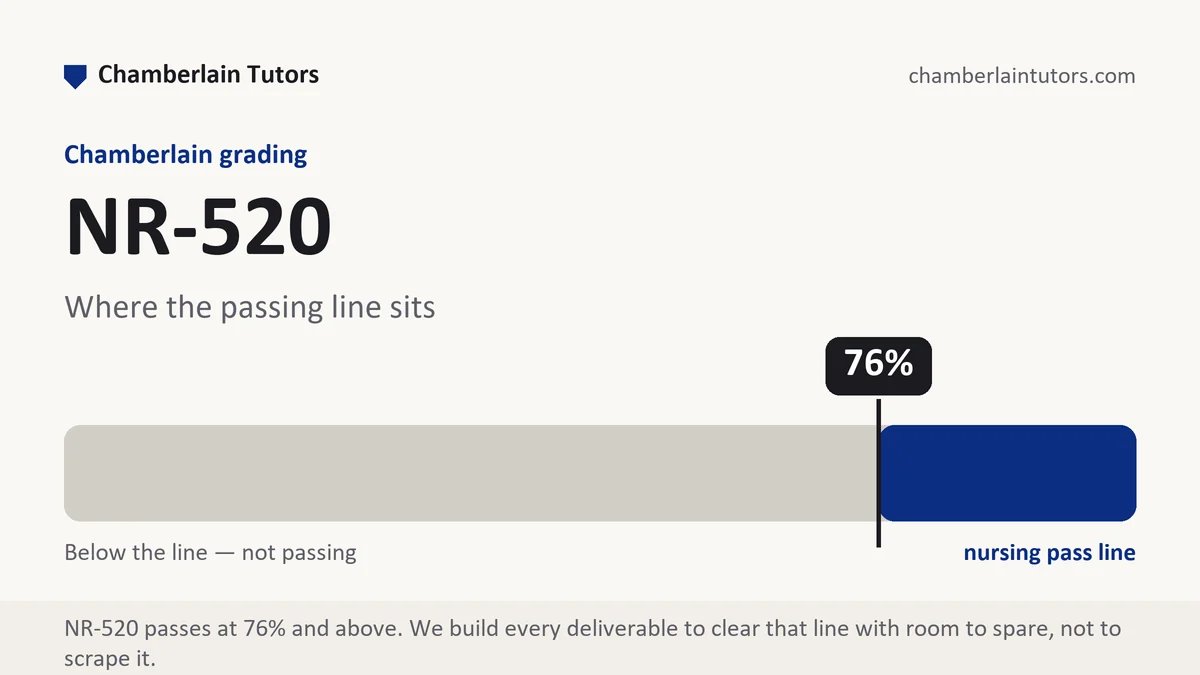
Core nursing courses pass at 76 percent. On the nurse practitioner specialty scale there is no C band, so 84 is the last passing number. Integration courses produce more unpleasant surprises than difficult ones, because every section can be individually correct while the paper as a whole scores in the middle, and that pattern is invisible until the feedback arrives.
The calendar leaves little room. Sixteen week semesters, two eight week sessions inside each of them, up to six starts a year and something graded every week, with no supplementary work able to repair a weighted average. If the first graded piece comes back with comments about connection rather than content, fix the connection habit that week rather than adding more content the next.
Turn the criterion rows into a section plan
Copy the rows into a blank document in printed order and reduce each to its verb: select, apply, integrate, evaluate, justify. Headings follow those verbs in the guide's own sequence, which keeps a grader from hunting and keeps you from writing a section the guide never asked for.
Then price the rows. Suppose the paper is capped at 1,500 words with four rows weighted 30, 25, 25 and 20 percent, giving roughly 450 words, 375, 375 and 300. The interesting feature is the flatness. Nothing here can be treated as a minor section, and the two 375 word rows are usually theory application and outcome measurement, which are exactly the two that students shorten when the week gets tight. A 300 word row is one strong paragraph plus a short one, and it is not optional.
Write the target beside each heading while drafting and remove it once the section is fed. Title page and references normally sit outside the count, and where a guide allows a table for measures or outcomes, that usually does too, which is an efficient way to carry detail.
The shape of a theory to decision paper
Most graded writing here is a decision analysis carried on a theoretical frame with a measurement plan attached. Each part below is one link a reader has to be able to follow to the next.
| Part | What it has to establish | How the thin version reads |
|---|---|---|
| The decision | The specific choice facing a team, stated as a choice with alternatives rather than as a topic. | A subject area such as improving communication. |
| The theory, chosen for a reason | Which framework and why it fits this decision, cited to the original where you can reach it. | A summary of a theorist with no link to the problem. |
| Theory doing work | The variables, relationships or stages the theory tells you to attend to, applied to your case explicitly. | A theory paragraph the rest of the paper never mentions again. |
| Evidence for the option | What the literature says about the choice, described before it is used, with the design named. | Sources cited in a block with no appraisal. |
| The measurement plan | Outcome, measure, baseline, interval and what would count as a real change rather than noise. | A promise to evaluate effectiveness. |
| Interdisciplinary and ethical check | Who else is affected, what burden moves where, and which principle you are weighing against which. | A closing sentence noting the importance of teamwork. |
Evidence and citation craft in an integration course
You are handling three kinds of source at once here, and each has different rules.
- Go to the theorist, not the chapter about the theorist. A textbook account is a secondary source and reads as one. Where the original work is reachable, cite it, and where it is not, say plainly that you are working from a secondary account rather than implying you read the original.
- Currency rules differ by source type. A foundational theory paper is legitimately old and the sentence should say why it still stands. An outcome estimate, a safety statistic or a practice guideline older than five years needs a stated reason or a newer replacement.
- Design and sample before the finding. Write that an interrupted time series across six units tracked an outcome for 18 months before and after a change, then the result. Quality improvement reports especially need their design named, because they are frequently cited as though they were trials.
- Verbs the design can pay for. Improvement work is almost never controlled. Rates fell after implementation is honest. The intervention reduced the rate claims a counterfactual that a before and after design cannot supply, and this is the course where that distinction is explicitly on the rubric.
- Denominator and window on every rate. Write that 27 events occurred across 4,100 patient days in the six months before the change, rather than quoting a rate alone. Improvement numbers are meaningless without the base and the period, and comparing two rates with different bases is the most common analytic error in this course.
The gap between a passing paper and a strong one
A passing NR-520 paper has a theory section, an evidence section, a plan and a conclusion. Every part is defensible. The parts are also detachable, and a paper whose sections could be reordered without loss is a paper that has not integrated anything.
Strong papers make the theory earn its keep by letting it choose the variables, so a reader can see why this outcome and not another one is being measured. They state what would count as failure, which is the sentence that converts a plan into an inquiry. And they name the person or group who absorbs the cost of the improvement, because an intervention that saves nursing time by adding pharmacy work is a trade rather than a gain, and saying so is what the ethical row is looking for.
Six mistakes that cost points here
- Decorative theory. If deleting the theory paragraph would not change the paper, the theory row scores in the middle at best.
- Outcomes with no measure. Improved satisfaction is not an outcome until you say what is measured, how often, and against what baseline.
- Comparing rates with different denominators. Two percentages built on different bases cannot be subtracted. Write both bases out before you compare.
- Ignoring the other disciplines. A plan that touches pharmacy or therapy and never mentions them misses a scored row and would fail in practice too.
- Treating ethics as a closing paragraph. The ethical question in improvement work is usually about who bears the burden, and it belongs inside the analysis.
- Posting to the board from the text box. Chamberlain posts cannot be edited after submission, so compose elsewhere and check the citation before pasting.
Questions NR-520 students ask
How do I pick a theory that will not fight my topic?
What does a measurement plan need at this level?
Can I write about a change my unit already made?
The weeks, one by one
Week 1
NR-520 Week 1 opens the course where every integration problem starts: how an advanced practice nurse knows anything at all, and which kinds of knowing can carry the weight of a clinical decision. Read the full Week 1 manual.
Week 2
NR-520 Week 2 is where theory stops being a subject and becomes a tool: you pick one practice problem and then argue your way to the framework that fits it, rather than the other way around. Read the full Week 2 manual.
Week 3
NR-520 Week 3 turns a practice problem into a question the literature can actually answer, then documents the hunt for that answer so a reader could repeat it. Read the full Week 3 manual.
Week 4
NR-520 Week 4 stops collecting and starts judging. Read the full Week 4 manual.
Week 5
NR-520 Week 5 is where a pile of separately judged studies has to become one statement a practice could act on. Read the full Week 5 manual.
Week 6
NR-520 Week 6 takes a decision that the evidence now supports and asks the two questions evidence cannot answer: who else does this land on, and what principle are you trading away to gain another. Read the full Week 6 manual.
Week 7
NR-520 Week 7 converts a chosen decision into something that can be checked. Read the full Week 7 manual.
Week 8
NR-520 Week 8 asks for the whole argument in one document, and for an audience that is not your instructor. Read the full Week 8 manual.
Where NR-520 sits in Chamberlain's programs
Open the exact program map for sequence, credit, and option context. The current student schedule and syllabus remain authoritative after transfer evaluation, electives, state rules, and approved plan changes.