NR-520 Week 3 turns a practice problem into a question the literature can actually answer, then documents the hunt for that answer so a reader could repeat it. Your section may print this as NR 520 or NR520; it is the same course. Chamberlain publishes no syllabi outside Canvas. The placement here is our teaching judgment from the course's catalog arc; your section's rubric decides what your week actually asks.
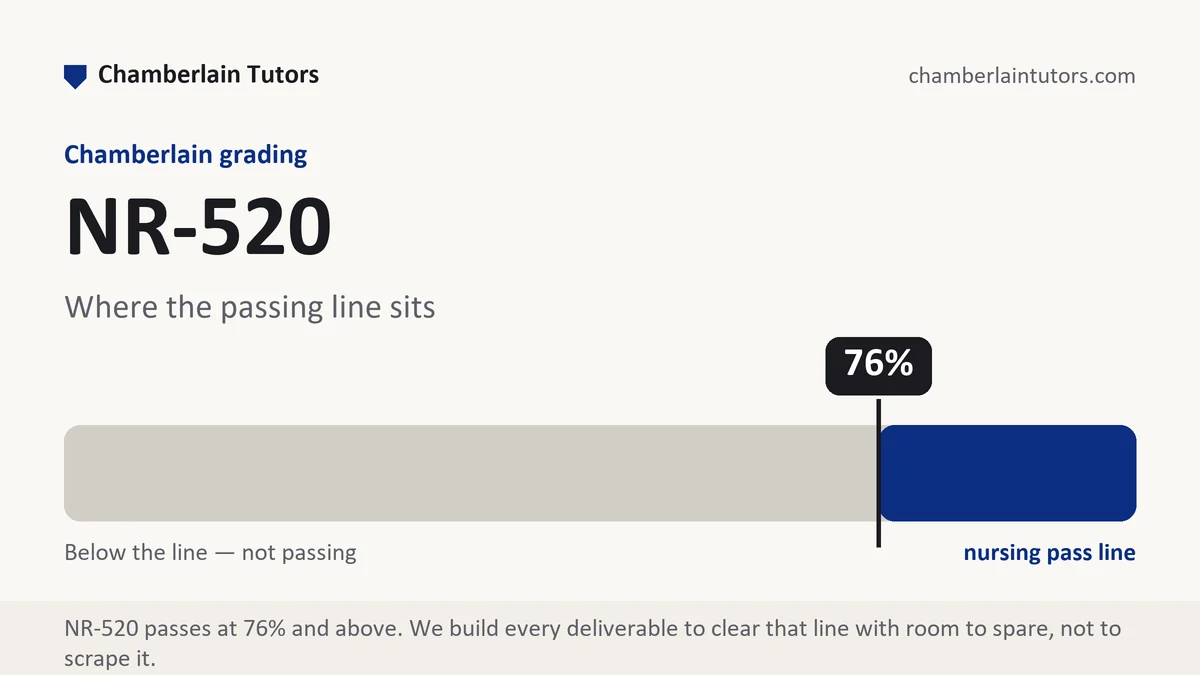
What NR-520 Week 3 asks for
Evidence based practice sequences always pass through the same gate: a searchable question. The standard instrument is the PICOT format, population, intervention, comparison, outcome and time, and the graded skill is precision at each slot. A population of adults with a condition is loose; adults over 65 with that condition in a primary care setting is a question a database can hold onto. The week's work typically pairs the question with a documented search, because a question nobody could re-run is a private one.
The search half is craft with rules. Databases have names and personalities, keywords differ from controlled vocabulary, and the trail from initial hits to kept studies is supposed to be visible: which terms, which limiters, which years, how many results at each cut, and why the survivors survived. Writing this down feels bureaucratic to clinicians and is exactly what the academic form requires, because reproducibility is the whole point of the exercise.
Deliverables in this territory tend to be a question plus search narrative, sometimes with the first appraisal of what came back. Keep the theory thread from your earlier weeks alive: the framework you selected has concepts, and those concepts should have influenced which outcome your question names. If your section runs a discussion this week, remember Canvas posts cannot be edited once submitted, and a PICOT with a mislabeled slot is the kind of error peers quote back.
The NR-520 Week 3 method, step by step
Six moves from a practice problem to a documented, repeatable search.
-
Draft the question backwards from the outcome
Decide first what measurable change would make the answer matter, because the outcome slot disciplines all the others. An outcome your framework's concepts point at keeps the course's threads connected.
-
Tighten every slot until it excludes something
Each PICOT element earns its place by ruling cases out. If a slot excludes nothing, adults, usual care, better outcomes, it is decoration, and the searches it generates will drown you in irrelevance.
-
Translate slots into search terms, then into controlled vocabulary
Write your natural keywords first, then find the database's own subject headings for the same ideas. Searching both, joined properly, is the difference between an amateur search and a documented one.
-
Choose two or three databases and say why those
Different databases index different literatures, and the justification is one sentence each. A nursing question usually needs the discipline's own index plus a large biomedical one, and your reading names the candidates.
-
Log the run: terms, limiters, counts at each step
Record the numbers as you go, hits before limits, after date and language limits, after title and abstract screening. Reconstructing the trail afterwards from memory produces the vague search narratives graders mark down.
-
Keep studies for stated reasons, not vibes
Write an inclusion rule before you screen, population matches, outcome measured, design at or above a stated level, then apply it. Every kept study should be defensible by the rule, not by how quotable its abstract was.
A layout and word budget for a question and search report
The frame below suits a deliverable of roughly 1,200 to 1,500 words in this territory. It is our tutoring outline, not an official structure, and your week's rubric overrides it on contact. Scale the targets to your assigned length.
| Section | What belongs in it | Word target |
|---|---|---|
| Problem and significance | The practice problem in two or three sentences with one current source establishing that it matters. | 150 to 190 |
| The question, slot by slot | The full question stated once, then each element unpacked with what it includes and excludes. | 260 to 320 |
| Search strategy | Databases chosen with reasons, keywords and controlled vocabulary listed, limiters named and defended. | 280 to 340 |
| The trail of numbers | Result counts at each narrowing step, so a reader can watch the funnel work. | 140 to 180 |
| What survived and why | The kept studies with the inclusion rule that admitted them, stated before any findings are touched. | 200 to 250 |
| Close and next step | What the haul looks like at a glance and what appraisal will have to establish about it. | 120 to 160 |
Evidence craft for search week
The search narrative is itself the evidence this week. Sentences like a comprehensive search was conducted claim without showing. Name the database, the terms, the limits and the counts in prose or a small table, and the claim becomes a record.
Cite the question format's source once. The PICOT structure comes from the evidence based practice literature your course assigns, and one citation on first use covers it. Re-citing the format every paragraph pads the reference list without adding warrant.
Date limits need a reason attached. Limiting to the last five years is defensible as a currency rule, but say it, and say what you did when a slot returned almost nothing, because widening a date window is legitimate when documented and quietly suspicious when not.
Describe what came back before judging it. This week's verbs are retrieved, indexed, screened, met criteria. Claims about what the studies found belong to appraisal, and reaching for findings language before the appraisal step signals the sequence was not understood.
Five mistakes that cost points in this week's territory
- A question built forwards from a favorite intervention. Starting from a solution you already like produces a question rigged to find it, and the rigging shows in a comparison slot chosen to lose.
- Slots that exclude nothing. A population of patients, a comparison of standard care and an outcome of improvement cannot steer a search, and the result counts will prove it.
- Keywords only, headings never. Skipping the database's controlled vocabulary misses the literature filed under terms you did not think of, and graders in this territory look for exactly that move.
- An unreproducible search story. If your narrative names no counts and no limiters, it reads as I looked around until I had enough, whatever actually happened.
- Screening by abstract appeal. Keeping studies because they sounded supportive rather than because they met a stated rule imports bias at the exact step the method exists to control.
Before you submit
- The question appears once in full and once decomposed by slot
- Every slot demonstrably excludes something
- Keywords and controlled vocabulary are both listed
- Each database choice carries a one sentence reason
- Result counts appear at each narrowing step
- An inclusion rule is stated before any study is kept
Search week closing in fast in NR-520?
Send the prompt and rubric from Canvas. A premium original draft with a tight question and a fully documented search trail comes back in 24 to 48 hours, revisions free until the grade posts.