In the MSN-FNP sequence, NR-511 is FNP didactic sequence. Students search the code mid-panic more than any title, so this page answers the code: here is the honest read and the service behind it.
What NR-511 actually grades
An early FNP didactic workhorse where diagnostic reasoning becomes weekly written cases under the no-C scale. Its rubrics reward the visible workup, findings weighed, differentials ranked, plans defended with guidelines, and its reputation among students is earned.
How we help in this course
Our 511 drafts read like competent clinic documentation expanded to rubric depth, current guidelines cited, the reasoning auditable. It is the single most-ordered Chamberlain course in our queue, and the free first sample exists for exactly this moment.
The service terms match the whole site: 24 to 48 hour delivery, A-band targeting on your scale with the floor math shown, two independent QA passes, free revisions until the target is met.
How to write this course's diagnostic write-ups
Chamberlain keeps its syllabi and scoring guides inside Canvas rather than on the public web, so any manual organized by week number would be guesswork wearing a uniform. What follows is the honest alternative: a working method built from the one document that actually decides your grade, the scoring guide attached to the assignment in your course shell. Open it in one window and keep this page in the other. The sections below turn its rows into an outline, a word budget, and a set of checks you can run before you submit, and they hold in the first week of the session and the last.
In NR-511 right now?
Send the week and the rubric from Canvas. First premium sample free, floor-checked, back in 24 to 48 hours.
The most-ordered course in our Chamberlain queue
No code reaches this desk more often than NR-511, and the reasons compound: weekly written cases that demand a visible diagnostic workup, rubrics that rank differentials and audit guideline citations, and underneath it all the specialty scale where the first passing number is 84. The volume taught us the course's grading personality thoroughly, which is why 511 drafts read like competent clinic documentation expanded to rubric depth rather than essays about medicine. Volume also means the desk has watched how different sections weight their workups, pattern knowledge no single student can accumulate in one session.
A case week, handled end to end
The pattern each week: case materials arrive, the workup is drafted with findings weighed, differentials ordered, and the plan defended from current guidelines, then the draft clears rubric QA and the separate APA and originality pass, gets floor-checked against the A band, and lands in your inbox inside 24 to 48 hours, days clear of the 11:59 p.m. Mountain-Time deadline. Board posts ship final because the boards do not forgive edits.
Why is the free sample pushed so hard on this page?
Because 511 is the course where students most need proof before trust, and a complete premium case draft, free, settles the question faster than testimonials can.
Can the desk pick up mid-course after a bad week?
Yes. Send the gradebook and the current week together; the recovery math on the no-C scale comes back with the first scope, honestly stated.
Read the scoring guide before you read the case
The prompt tells you the topic. The scoring guide tells you where the points sit, and those are rarely the same emphasis. Before writing a sentence, copy each criterion row into a blank document as a heading. If a row has no heading of its own, its points have nowhere to land, and rows scored at zero are the most common reason an accurate case comes back in the low eighties.
Then convert weight into words. Say your guide splits a 1,500 word write-up across four rows weighted 35, 25, 25 and 15. Multiply each weight by the total and the budget writes itself: about 525 words under the heaviest row, 375 under each of the two middle rows, and 225 under the lightest. Title page, reference list and any template header sit outside that total, because no row pays for them. Weights differ by section and term, so run the arithmetic on your own guide, not on the split above.
Most 511 drafts that land under target share one shape: 600 words of history, 200 words of assessment. That is the budget inverted. Then read the top band alone. If its verbs are defends, justifies or differentiates, description cannot reach it however carefully it is written.
The shape of a diagnostic write-up
Nearly everything graded here is a documented clinical encounter expanded to academic depth. The parts below are what a diagnostic reasoning rubric pays for, and each does a job no other part can do.
| Part | What belongs there | What it has to prove |
|---|---|---|
| Presenting concern and history | The story in the patient's own sequence: onset, course, what worsens and relieves it, plus the negatives you deliberately asked about | That you gathered on purpose rather than transcribed. Every negative should be one that moves a candidate up or down. |
| Objective findings | Vitals and the focused examination the history actually called for, with normal findings stated where their absence would matter | That the examination was chosen by the history rather than copied from a template. |
| Ranked differential | Three to five candidates in order, each with the finding that raises it and the finding that argues against it | That you can reason toward a diagnosis and away from its rivals. This is the row where bands separate. |
| Working diagnosis | The choice, defended against the runner-up in one or two explicit sentences | That the ranking had a reason. Naming a diagnosis without dismissing second place answers half the row. |
| Plan | Diagnostics, therapeutics, education and referral, each tied to the assessment above it and to a named current guideline | That the plan follows from your reasoning rather than from a remembered protocol. |
| Follow-up and safety net | The return interval, and the specific findings that should bring the patient back sooner | That you thought past the visit. Graders read this short section for clinical judgment. |
Proportion carries as much weight as presence. If the ranked differential and its defense together occupy less space than the history, the write-up reads as data collection, and the assessment row gets scored accordingly.
Citing evidence the way a clinician does
Four habits protect the source and evidence rows here, and all four are mechanical.
Cite the current edition of whatever guideline governs the condition and put its year inside the sentence, not only in the parenthetical. A superseded edition costs points even when it says the same thing as the current one. Second, give design and sample before you give a finding: a prospective cohort of 412 adults presenting to primary care and a referral-clinic series produce different numbers for the same test, and a sensitivity quoted without its population is a number without meaning.
Third, watch the verb. Observational data licenses was associated with; only a design that randomized licenses reduced or caused. More points are lost to one wrong verb in this course than to any formatting error. Fourth, no rate without its denominator and its measurement window. Fourteen of 220 patients over twelve months tells a reader something. Six percent, standing alone, tells them nothing they can check.
What separates a passing write-up from a strong one
A passing 511 write-up names a defensible diagnosis and attaches a plan that would harm nobody. A strong one does four more things. It ranks the differential and shows the data that moved each candidate. It states what would change the diagnosis and names the finding that would trigger the change. It ties every plan element back to the assessment above it instead of to habit. It holds clinic register throughout, so the document reads like documentation rather than an essay about medicine.
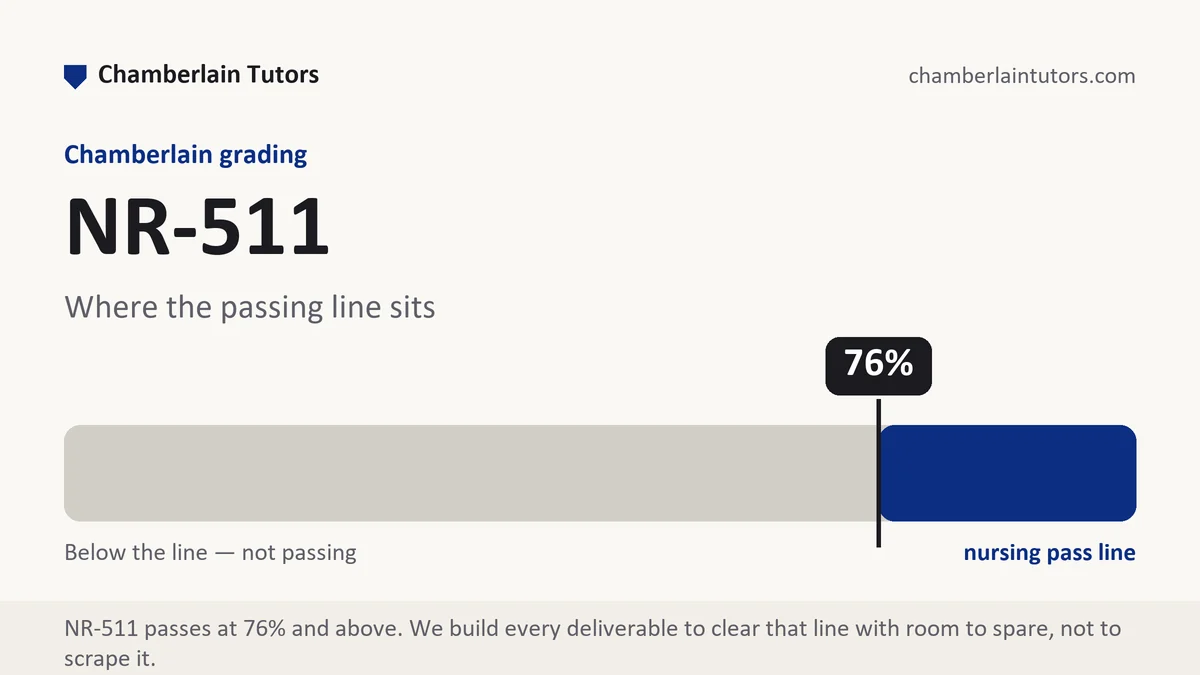
The specialty scale gives that gap teeth: no C band, so the first passing number is 84, and a session of merely adequate work sits near the line rather than safely above it. Supplementary work will not rescue a thin weighted average.
Six mistakes that cost points in this course
- Data before judgment. Pages of history and examination followed by two sentences of assessment. The rubric pays for the reasoning, and the reasoning is what got compressed.
- Listing a differential without ranking it. An unranked list transfers the decision to the grader, who scores it as indecision rather than breadth.
- A plan defended from memory. Each element needs its guideline named in the plan itself, current edition, year stated.
- Register drift. The document starts as documentation and turns into an essay by the plan section. Choose clinic voice and hold it.
- A percentage with no denominator. Every rate needs how many out of how many, over what window, from which population.
- Half-answering a board prompt. Discussion posts cannot be edited once submitted, so a three-part prompt gets counted into three parts before anything is written.
Three questions NR-511 students send
My differential list keeps growing. Should I cut it?
How current does a source have to be for a case plan?
I posted a discussion answer and then noticed I missed part of the prompt. Can I fix it?
The weeks, one by one
Week 1
NR-511 Week 1 is where the diagnostic habit gets built, before any patient of yours is written up for a grade. Read the full Week 1 manual.
Week 2
NR-511 Week 2 moves from how you think to how you ask. Read the full Week 2 manual.
Week 3
NR-511 Week 3 is where the hands and the keyboard get connected. Read the full Week 3 manual.
Week 4
NR-511 Week 4 is the halfway pivot, where ordering stops being a reflex and starts being an argument. Read the full Week 4 manual.
Week 5
NR-511 Week 5 is where an unordered list becomes an argument. Read the full Week 5 manual.
Week 6
NR-511 Week 6 turns the diagnostic method toward the youngest patients on a family practice panel. Read the full Week 6 manual.
Week 7
NR-511 Week 7 is where reasoning turns into instructions somebody has to follow. Read the full Week 7 manual.
Week 8
NR-511 Week 8 closes the session by asking you to present one patient end to end and then to account for your own growth as a diagnostician. Read the full Week 8 manual.
Where NR-511 sits in Chamberlain's programs
Open the exact program map for sequence, credit, and option context. The current student schedule and syllabus remain authoritative after transfer evaluation, electives, state rules, and approved plan changes.