NR-511 Week 5 is where an unordered list becomes an argument. The territory is ranking: putting candidates in sequence, naming the feature that lifts each one and the feature that sinks it, and holding the dangerous possibilities in view even when they sit far down the order. Your section may print this as NR 511 or NR511; it is the same course. Chamberlain publishes no syllabi outside Canvas. The placement here is our teaching judgment from the course's catalog arc; your section's rubric decides what your week actually asks.
Week five of an eight-week session usually lands after the workup material, which is deliberate: you cannot defend an ordering until you can say what the history, the examination and the results each contributed. Everything on this page concerns the written argument. Hours, site paperwork and preceptor sign-off remain outside what any writing service touches, including this one.
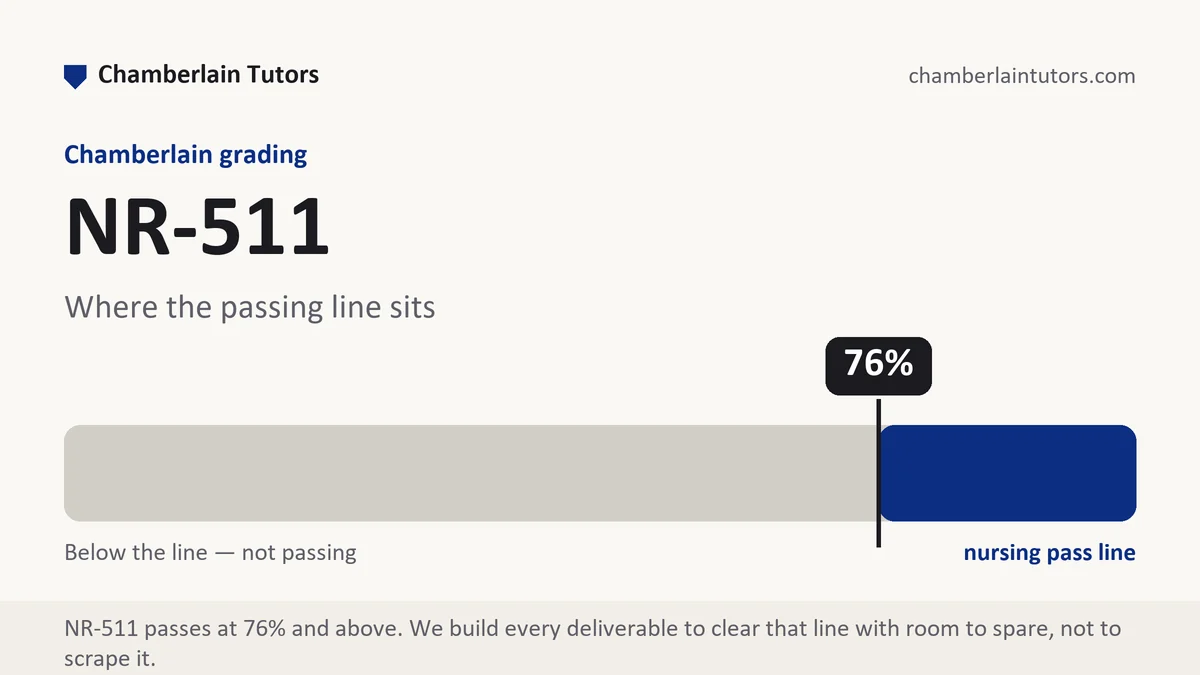
What NR-511 Week 5 asks for
Expect the territory to include how a candidate list is generated and then pruned, the discriminating feature as the working unit of diagnosis, the distinction between the most likely condition and the one you cannot afford to miss, warning features that force escalation regardless of how likely they are, and the honest handling of uncertainty when nothing in the case reaches a threshold.
The written shapes that carry this at week five tend to be a case analysis with a ranked list at its center, a comparison paper that separates two conditions that share a presentation, or a table-plus-defense format where the ordering is displayed and then argued in prose. If your section runs a discussion this week, it usually asks you to justify why your second candidate is not your first.
What earns the band is the argument against, not the argument for. Nearly every submission explains why the leading candidate fits. The ones that score explain why the runner-up does not, using the same evidence.
The NR-511 Week 5 method, step by step
Six moves from a raw list to a defended order.
-
Generate wide, then prune with a reason
Start from the anatomy and the mechanisms the complaint could involve rather than from memory alone, then cut each candidate with a stated reason: wrong age band, wrong time course, absent finding the condition requires. Pruning silently loses the row that pays for breadth.
-
Attach one lifting and one sinking feature to every survivor
Each remaining candidate gets a finding that raises it and a finding that argues against it. Candidates with no sinking feature usually mean the case was not examined for them, which is worth knowing before you commit to an order.
-
Rank on discrimination, not on familiarity
Order by which candidate the evidence supports most strongly, and write the comparison explicitly: this outranks that because of the timing and the absent finding. A ranking with no comparison sentence is a list wearing numbers.
-
Keep a separate line for what cannot be missed
Serious conditions belong in the argument even at low likelihood, with the feature that would raise them and what you would do the moment it appeared. Rank by probability, escalate by consequence, and say in the paper that you are doing both.
-
Set the threshold that ends the debate
Name the finding, result or interval that would let you settle on the leading candidate, and name the one that would send you back to the list. A ranking with no exit condition reads as indecision no matter how carefully it is written.
-
Write the defense in comparison sentences
Then run format: current APA, headings echoing your rubric's wording, and a display table only if the prose still carries the argument when the table is removed.
A ranked differential paper, section by section
Targets below assume a piece near 1,400 words, a size that suits a full case analysis at this stage. Rescale for your prompt, and keep the comparison section the largest block whatever the total.
| Section | What belongs there | Word target |
|---|---|---|
| Case summary | The presentation trimmed to the features that carry diagnostic weight, with the timeline intact | 170 to 210 |
| Candidates considered and cut | The wider list with a one-line reason for every condition removed | 190 to 230 |
| The ranked list | Three to five survivors in order, each with its lifting and sinking feature stated | 330 to 400 |
| The comparison | Leading candidate defended directly against the runner-up on shared evidence | 300 to 360 |
| What cannot be missed | The serious possibilities, the feature that would raise each, and the immediate action if it appeared | 190 to 230 |
| Threshold and next step | The result or interval that settles the question, plus what reopens the list | 150 to 190 |
Proportion check: if the ranked list is longer than the comparison, the paper is describing candidates rather than choosing between them, and the choosing is what the week exists to grade.
Citing the features that do the discriminating
The claims in this week's writing are comparative, so the sources have to be comparative too. A study that describes how often a feature appears in one condition cannot tell you how well it separates that condition from another; only work that measured both groups can support a separation claim. Say which kind of study you are holding.
Population before number, every time. The frequency of a discriminating feature shifts with age band, setting and how the sample was assembled, and a figure from a hospital series should be labeled as such when your patient is sitting in a primary care room. Give the denominator and the interval: 47 of 260 adults over six months is checkable, a bare percentage is not.
Verbs decide claims here more than anywhere else in the course. Was more common among is what most comparative observational work supports. Rules out belongs only to a test measured against a reference standard, and even then it belongs with the population attached. Where a professional organization publishes current criteria for the conditions you are separating, cite the current edition and put its year inside your sentence.
Five mistakes that cost points in a ranking week
- An alphabetical or arbitrary list. Order with no stated basis hands the decision back to the grader, who scores it as indecision.
- Candidates that share no features. A list of unrelated conditions cannot be compared, so the comparison section collapses into three separate summaries.
- The dangerous condition dropped because it is unlikely. Consequence and probability are different axes, and a paper that collapses them loses the safety row.
- Defense by restatement. Explaining again why the leader fits, instead of explaining why the runner-up does not, answers half the argument.
- No exit condition. A paper that ends still weighing everything reads as unresolved rather than as thorough.
Before you submit
- Every cut candidate carries the reason it was removed
- Each survivor has both a lifting feature and a sinking feature named
- At least one sentence compares the leader against the runner-up directly
- Serious possibilities appear with their raising feature and an immediate action
- A threshold is stated that would settle the case, and one that would reopen it
- Comparative claims rest on sources that measured more than one group
Ranked case due this week?
Send the prompt and the rubric out of Canvas. An original draft returns inside 24 to 48 hours with the comparison written out rather than implied.