NR-511 Week 3 is where the hands and the keyboard get connected. The territory is the focused physical examination chosen by your working list, and the note that records it in a form another clinician could act on: objective findings kept clean of interpretation, an assessment that follows visibly from what came before it, and a plan attached to the assessment rather than to habit. Your section may print this as NR 511 or NR511; it is the same course. Chamberlain publishes no syllabi outside Canvas. The placement here is our teaching judgment from the course's catalog arc; your section's rubric decides what your week actually asks.
By the third week of an eight-week session the written work usually widens from one section of a note to the whole note. The documentation you submit for a grade is an academic artifact built from your learning, and it is separate from anything charted at your site. Records, logs and site paperwork remain your responsibility and your preceptor's; we work on the coursework document only.
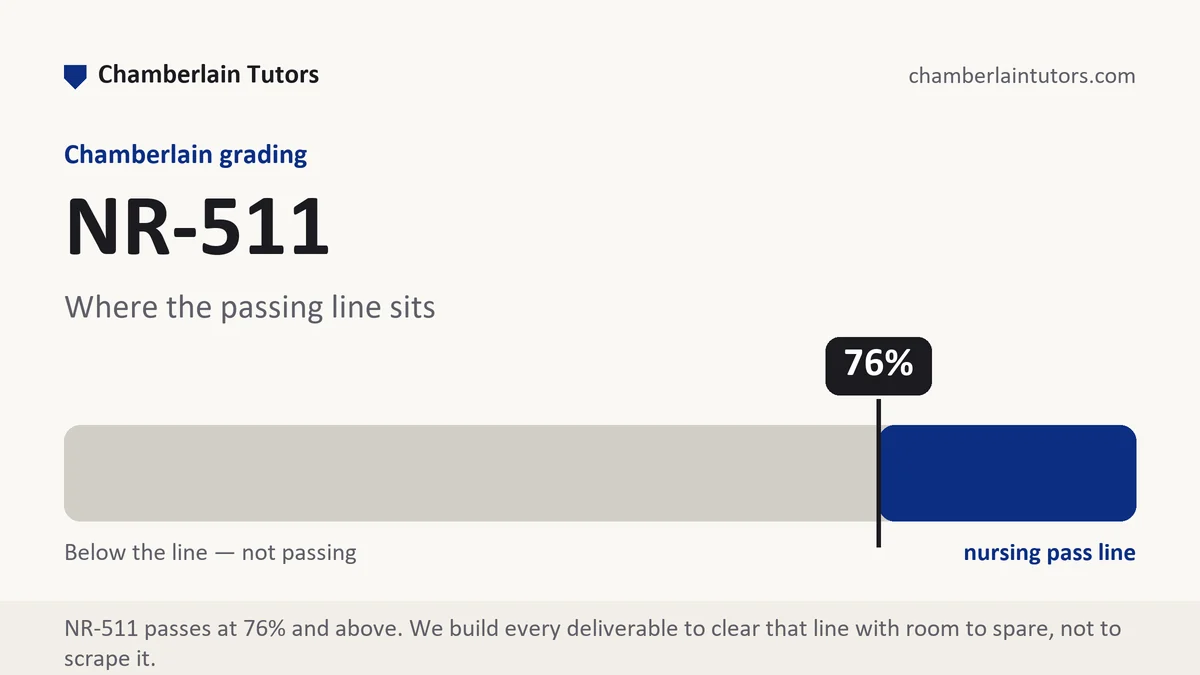
What NR-511 Week 3 asks for
The examination taught at this point is selective. The history hands you two or three candidates, and each candidate names the maneuvers that could raise or lower it, which is why two patients with the same complaint can honestly receive different examinations. Expect territory covering inspection, palpation, percussion and auscultation applied to a focused region, the general survey and vital signs as data rather than as a formality, and the discipline of recording exactly what was done.
The written container at this stage is usually a full note in subjective, objective, assessment and plan order, sometimes with a short rationale section attached that explains why each maneuver was chosen. Some sections pair the note with a documentation exercise that asks you to correct a flawed sample. If your section runs a discussion this week, it commonly asks what a single unexpected finding would do to your list.
What separates bands here is boundary discipline. Objective holds observations; assessment holds interpretation; plan holds action. Every leak across those walls costs something, and leaks are visible at a glance.
The NR-511 Week 3 method, step by step
Six moves from the doorway to a note that reads as clinical documentation.
-
Let the list choose the maneuvers
Write your candidates in the margin, then list the examination steps that could move each one. Everything on that list gets done and documented. Everything else is optional, and its absence from the note is not a gap, it is a choice you can defend.
-
Take the general survey seriously
Appearance, distress, posture, work of breathing, hydration and gait carry real information and are the first thing an experienced reader looks for. A note that opens with vitals and no survey has skipped the cheapest data in the encounter.
-
Record findings, not conclusions
Tender at the right lower quadrant with guarding is an observation. Consistent with appendicitis is a conclusion, and it belongs one section lower. Keeping them apart is what lets a reader disagree with your reasoning while trusting your data.
-
State the normals that carry weight
A negative finding earns its space when its absence would have changed the list. Clear lungs matter in a cough case; they are filler in an ankle sprain. Choose the negatives your candidates asked for and let the rest go.
-
Build the assessment out of the note above it
Each sentence of the assessment should point back to a finding already documented. If the assessment introduces new information, the note has a hole in it, and graders find that hole quickly because the reference has nowhere to land.
-
Run the integrity and format pass
Nothing carried forward that you did not verify, abbreviations expanded on first use, times and units consistent, current APA on any source, and headings that match the wording your week's rubric uses.
A focused note, section by section
Targets below assume a documented encounter near 1,100 words, which is typical when a rationale block is bundled with the note. Adjust to your prompt, and remember that the assessment usually carries more weight per word than any other block.
| Block | What belongs there | Word target |
|---|---|---|
| Subjective, condensed | The present illness and the pertinent negatives already gathered, trimmed to what the examination needed | 200 to 250 |
| General survey and vitals | Appearance, distress, and the measured values with any repeat or positional reading noted | 90 to 120 |
| Focused examination | Region by region in a fixed order, each maneuver with its finding, positive and chosen negative alike | 280 to 340 |
| Rationale for the examination | Why these maneuvers and not others, tied to the candidates you carried in | 140 to 180 |
| Assessment | The working interpretation, each sentence anchored to a documented finding | 200 to 250 |
| Plan and follow-up | Next steps in the order they would happen, with the return interval and the finding that would bring the patient back sooner | 150 to 190 |
Run one arithmetic check against your own rubric before drafting. If the assessment block is weighted heavily and your outline gives it two sentences, the note is already capped below the top band no matter how thorough the examination section becomes.
Citing evidence about examination findings
Physical examination research is measured against a reference standard, and the useful sources say so. When you cite a maneuver, name what it was compared against and in whom: a finding validated against imaging in a referral clinic behaves differently in a walk-in primary care population, because the mix of disease is different.
Give the numbers their shape. Sensitivity and specificity describe the test in patients whose status is already known; they are properties of the maneuver in that sample, not promises about your patient. If you want to say what a finding means for this patient, you need the frequency of the condition in your setting as well, and the sentence should say so plainly.
Guard the verb and the year. A maneuver was associated with the diagnosis in a cohort; it did not detect it unless the study reported detection against a standard. Where a professional organization has issued current guidance on examining the region in question, cite that current edition and place the year inside your sentence so a reader can tell at a glance that it has not been superseded.
Five mistakes that cost points in a documentation week
- A template examination with no relationship to the history. Twelve systems documented normal in a focused visit tells a grader the maneuvers were not chosen.
- Interpretation inside the objective block. Words like consistent with, suggestive of, or likely belong to the assessment and are marked wherever else they appear.
- Findings recorded that were never performed. A documentation integrity issue that a preceptor and a rubric both take seriously.
- An assessment that arrives from nowhere. New data appearing for the first time under assessment breaks the chain the whole note exists to show.
- Abbreviation drift. Shorthand a shift colleague would read fluently is not shorthand a grader is required to decode. Expand on first use, every time.
Before you submit
- Every documented maneuver can be traced to a candidate it was meant to move
- The objective block contains no interpretive language at all
- Each stated normal is one whose absence would have changed the list
- Every assessment sentence points back to a finding already written above
- The plan names a return interval and a specific finding that would accelerate it
- Abbreviations are expanded on first use and units are consistent throughout
Note due before the Mountain-Time cutoff?
Send the prompt, the rubric and whatever case detail you are cleared to share. A clean original note comes back inside 24 to 48 hours with the section walls held.