NR-451, the RN Capstone Course, is where the RN-to-BSN sequence gets totalled up: three theory credits, no clinical block, and a grade assembled almost entirely from writing built around one evidence-based project that puts a change into a healthcare setting you selected. The scoring does not reward how important your topic sounds. It rewards a change narrow enough to be real, evidence about the fix rather than the problem, and a measure that lets somebody else say afterwards whether anything moved. This page is the manual for writing that.
What NR-451 actually grades
The catalog calls this a synthesis course: a senior demonstrates what the general education courses and the nursing sequence added up to, and does it through an evidence-based project implementing change in a selected healthcare setting. In practice the synthesis is judged through project writing, and project writing goes wrong in the same places every session. Students pick a problem the whole profession already agrees is a problem, cite six studies proving it exists, propose staff education as the intervention, then close by surveying whether staff enjoyed the education. Nothing there is false and almost none of it is scoreable, because the document never says what one person will do differently at one moment on one unit, or how anyone would know it happened.
The rows that carry weight in a project course reward specificity you only get by choosing something small. A capstone on medication safety across an organization has nowhere to go. One on the interruption rate during the 0700 medication pass on a single 32-bed unit already has a baseline, an intervention, an owner and an evaluation window inside the sentence.
How we help in this course
We work the written layer: turning your setting into a problem statement with a gap in it, finding evidence that tested the intervention rather than described the topic, and keeping the implementation and evaluation sections aligned across a long document drafted in pieces.
What we do not do is stand between you and your workplace. We do not contact a manager, a unit council, a site or a preceptor, we sign nothing, and no draft will describe an approval you have not obtained or a result you have not produced. Send the real constraints and the draft is built inside them.
How to write this course's deliverables
Chamberlain keeps section materials in Canvas rather than publishing syllabi, so anything week-numbered here would be invention. What follows is arranged by craft and works against whatever your scoring guide asks this week: converting the guide into a section plan with a word budget, the parts a change proposal has to carry, and the evidence habits that keep a project document from overclaiming.
In NR-451 right now?
Send the week and the rubric from Canvas. First premium sample free, floor-checked, back in 24 to 48 hours.
A capstone with no clinical hours behind it
Three theory credits and no clinical component means every point in NR-451 comes from something you wrote. There is no lab performance, no skills check and no hours total to carry a weak paper. The catalog also places this capstone alongside NR-447, the leadership course, as a co-requisite, so the two run together and both want writing grounded in a workplace you know.
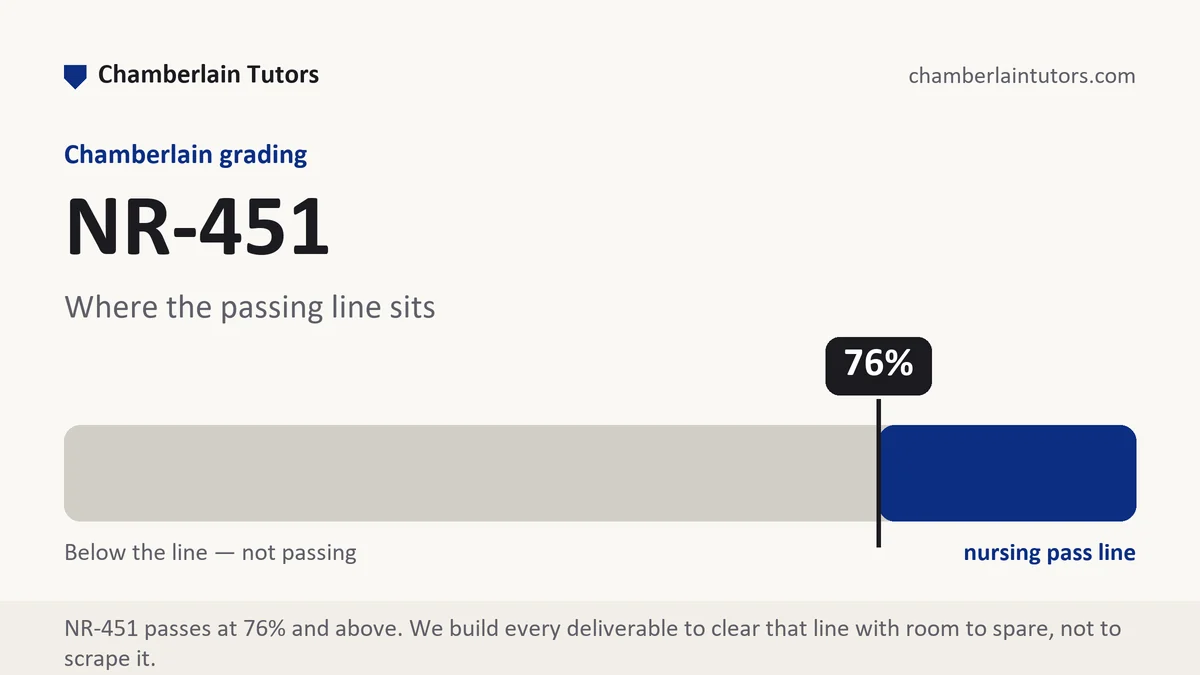
The calendar tightens that further. A sixteen week semester splits into two eight week sessions, as many as six starts run in a year, and deliverables land weekly inside whichever session you are in. A project that would sit comfortably across a full semester has to be planned, evidenced, written and evaluated inside eight weeks of graded work. In core nursing courses 76 percent is the passing floor, and supplementary work cannot rescue a weak weighted average, so drifting for three weeks and rescuing it in week seven is a plan that rarely survives the grade book. Discussion posts do not reopen once submitted, which matters here because the boards are often where you first describe your problem, and a vague first description tends to become the paper's first paragraph.
Read the rubric before the prompt, then keep a two column ledger
The prompt describes the assignment. The scoring guide is the assignment. Open the guide first, copy every criterion row into an empty document in the guide's own order, and strip each row to the verb it is built on: identify, support, propose, plan, evaluate. Those verbs become your headings, kept in the same order, so a grader working down the guide meets your sections in the sequence they are looking for them.
Then price the headings. Suppose your section caps the project document at 2,000 words and the guide carries five rows weighted 30, 25, 20, 15 and 10 percent. Multiply straight through and you get 600 words, 500, 400, 300 and 200. Write those figures in brackets beside each heading before drafting a sentence, and remember that the title page and the reference list are not part of that count unless your guide says they are. The arithmetic usually feels wrong, because the heaviest row is rarely the part you were looking forward to writing, and 600 words is far more than the two paragraphs you had in mind for it.
The second column is what makes this a ledger rather than a wish. When the draft is done, select each section, read the word counter, and write the real number beside the target. Anything more than fifteen percent off gets fixed before submission. The pattern is nearly universal: the description of your unit runs 200 words over and the evaluation section runs 200 words under. Moving those words is one afternoon of work that changes the band the document lands in.
The parts of a practice change proposal
Whatever your section calls the document, the shape underneath is stable. Each part has a job a grader can find or fail to find, and each has a weak version that shows up constantly.
| Part | What it has to prove | The weak version |
|---|---|---|
| The problem, stated as a gap | A distance between what happens on your unit now and what should happen, said in one sentence | A topic announced as important, with no distance in it |
| Population and setting, bounded | One unit, one patient group, one shift pattern, with counts attached | The hospital, or nurses in general |
| The baseline | A starting number with a source, a denominator and the months it covers | A word standing in for a number, such as frequent or increasing |
| Evidence for the fix | Studies that tested the intervention you are proposing, in a setting close enough to argue from | More articles proving the problem exists, which nobody disputed |
| The change, as one behaviour | Who does what differently, at what point in the shift, instead of what | Increase awareness, improve communication, provide education |
| The framework carried through | A change model that decides the order of your steps from the first page onward | A model paragraph dropped in just before the conclusion |
| Stakeholders and resistance | Roles named, what each one loses in time or control, and your answer to that | A sentence saying buy-in will be essential |
| The evaluation plan | The baseline measure collected again, after a stated interval, by a named role | A survey asking whether staff liked the new process |
| What happens when you leave | Who owns the change after the course ends and where it lives in the routine | Continued monitoring is recommended |
Rates, denominators and verbs that fit the design
A capstone lives or dies on how it handles numbers, both other people's and its own. Four habits carry most of the difference.
Currency, checked rather than assumed. Treat anything older than five years as needing a stated reason to be in the paper, unless your guide sets a different window. A guideline document is current when it is the current version, so cite the version and its year rather than the year you first read it. If an older trial is still the study the whole intervention rests on, say so in the sentence and the age stops being a problem.
Design and sample before the finding. Never let a result arrive undressed. Say what kind of study produced it and how many people were in it before saying what it showed. Eleven words spent on a quasi-experimental study across four medical units, 214 patients, turns a claim into evidence, and it is the cheapest scoring move in the document.
Verbs sized to the design. A study that only watched can support predicted, occurred more often among, or was associated with. Reduced, caused and prevented belong to designs that changed something on purpose and measured what followed. This matters more in a capstone than anywhere else, because you are borrowing other people's causal claims to justify your own plan, and a grader who spots one inflated verb starts checking the rest.
No rate without its base and its months. Falls fell by 37 percent is not a finding. Falls fell from 4.1 to 2.6 per 1,000 patient days across two quarters is a finding, and it also tells your reader what your own evaluation will have to collect. Apply the same rule to internal figures: name the report and the months it covers, and strip anything that could identify a patient or colleague.
Passing project, strong project, in this course
A passing capstone here names a real problem, cites real sources, proposes something plausible and reads cleanly. It clears the floor and leaves the reader with no picture of anything happening.
A strong one differs in three ways visible on the first page. It is narrow enough that a reader can see the shift: a named unit, a named moment, a named group of patients. Its evidence is about the intervention rather than the problem, which usually means fewer sources doing more work because the search took longer. And its evaluation could be run by somebody who never spoke to you, since the measure, the interval, the collector and the comparison point are all written down. Narrow, fixed to the intervention, independently runnable.
Six mistakes that cost points here
- Education as the entire intervention. Teaching people about a problem is a step in a change, not the change. If nothing about the workflow differs afterwards, there is nothing to measure.
- Citing the problem when the row wants the fix. Six studies establishing that pressure injuries are costly do not support the specific rounding schedule you are proposing.
- No baseline. Without a starting number the evaluation section cannot exist, and the two heaviest parts of the document collapse together.
- An outcome you have no way to collect. Readmission data you cannot access is a measure in name only. Choose something countable by someone standing on the unit.
- The change model arriving late. A framework named on page seven has decided nothing. It should be visible in the order of your implementation steps.
- Scope that spans a building. Organization-wide capstones read as brochures, because nothing that broad can carry a denominator or a named owner.
Questions students ask in this course
My manager will not approve an actual change on my unit. Can I still write the capstone?
My unit does not publish a number for the problem I picked. Where does a baseline come from?
NR-447 runs alongside this capstone and both want writing about my workplace. Can I use the same unit twice?
Where NR-451 sits in Chamberlain's programs
Open the exact program map for sequence, credit, and option context. The current student schedule and syllabus remain authoritative after transfer evaluation, electives, state rules, and approved plan changes.
The weeks, one by one
Week 1
NR-451 opens with a decision that shapes the entire session: which problem, in which healthcare setting, your capstone change project will spend eight weeks addressing on paper, and the first written work of a capstone arc almost always asks you to select that problem, ground it in a real setting. Read the full Week 1 manual.
Week 2
The second stage of the RN capstone is an evidence hunt with a destination: where a research course collects studies to understand a question, a capstone collects them to justify a change, so the arc of NR-451 typically asks you this week to gather, organize, and briefly appraise the published. Read the full Week 2 manual.
Week 3
NR-451 Week 3 is where a good idea acquires a skeleton: the capstone arc typically turns here from what should change to how change is organized, asking you to select a recognized change framework, map your project onto its stages, and write the plan so a reader can see the theory holding the. Read the full Week 3 manual.
Week 4
Week 4 of NR-451 is the stage where your project stops describing a problem and starts specifying an intervention: in our reading of the capstone arc, this is the week the proposed change gets its full anatomy on paper, components, sequence, materials, roles, and the definition of doing it right,. Read the full Week 4 manual.
Week 5
NR-451 Week 5 turns from what should change to how change survives contact with a working unit: the capstone arc at this point typically asks for an implementation plan, the stakeholders who must be brought along, the barriers that will push back, the resources the rollout consumes, the pilot's. Read the full Week 5 manual.
Week 6
The sixth stage of the RN capstone asks a blunt question of your whole project: how would anyone know the change worked, and the arc of the course typically answers it here with an evaluation plan, the outcomes you would track, the process measures that show the intervention actually happened, the. Read the full Week 6 manual.
Week 7
The seventh stage of the RN capstone is where six separate submissions have to become one document that a stranger could read start to finish without noticing the seams: the problem, the evidence, the framework, the intervention, the rollout and the evaluation, joined by transitions, reconciled in. Read the full Week 7 manual.
Week 8
The capstone's last stage usually asks two things at once: put the project into a form other professionals could receive, a presentation, a poster, a slide set or an executive summary aimed at a named audience with a specific ask, and then say what the degree changed in the nurse who built it. Read the full Week 8 manual.