NR-447 sits in Chamberlain's Collaborative leadership course, on the RN to BSN path. This is its help page: what the course really grades and how our team carries it, floor check included.
What NR-447 actually grades
The collaborative-leadership course of the RN-to-BSN, where working nurses write about teams, conflict, and healthcare organizations they actually know. Specificity about your real unit is what the rubric rewards and generic leadership prose is what it punishes.
How we help in this course
Send a paragraph about your unit with the order; the draft comes back built on it. Leadership writing grounded in a named context is the cheapest A-band upgrade in the program.
Deliverables run the standard promise: a premium original draft in 24 to 48 hours, targeted at the A band of your course's actual scale, through the eight-person pipeline with both QA passes and the floor check, revised free until it lands.
Writing the deliverables in this course
Section materials at Chamberlain live inside Canvas, which means a manual arranged by week number could only ever be guesswork. So this one is arranged by craft instead, and every piece of it applies to whatever your scoring guide is asking for this week: how to read the guide as an allowance rather than a checklist, what a unit-level leadership analysis has to contain, and how to handle evidence about nurses without overclaiming. The rest of this page carries that manual.
In NR-447 right now?
Send the week and the rubric from Canvas. First premium sample free, floor-checked, back in 24 to 48 hours.
The cheapest A-band upgrade in the program
NR-447 rewards specificity about a unit you actually know and punishes generic leadership prose, which makes it unusual: the highest-leverage thing you can do costs five minutes. Send a paragraph about your real floor, staffing pattern, the recurring conflict, the committee that never decides, and the draft comes back built on it, leadership frameworks applied to a named context instead of recited at one. Faculty read hundreds of abstract essays about teams; grounded ones stand out at grading time. Your context notes stay on file, so every later week's draft anchors to the same unit without re-asking.
How leadership writing grades under Chamberlain's rules
The rubric scores substance and evidence separately from enthusiasm, the discussion boards where much of the course lives are permanent on posting, and the deadlines run on Mountain Time regardless of your zone. The desk's standard machinery covers all three: sourced, rubric-checked posts delivered final for their single paste, written work through both QA passes in 24 to 48 hours, and the calendar conversions done for you at intake.
What if I cannot share details about my workplace?
Share what you can generically, unit type, size, the friction pattern, and the draft anonymizes from there; the rubric wants a concrete context, not identifying information.
Is the first leadership draft really free?
It is, full premium standard with the walkthrough attached, so you can see the named-context method working before any order is placed. Five minutes of context, one free draft, full information.
Read the scoring guide as a paragraph allowance
A rubric is not a checklist of things to mention. It is an allowance, and it tells you how much of your paper each idea is allowed to occupy. Before drafting, paste every criterion row into an empty document as a heading, keep the guide's order, and treat the space under each heading as rationed. Rows the guide values get room; rows it barely weights get a paragraph and a full stop.
Convert the weights into paragraphs, because leadership writing runs long on story and short on analysis. Suppose the assignment asks for roughly 1,100 words of body and your guide reads: leadership framework applied, 30 points; team and conflict analysis, 25; context and problem, 20; action plan with measures, 15; APA and scholarly voice, 10. Lift out the writing row, since it is scored across the whole submission rather than in one place. Academic body paragraphs run near 130 words, so 1,100 words is about eight of them, and those eight get divided in the ratio of the 90 remaining points.
| Criterion row | Weight | Paragraphs it has earned |
|---|---|---|
| Leadership framework applied | 30 | Three |
| Team and conflict analysis | 25 | Two |
| Context and problem | 20 | Two |
| Action plan with measures | 15 | One |
| APA and scholarly voice | 10 | Judged across all eight |
Your own guide will weight things differently, so run your numbers rather than borrowing these. The point is what the arithmetic exposes: the framework row has earned three paragraphs and the context row two, while most leadership papers hand five paragraphs to the story of the unit and one clause to the framework. That inversion is the single most common reason a paper that felt strong to write comes back a band lower than expected.
The shape of a unit-level leadership analysis
Whatever the prompt is called, a leadership deliverable in this course is asking you to analyze a work system you know from the inside. Each part below has a job, and the weak version of each is what a grader sees most often.
| Part | What it must prove | The weak version |
|---|---|---|
| The unit, described by function | A specific system: type of unit, size, shift pattern, staffing mix, who reports to whom | A busy hospital unit, a phrase that fits everywhere and therefore describes nowhere |
| The problem, stated as behavior | A repeating pattern with observable behavior and a rough frequency | A colleague's character, which no plan can act on and no rubric can score |
| The framework, chosen and defended | One model picked for a reason, with what it predicts about your situation stated | A definition paragraph naming a theory that never appears again |
| The evidence | Peer-reviewed work supporting both the diagnosis and the response | Textbook citations only, or one source carrying the entire argument |
| The stakeholder map | Who gains, who loses, who can quietly veto the whole thing | Staff and management, treated as two blocks with single opinions |
| The action plan | Something a manager could accept or refuse: owner, first step, resources, sequence | Improve communication, increase collaboration, foster teamwork |
| The measure | A number your organization already collects, with a review date attached | Outcomes will improve, which cannot be checked and so cannot be credited |
| Your own position | Where you sit in the system and what you can influence from there | A plan written as though you held authority you do not have |
Evidence about nurses, handled without overclaiming
Leadership rubrics score evidence use separately from argument, and the evidence rows are lost on habits, not on intelligence.
Prefer recent work, and say why when you do not. Staffing, turnover and workplace-safety research describes a workforce that has changed sharply in a short time. When you cite older work, it should be because the design is strong and the finding is structural, and that reasoning belongs in your sentence rather than in your head.
Set up the study before you quote it. Tell the reader whether it was a single-unit before-and-after project, a cross-sectional survey of nurses, or a study across many hospitals, and how many nurses it covered, ahead of the finding itself. Two sentences of setup turn an assertion into evidence.
Only a study that changed something can carry a causal verb. Surveys show that units reporting one thing also report another. They do not show that the first caused the second. Write associated with, reported alongside, or predicted, and hold reduced, improved and caused for studies where something was actually changed and measured.
State the denominator and the window before any rate. Turnover of 22 percent means nothing until you say 22 percent of which staff group, counted by which definition, over what period. The same discipline applies to falls per 1,000 patient days, vacancy rates and overtime hours. When the number is your own unit's, label it as local and unpublished, strip anything identifying, and use it as illustration rather than as proof.
What lifts a leadership paper above passing
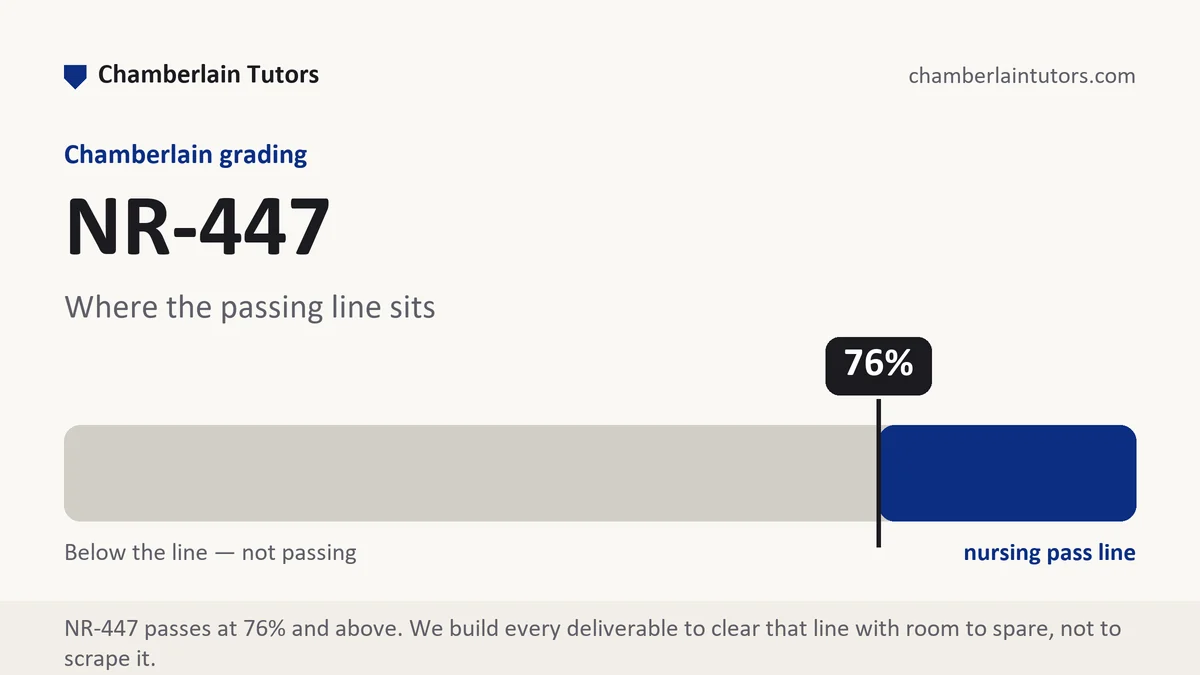
A passing paper names a theory, describes a problem and recommends better communication. It gets the core work over the 76 percent floor and reads like every other paper in the section.
The papers that score at the top do four things a grader can point at. The framework earns its place by changing what the writer notices: applied properly, a model should make you see one thing in your unit differently from how you saw it before you opened the reading. The recommendation is specific enough to be refused, which means it names who chairs it, who comes off the floor to attend, what existing meeting it replaces and what it costs in hours. The constraint is admitted rather than stepped around, because every real unit has a budget line, a contract term or a schedule that makes the obvious fix hard, and a paper that pretends otherwise reads as fiction to anyone who has worked a floor. And the outcome measure already exists in the organization, so the plan could start on Monday without anybody building a new dashboard first.
Where leadership papers lose points
- Describing a person instead of a system. The rubric wants the pattern that produces the behavior, not the character of whoever displays it.
- The disappearing framework. A model defined in one paragraph and abandoned for the rest of the paper scores as a mention, not an application.
- Recommendations nobody could act on. If a charge nurse could not tell you what to do differently tomorrow morning, the plan row is not satisfied.
- Identifying detail left in. Employer names, unit names, coworkers' names and details that could only mean one person all belong out of the draft before it is submitted.
- Agreement posts. Discussion rows ask you to move a thread forward, not endorse it, and the board keeps whatever you submit, so your first attempt is the one that gets scored.
- Naked statistics. A workforce number quoted without its denominator, definition or period loses the evidence row no matter how apt the number is.
Questions from students in this course
I am a staff nurse, not a manager. Whose leadership am I supposed to analyze?
How do I apply a leadership model without sounding like I am reciting it?
The honest answer is that my organization will never fund my plan. Do I write that?
Where NR-447 sits in Chamberlain's programs
Open the exact program map for sequence, credit, and option context. The current student schedule and syllabus remain authoritative after transfer evaluation, electives, state rules, and approved plan changes.
The weeks, one by one
Week 1
NR-447 Week 1 is where a working RN stops describing leadership and starts arguing about it. Read the full Week 1 manual.
Week 2
NR-447 Week 2 sits in the territory of communication and collaboration: how information moves between nurses, providers, and the rest of the interprofessional team, where it breaks, and what structured tools change about the break points. Read the full Week 2 manual.
Week 3
NR-447 Week 3 belongs to conflict: where it comes from on nursing units, the named styles people bring to it, and what a leader does to move a dispute from personalities to interests. Read the full Week 3 manual.
Week 4
NR-447 Week 4 works the territory every RN already lives in and few have written about carefully: delegation, supervision, and the scope-of-practice lines that decide who may do what for which patient. Read the full Week 4 manual.
Week 5
NR-447 Week 5 moves the course into quality improvement and patient safety as leadership work: how a unit-level problem becomes a measured improvement effort, and what leaders do to make safety a system property rather than an act of individual vigilance. Read the full Week 5 manual.
Week 6
NR-447 Week 6 turns to change: the named theories that describe how organizations move, the predictable shapes resistance takes on nursing units, and the leader behaviors that carry a practice change from announcement to habit. Read the full Week 6 manual.
Week 7
NR-447 Week 7 usually carries the material nurses meet last and managers meet first: staffing models, skill mix, budgets as constraint and argument, and the leader's job of matching finite people to variable demand without trading away safety. Read the full Week 7 manual.
Week 8
NR-447 Week 8 is the closing stage, and closing stages in leadership courses usually ask for synthesis: what the eight weeks changed in how you read your unit, argued as a claim about growth with evidence from your own coursework, and pointed forward at the leadership you will practice next,. Read the full Week 8 manual.