The sixth stage of the RN capstone asks a blunt question of your whole project: how would anyone know the change worked, and the arc of the course typically answers it here with an evaluation plan, the outcomes you would track, the process measures that show the intervention actually happened, the comparison that gives numbers meaning, and the schedule on which someone would look. Your section may print this as NR 451 or NR451; it is the same course. Chamberlain publishes no syllabi outside Canvas. The placement here is our teaching judgment from the course's catalog arc; your section's rubric decides what your week actually asks.
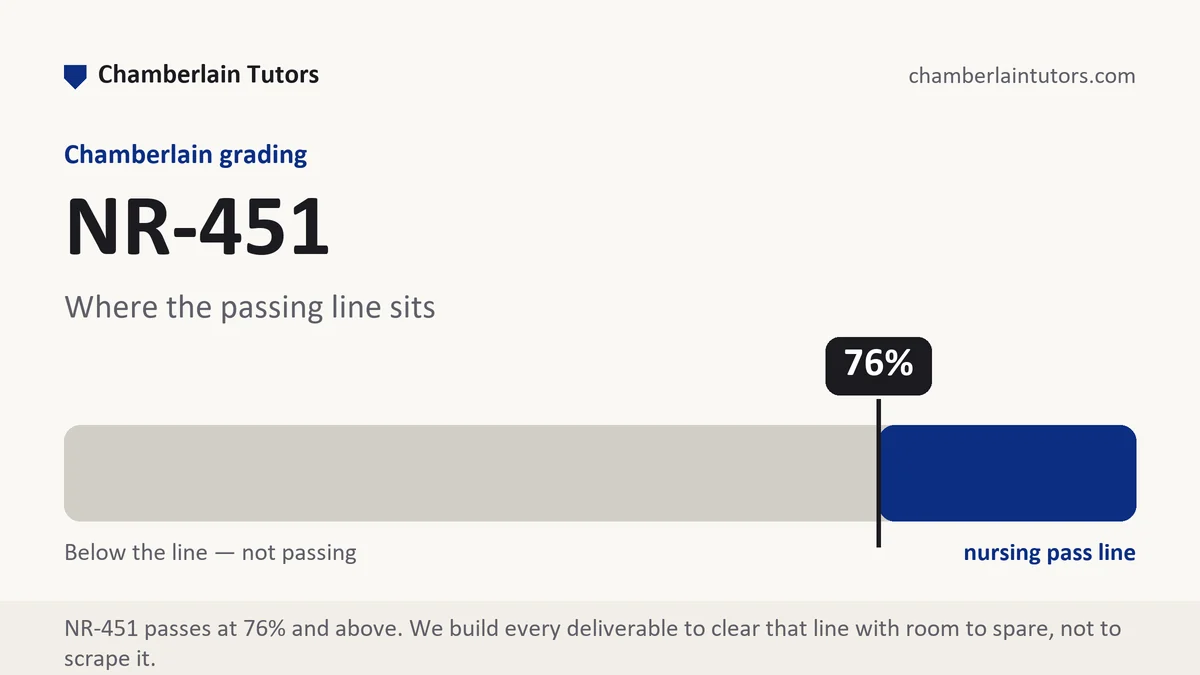
What NR-451 Week 6 asks for
Return to a unit that has lived through an unevaluated change, because most nurses have one in memory. A memory care wing once adopted a new bedtime routine to reduce nighttime falls among residents recently moved in from home, and a year later nobody could say whether it helped: night staff swore things were calmer, day staff saw no difference, the binder was still in use on one hall and quietly abandoned on the other, and when leadership asked for the results there were none, only impressions. The intervention may even have worked. No one will ever know, and that institutional amnesia is exactly what an evaluation plan exists to prevent.
The written work this week asks you to design the knowing in advance. A complete plan usually carries four layers, and capstone rubrics tend to touch all of them. Outcome measures answer whether the goal moved: the fall rate, the return-transfer rate, whatever your problem statement promised to improve. Process measures answer whether the intervention was actually delivered as designed, using the fidelity definition your design week wrote. A comparison strategy answers against what, since a number with no baseline or reference period is a fact without a meaning. And a schedule with named roles answers who looks, how often, and what they do with what they see.
The intellectual honesty of this section is graded as heavily as its machinery. A proposal-level evaluation can promise measurement; it cannot promise results, and it must not claim the project will achieve any particular improvement. The register that scores is conditional and precise: the plan would track this rate, compare it to the pre-implementation period, and judge the pilot against the criteria stated in advance. Students who write the evaluation as a victory lap, describing the improvements the project will deliver, have converted a measurement plan into a prophecy, and rubric language about realistic evaluation exists to catch precisely that.
The NR-451 Week 6 method, step by step
Six moves for building an evaluation a skeptic would accept.
-
Outcome selection
Choose one primary outcome, the number your problem statement was always about, and no more than two secondary ones. Every added outcome multiplies data burden, and evaluation plans die of ambition more often than of neglect. The primary outcome should be the same one your evidence sources measured.
-
Measure operationalization
Define each outcome so two people would count it identically: what events qualify, over what population, per what denominator, in what window. A fall per thousand resident-nights is countable; safety improvement is a wish. Write the definition into the plan verbatim.
-
Process pairing
For each outcome, add the process measure that shows delivery: the share of eligible discharges that received the complete intervention, per your fidelity definition. Without it, a flat outcome cannot be diagnosed, because an intervention that never happened and one that happened and failed look identical from the outcome alone.
-
Comparison framing
State what the post-change numbers would be judged against: the same unit's pre-implementation period is the standard proposal answer, with its length specified. Name the comparison's main weakness too, seasonality, census shifts, in one honest sentence.
-
Data source naming
Say where each number would come from as a type of source: incident reporting systems, transfer logs, the documentation field your design created. The proposal never touches real records; it demonstrates that you know which routine data streams a facility already has and which the project would add.
-
Review scheduling
Set the cadence and the actors: who compiles, who reviews, at what interval during the pilot and after spread, and what decision each review can trigger, continue, adjust, or stop. An evaluation nobody is scheduled to read is a data collection hobby.
A layout and word budget for an evaluation plan
Sized for an evaluation section of roughly 900 to 1,200 words. This is our teaching frame, not a university document, and your section's rubric or template overrides it wherever they conflict. If your instructions fold evaluation into a larger proposal document, these become subsections at proportional length.
| Section | What belongs in it | Word target |
|---|---|---|
| Evaluation logic | One paragraph connecting the problem, the intervention, and the question the evaluation must answer. | 90 to 120 |
| Primary outcome | The measure fully operationalized: events, denominator, population, window, and its link to your evidence base. | 160 to 200 |
| Secondary and balancing measures | One or two additional outcomes, plus anything the change could worsen that deserves watching. | 130 to 170 |
| Process measures | Delivery and fidelity tracking, built directly on the done-correctly definition from your design. | 140 to 180 |
| Comparison and data sources | The reference period, its stated weakness, and the source type for every number. | 170 to 210 |
| Review cycle | Cadence, roles, and the decisions each review can trigger during pilot and beyond. | 120 to 160 |
Evidence craft for evaluation writing
Inherit your measures from your sources. The studies in your evidence table measured something specific in a specific way, and aligning your planned measures with theirs is both scientifically sound and rhetorically powerful: it lets your proposal claim that a comparison to published results would even be possible. Cite the source next to the inherited measure.
Balancing measures show a trained eye. One sentence acknowledging what the change could unintentionally worsen, scheduled walking and staff time, structured routines and resident autonomy, plus a plan to watch it, is the single highest-value addition most capstone evaluations lack. The improvement literature you cite this week treats balancing measures as standard; borrow the standard.
Numbers in the plan are definitions, not predictions. Your text may define rates, denominators, and windows in full precision, and must not project the values they will take. The plan measures falls per thousand resident-nights over the pilot span; it does not announce that falls will drop. Every predictive sentence in an evaluation section is a claim no evidence can back.
Concede the design's limits in one clean paragraph. A before-and-after comparison on one unit cannot rule out everything else that changed in the same season, and saying so, briefly and without self-flagellation, is what makes the rest of the plan trustworthy. Proposals that concede nothing are read skeptically everywhere; proposals that concede precisely are trusted precisely.
Five mistakes that cost points in this week's territory
- Unmeasurable outcomes. Improved quality of care and better communication cannot anchor an evaluation; if it lacks a denominator, it is a hope, not a measure.
- Outcome-only tunnel vision. Without process measures, the plan cannot tell a failed intervention from an undelivered one, and graders check for the pairing.
- Promised results. Any sentence stating the improvement the project will achieve converts measurement into prophecy and calibration into a defect.
- Comparison-free numbers. A post-implementation rate with no baseline period is a figure floating in space, and the omission unravels the whole section.
- Data burden blindness. A plan requiring new manual tallies on every shift will be abandoned by week two of any real pilot, and experienced readers price that in immediately.
Before you submit
- The primary outcome has events, denominator, population, and window defined
- Every outcome measure traces to how your evidence sources measured it
- A process measure pairs with each outcome, built on the fidelity definition
- The comparison period is specified along with its main weakness
- Each number has a named data source type, none requiring real records now
- No sentence anywhere predicts the size or direction of results
Building your NR-451 evaluation plan?
Send the rubric and your design and implementation drafts out of Canvas. A premium original draft comes back in 24 to 48 hours with measures operationalized and the calibration graders look for, and revisions run until the grade lands.