NR-342 Complex Adult Health is the five credit version of the complex adult health course: the same theory column, three credits, sitting against a doubled clinical column of two credits and 96 hours. More time on the unit means fuller patient assignments, and the written work follows, asking you to reason across encounters and defend choices made between patients rather than about one.
What NR-342 actually grades
The catalog content is critical and emergent adult care: unstable patients, comprehensive assessment, advanced skills, clinical judgment. What separates NR-342 from its 48 hour sibling is not the subject but the volume of practice behind the writing. Ninety six hours inside an eight week session averages twelve hours a week on a unit, and students carrying that load are usually holding more than one patient at a time by the middle of the term.
That changes what a grader expects on the page. With one patient, judgment looks like a sequence of actions. With a full assignment, judgment looks like a set of trade offs, because attention is finite and giving it to one bedside means withholding it from another. Written work in this course rewards the student who says out loud what was deferred and why it was safe to defer it. A submission that describes each patient separately, in tidy consecutive sections, has recorded a shift without ever showing the reasoning that ran across it.
How we help in this course
The hard boundary first. Clinical hours, site contact, faculty contact, signatures and hour logs are not things we do, ask about, or touch in any form. Those belong to you and your school.
Our side is the writing, and in a course with two clinical credits the writing is what gets squeezed. We read the week's rubric before anything else, build the plan its rows demand, draft in the register a critical care faculty member reads all term, and annotate where the reasoning is carrying the score so you can reproduce the move next week. Students in the 96 hour version rarely lack material. They lack a quiet evening in which to shape it.
How to write this course's deliverables
The rest of this page is method. Scoring guide first, section plan second, patients third. Written in that order the paper practically assembles itself on a clinical night when you have ninety minutes and no energy for structural decisions.
In NR-342 right now?
Send the week and the rubric from Canvas. First premium sample free, floor-checked, back in 24 to 48 hours.
The clinical block versus the 76 percent floor
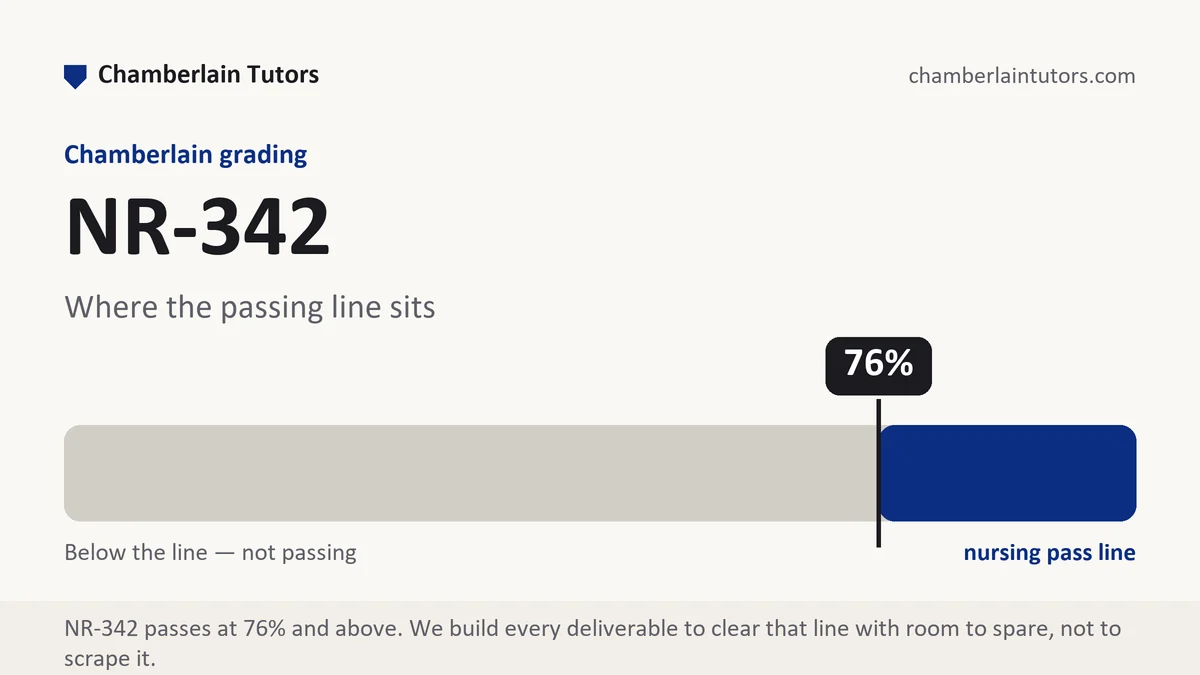
Nursing core courses pass at 76 percent, and the risk in NR-342 is scheduling rather than difficulty. Two clinical credits eat the calendar, weekly deliverables keep arriving, and the eight week session inside Chamberlain's sixteen week semester gives you no slack quarter to recover in. Supplementary work will not repair a weak weighted average, so the only real defense is protecting one fixed writing window a week and treating it like a shift you cannot swap.
Pick that window on a non clinical day and put the rubric in front of you before you open the prompt. Students who write on the evening after twelve hours on a unit produce their weakest work of the term and then conclude the course is harder than it is. It is not harder. It is scheduled against you, and the fix is calendar shaped.
Price the rubric rows before you write a sentence
Every scoring guide is an instruction about proportion disguised as a grading table. Lift the rows out into a blank page in the order they appear, then multiply each weight by the word cap to get the space that row has bought.
Consider a week capped at 1,000 words with three rows weighted 50, 30 and 20 percent. That is 500 words, 300 words and 200 words. A three row guide is a much blunter instrument than a five row one, and it is the shape that catches students out, because half the paper now belongs to a single row. If the 50 percent row is about prioritization across patients, then five hundred words of your submission has to be prioritization reasoning and nothing else. Not assessment findings, not background, not the intervention list. Five hundred words of why this before that.
Write those three numbers next to your headings and hold yourself to them. A section that comes in far under its share is not concise, it is underweight, and the row it belongs to is the one your grade is standing on. When a guide is this top heavy, the fastest way to lift a grade is to move two hundred words out of the sections nobody weighted and into the one that was.
The shape of a multi patient write up
When the week asks you to write across an assignment rather than about one bedside, the deliverable has a recognizable skeleton. Each part answers a question a grader is holding while reading.
| Part | The question it answers | What a weak version does instead |
|---|---|---|
| The assignment in brief | Who was in your care, at what acuity, in two lines each and no identifiers. | Full separate histories that consume a third of the budget before any reasoning starts. |
| The competing demands | What each patient needed at the same moment, stated so the collision is visible. | Needs listed patient by patient, so nothing ever collides on the page. |
| The ranking, with a rule | Which demand you took first and the principle behind the choice, airway before comfort, unstable before scheduled. | An order presented as obvious, with no principle named. |
| What was deferred, and its safety net | What waited, how long, and what you put in place so waiting stayed safe. | Silence about everything you did not do. |
| Delegation and handoff | What went to another team member, why that task and that person, and what you verified afterward. | Delegated appropriately, with no task, person or check named. |
| Reassessment across the assignment | The intervals you set for each patient and how the ranking changed when new findings arrived. | A single retrospective judgment made at the end of the shift. |
| The trade off you would revisit | One ranking decision worth reconsidering, argued rather than confessed. | General self criticism attached to no particular moment. |
Citing evidence across more than one patient
Sources have to be current, and acute care sources age badly. Anything past five years needs a stated reason to be on the page. Bundles, escalation criteria and staffing guidance get revised, and a paper defending a priority rule from a superseded document argues from a position that no longer exists. If your unit policy differs from what you cite, say so in a clause instead of hiding the disagreement.
Name the study before you name the number. A finding that arrives with no design behind it is an assertion with a year in brackets. Say that a retrospective review of 2,300 medical unit admissions examined escalation delays, and the reader can weigh what follows. Say only that escalation delays worsen outcomes, and you have written an opinion.
Keep the verb inside what the design can support. Cohort and review evidence supports was associated with, occurred more often among, and preceded. Trials support reduced and prevented. Prioritization literature is almost entirely observational, so a sentence claiming that a rounding structure reduced failures to rescue, when the study observed fewer of them in units that used one, has overstated the evidence in the exact way this level of writing is meant to catch.
Every rate needs a base and a clock. Write that 23 of the 410 patients on the unit met escalation criteria during a twelve hour shift rather than that 6 percent escalated. In a course about competing demands, the denominator and the window are the argument, since they are what tell your reader how often one nurse faced two problems at once.
What a strong NR-342 submission does differently
The passing version of this paper is thorough. Each patient is covered, each intervention is appropriate, each citation checks out. It reads like a well kept chart, and a well kept chart is not an argument.
Strong submissions make the reasoning comparative. They put two demands in the same sentence so the reader sees the choice being made. They name the rule they ranked by, which turns a personal decision into a defensible one. They account for what was left waiting, because a grader who cannot find the deferred item assumes it was forgotten rather than judged. And they show the ranking moving when new information arrives, since a priority list that never changes across a shift is a plan, not judgment. Comparison, rule, deferral, revision. Those four are what the top of a scoring guide is describing when it asks for something more than complete.
Six habits that quietly lose points
- Sequential patient sections. Patient A, then patient B, then patient C, each self contained, removes every collision the rubric wanted to see you resolve.
- Ranking without a rule. Saying you saw the sicker patient first is a result. Naming the principle that made them sicker in your ordering is the reasoning being scored.
- Omitting the deferral. What waited is graded material. Leaving it out reads as an oversight even when your actual shift was well run.
- Delegation with no verification. Handing a task over is half the sentence. What you checked afterward, and when, is the half that earns credit.
- Reusing the same patient every week. Across eight weeks it flattens the range of your evidence and starts to look like avoidance of the harder assignments.
- Composing a board post inside Canvas. Chamberlain posts cannot be edited after submission. Write it in a document, check the citation and the tone, then paste once.
NR-342 questions we get most
Should I take the 96 hour version or the 48 hour one?
How do I write about several patients without the paper turning into a chart?
My instructor wrote that my paper was descriptive. What does that mean in practice?
Where NR-342 sits in Chamberlain's programs
Open the exact program map for sequence, credit, and option context. The current student schedule and syllabus remain authoritative after transfer evaluation, electives, state rules, and approved plan changes.
The weeks, one by one
Week 1
NR-342 Week 1 is where a complex adult health course teaches you to see trouble before the monitor announces it, and the opening written work usually turns on recognition: which assessment findings signal a stable patient drifting toward an unstable one, and in what order a nurse acts on them. Read the full Week 1 manual.
Week 2
The written tasks usually ask you to reason through a worsening gas exchange case in care-plan or analysis form. Read the full Week 2 manual.
Week 3
The written work usually asks you to reason through a cardiac case where minutes matter, connecting symptoms, rhythm and perfusion into one argued plan. Read the full Week 3 manual.
Week 4
Week 4 written work usually asks you to distinguish shock types from assessment data and to argue an early-recognition case in care-plan or analysis form. Read the full Week 4 manual.
Week 5
The written work usually asks you to reason through a neuro deterioration case where the earliest finding is behavioral, not numeric. Read the full Week 5 manual.
Week 6
The written work usually asks you to read laboratory data alongside assessment findings and argue a plan where the danger is invisible at the bedside. Read the full Week 6 manual.
Week 7
Written work usually asks for a structured survey applied to a case, or an analysis tracing how an injury becomes a systemic threat. Read the full Week 7 manual.
Week 8
The written work is typically a full-length case synthesis, a reflective piece, or the pair together, landing while the last of the course's 96 clinical hours wraps up. Read the full Week 8 manual.