Stage six of a complex adult health arc, in our teaching judgment, turns inward to the body's chemistry: acute kidney injury, the diabetic crises, and the electrolyte disturbances that destabilize an adult without a single dramatic symptom. The written work usually asks you to read laboratory data alongside assessment findings and argue a plan where the danger is invisible at the bedside. NR-342 carries this content on top of its 96-hour clinical component, the expanded variant of the complex adult sequence. Your section may print this as NR 342 or NR342; it is the same course. Chamberlain publishes no syllabi outside Canvas. The placement here is our teaching judgment from the course's catalog arc; your section's rubric decides what your week actually asks.
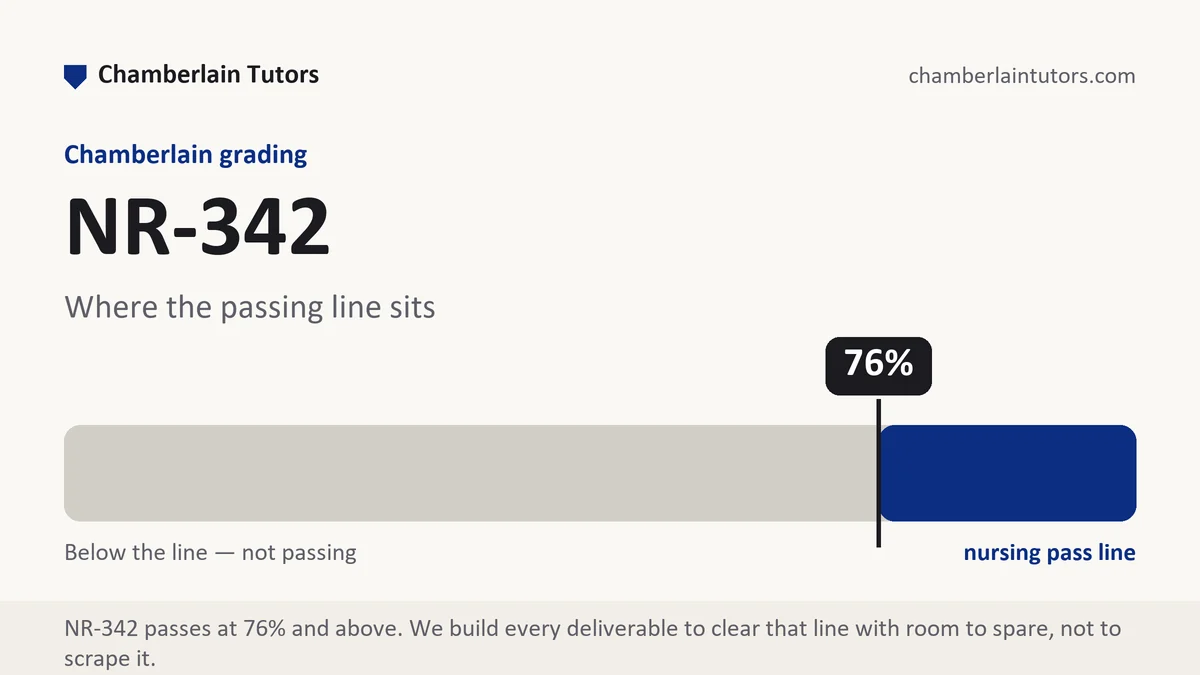
What NR-342 Week 6 asks for
Where does a metabolic emergency hide before it declares itself? Our tutors teach this week from a home health scene. A nurse visits a widower three weeks into a new diuretic after a heart failure admission. His ankles look better, which pleases him, but his notebook of daily weights shows five pounds gone in six days, he steadies himself on the counter when he stands, and he mentions his legs cramped him awake twice this week. Nothing in the room beeps. The visit nurse who charts improved edema and leaves has read the surface. The one who reads the weight slope, the orthostatic wobble and the cramps as one chemistry problem, holds the next dose, and calls the prescribing clinic before leaving the driveway has done what this week trains. Renal and metabolic writing is the craft of making an invisible emergency visible in prose, using numbers most patients never feel.
The week braids three strands. The kidney strand: acute injury sorted by where the insult sits, before, within or beyond the organ, and why urine output is the cheapest early-warning system in the building. The glucose strand: the two diabetic crises, one acid-driven and fast, one osmolar and slow, and the assessment trail that tells them apart. The electrolyte strand: potassium, sodium and friends, each with a direction, a speed and a set of findings, and each capable of ending a case on its own. Deliverables at this stage typically supply a laboratory panel with a clinical vignette and ask for interpretation, prioritization and a nursing plan, or ask you to trace one crisis from mechanism to resolution in care-plan form.
The graded skill underneath all three strands is assigning meaning to numbers in context. A potassium value is not high or low in the abstract; it is high for a patient on this medication with this kidney function and this rhythm risk. Papers that interpret each laboratory value against the patient rather than against the reference column read a full level above papers that do not, and that single habit is worth more this week than any memorized list. The bedside layer of the course, your dialysis observation days, your medication passes, your 96 hours and everything your instructor countersigns, remains your own real work; this manual serves the written argument only.
The NR-342 Week 6 method, step by step
How do you turn a lab panel and a vignette into an argued paper? Six moves.
-
Pair every laboratory value with a bedside finding
Before interpreting anything, build a two-column inventory: the number, and the assessment finding that corroborates or contradicts it. A value with a matching finding is a confirmed problem; a value standing alone is a question to flag. This pairing is the week's core discipline.
-
Sort the kidney problem by location of insult
Say whether the data point to a supply problem before the kidney, damage within it, or obstruction beyond it, and name the finding that sorts it. The location decides the nursing priorities, so the sort must come before the plan.
-
Name the crisis by its mechanism and its speed
If glucose is the axis, commit to which crisis the data describe and say how fast it moves, because tempo governs monitoring intervals and escalation urgency. A slow osmolar emergency and a fast acid-driven one demand different clocks, and your paper is graded on knowing which clock is running.
-
Rank the electrolyte risks by what they can stop
Not all deranged values are equal. Order them by consequence, with rhythm-threatening derangements first, and defend the ranking in a sentence each. This is the priority row of the rubric wearing chemistry clothes.
-
Write the fluid logic explicitly
Volume in, volume out, and which compartment the problem lives in. State what you would monitor as fluids run, and which finding would mean the correction itself is becoming the hazard, since overcorrection is the classic error of every strand this week.
-
Close with the surveillance chemistry cannot skip
Name the values to be redrawn, the outputs to be measured, the rhythm watch where potassium is involved, and the intervals for each. A metabolic plan without scheduled remeasurement is a guess wearing a plan's clothing.
A layout and word budget for a metabolic case analysis
What shape should the paper take? Our frame for a renal or metabolic analysis of roughly 950 to 1,150 words follows. It is our own outline rather than anything the university issues, and your week's rubric outranks it wherever the two disagree.
| Section | What belongs in it | Word target |
|---|---|---|
| Paired inventory | Each significant laboratory value set beside the bedside finding that confirms or questions it, in a readable sequence. | 170 to 200 |
| Kidney sort | The insult located before, within or beyond the organ, with the deciding data named and the urine output trend read aloud. | 150 to 180 |
| Crisis and tempo | The metabolic crisis named by mechanism, with its speed stated and the monitoring clock that speed demands. | 150 to 180 |
| Ranked risks | Electrolyte derangements ordered by consequence, each with one defending sentence and its rhythm implication where relevant. | 160 to 190 |
| Fluid and correction logic | The volume plan with its compartment reasoning, the overcorrection hazard named, and the watch findings during correction. | 200 to 240 |
| Remeasurement schedule | Redraws, output measurement, rhythm surveillance and intervals, with the value that triggers the next escalation. | 110 to 140 |
Evidence craft for renal and metabolic writing
Do reference ranges need citations? The ranges themselves live in your course materials and laboratory reports, but every claim about consequence does need a source: that a given derangement threatens rhythm, that a crisis corrects at a bounded rate, that output below a threshold signals injury. Cite the course text or the guideline in the sentence carrying the claim, with a year, because thresholds and correction practices are exactly the knowledge that revises over time.
Write values with their units and their trend. A creatinine has a unit, a prior value and a direction, and all three belong in the sentence. Doubling matters more than the absolute number in an acute injury argument, and a paper that quotes single values without trajectories has hidden its own best evidence.
Show the osmolar and acid logic in one sentence each. When your case involves a glucose crisis, one plain-language sentence on why water follows glucose, or why the body breathes off acid, demonstrates the mechanism understanding the rubric pays for. Borrowed jargon without the mechanism sentence earns the opposite impression.
Keep home and clinic observations as texture, cited knowledge as proof. A de-identified detail like a weight notebook or a cramping complaint can open an argument the way our home health scene opened this page, but the argument's weight rests on published sources. If your section invites practice examples, strip every identifier and let the literature carry the conclusion.
Five mistakes that cost points in this week's territory
- Interpreting the panel against the reference column alone. Values read without the patient's medications, kidney function and rhythm risk produce conclusions the case itself contradicts.
- Skipping urine output. The cheapest kidney datum is the one most papers forget to trend, and its absence guts an acute injury argument.
- One clock for both crises. Writing the slow crisis with the fast crisis's urgency, or the reverse, signals pattern-matching rather than mechanism.
- Correction without a hazard watch. Every fluid and electrolyte fix can overshoot, and plans that never name the overcorrection finding read as half-plans.
- Flat lists of deranged values. Ten abnormalities presented as equals hide the one that can stop the heart, and the rubric's priority row is built to notice.
Before you submit
- Every significant value is paired with a bedside finding or flagged as unconfirmed
- The kidney insult is located with its deciding data named
- The crisis carries both a mechanism and a tempo
- Electrolyte risks are ranked by consequence, not listed
- The correction plan names its own overshoot hazard
- Redraws, outputs and rhythm surveillance have stated intervals
In the metabolic week of NR-342?
Send the panel, the case and the rubric out of Canvas. A premium original draft comes back in 24 to 48 hours with the values paired, the risks ranked and the correction logic argued, and revisions run until the grade lands.