NR-342 Week 1 is where a complex adult health course teaches you to see trouble before the monitor announces it, and the opening written work usually turns on recognition: which assessment findings signal a stable patient drifting toward an unstable one, and in what order a nurse acts on them. NR-342 is the expanded-clinical variant of Chamberlain's complex adult health sequence, carrying 96 clinical hours, so the written layer runs beside a heavy bedside schedule from the first week. Your section may print this as NR 342 or NR342; it is the same course. Chamberlain publishes no syllabi outside Canvas. The placement here is our teaching judgment from the course's catalog arc; your section's rubric decides what your week actually asks.
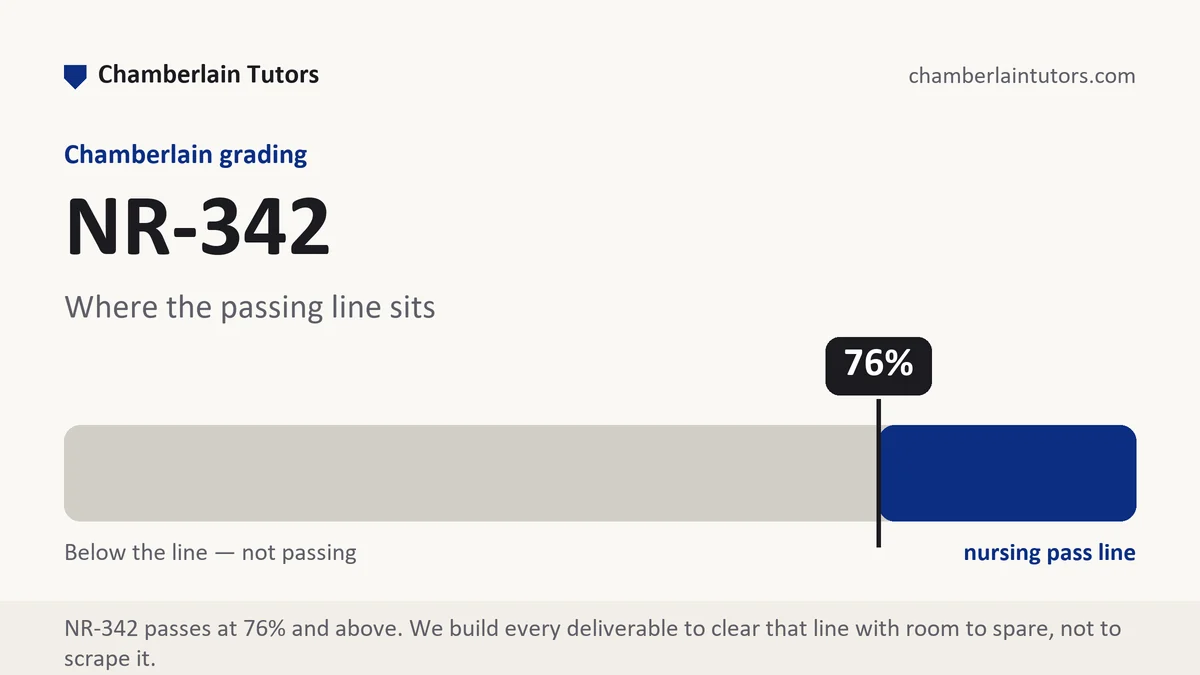
What NR-342 Week 1 asks for
What does an opening week in critical and emergent adult care actually want from your writing? Picture the scene our tutors use to explain it: a man walks into a community urgent-care clinic saying his asthma is acting up. He is speaking in four-word sentences, sitting forward with his hands braced on his knees, and his respiratory rate is climbing while everyone waits for the nebulizer. The clinic nurse who writes that patient up as an asthma flare has described him. The nurse who writes that his posture, sentence length and rising rate together signal impending respiratory failure, and who names transfer as the priority over another breathing treatment, has recognized him. Week 1 written work in this course lives in the gap between those two write-ups.
Because this is a clinical course, the opening stage usually splits into two layers. The bedside layer, your 96 hours, your patient assignments, your paperwork for the clinical site, is entirely your own real work and no manual touches it. The written layer is what this page covers: the prep sheets, priority-setting exercises, early case analyses and posted responses that ask you to reason on paper about a deteriorating adult. Early deliverables tend to be short and diagnostic, because faculty want to see your clinical reasoning in prose before the multisystem weeks arrive.
The habit to install now is ordered noticing. Undergraduate assessments reward a specific sequence: cue, cluster, priority, action, rationale. A paragraph that lists twelve findings in the order you happened to notice them reads like a transcript. A paragraph that clusters three findings into a pattern, names the pattern, and states the first nursing action with its reason reads like judgment, and every rubric in a course at this level has a row that is really asking for that shape.
The NR-342 Week 1 method, step by step
How do you turn a recognition exercise into scoring prose? Six moves.
-
Read the scoring rows before the case
Copy each rubric row into your draft as a heading and reduce it to its verb. Identify, prioritize, and support are different depths of work, and a row asking you to support means a textbook or guideline citation belongs in a paragraph most students write from lecture memory.
-
List every cue the case gives you, then cluster before you interpret
Pull vital signs, assessment findings and history into one raw list. Group them by system before you name any problem. Clustering first is what stops you from anchoring on the loudest finding and missing the quieter pair that changes the priority.
-
Name the pattern with a nursing label, not a medical diagnosis
Your scope on paper mirrors your scope on the floor. Write impaired gas exchange or decreased perfusion rather than pronouncing a diagnosis, and let the physician-level language appear only where the case itself supplies it.
-
Rank using a framework and say which one
Airway, breathing, circulation; acute before chronic; unstable before stable; actual before potential. Whichever framework orders your priorities, name it in the sentence so the grader can check your ranking against a standard instead of guessing at your logic.
-
Attach one action and one rationale to each priority
The action needs a verb a nurse can perform and the rationale needs a mechanism: reposition to open the airway because, apply oxygen because, escalate because. An action without a because is an order; with one, it is reasoning.
-
Close with the reassessment you would run
Deterioration writing is a loop, not a line. Say what you would recheck, at what interval, and which finding would tell you the intervention failed and escalation is next. That closing loop is the most commonly forgotten scoring point in opening-week work.
A layout and word budget for a deterioration write-up
What does the finished piece look like? Below is the frame our tutors keep beside an opening recognition exercise, sized for roughly 800 to 1,000 words. It is our own outline rather than anything the university issues, and your week's rubric outranks it wherever the two disagree. Scale proportionally if your assigned length differs.
| Section | What belongs in it | Word target |
|---|---|---|
| Situation in one frame | The patient, the setting and the presenting concern in two or three sentences, no findings yet. | 60 to 80 |
| Cue inventory | The abnormal and pertinent normal findings, clustered by system rather than listed in discovery order. | 150 to 180 |
| Pattern and priority | The problem the clusters point to, stated in nursing language, with the ranking framework named. | 160 to 190 |
| Actions with rationales | Two or three nursing actions in order, each carrying a because clause with a mechanism inside it. | 200 to 240 |
| Escalation line | Who you would notify, with which exact findings, and the communication format you would use. | 110 to 140 |
| Reassessment loop | What you recheck, the interval, and the finding that would mean the plan is failing. | 90 to 120 |
Evidence craft for recognition writing
Where does support belong in a case exercise? In the rationale, every time. The claim that a rising respiratory rate is the earliest sign of deterioration is a published finding, not folklore, and a citation to your course text or a nursing guideline turns your because clause from opinion into evidence. One source per rationale is a workable floor.
Quote parameters, not impressions. Write the numbers the case gives you: a rate of 28, a pressure of 88 over 52, a saturation of 89 on room air. Vague adjectives like tachypneic and hypotensive without values force the grader to trust you, and clinical writing at this level is graded on whether the reader could verify you.
Keep your clinical days out of the evidence chain. If your section invites examples from your 96 hours, use them as illustration with every identifier stripped, never as proof. A scene from your clinical placement can show a pattern operating; it cannot establish that the pattern exists. The published literature does that.
Cite the assessment standard you rank against. Priority frameworks come from somewhere. Naming the framework and its source in one clause costs a dozen words and converts your ranking from instinct into method, which is exactly the distinction opening-week rubric rows are built to detect.
Five mistakes that cost points in this week's territory
- Narrating instead of clustering. A tour of findings in the order the case revealed them earns description credit only. Grouping is the graded skill.
- Diagnosing beyond scope. Pronouncing a medical diagnosis on paper loses the same points it would lose you on the floor. Stay in nursing language unless the case hands you the label.
- Actions without mechanisms. Apply oxygen is an order sheet. Apply oxygen because falling saturation with rising rate signals failing compensation is an answer.
- No escalation threshold. Writing that you would monitor closely without naming the finding that triggers the call reads as hedging, and hedging scores as incomplete.
- Forgetting the loop. Every intervention needs its recheck. A plan that ends at the action has answered half the question the week is asking.
Before you submit
- Findings appear clustered by system, not in discovery order
- The priority problem is stated in nursing language
- The ranking framework is named in the sentence that uses it
- Every action carries a because clause with a mechanism
- An escalation threshold names the finding and the recipient
- Each rationale is supported by a cited course text or guideline
Starting NR-342 this week?
Send the instructions and the rubric out of Canvas. A premium original draft comes back in 24 to 48 hours with the clusters built and the rationales cited, and revisions run until the grade lands.