NR-330 Adult Health II is a six credit course, three theory and three clinical, with a 144 hour clinical block behind it. Your hours are attested on their own track. Your Canvas grade is assembled almost entirely from what you write about alterations in life processes, the clinical decisions those alterations force, and the discharge plan that has to hold up after the patient goes home.
What NR-330 actually grades
The catalog puts NR-330 in the adult health sequence as the heavier clinical partner to NR-325, at 144 clinical hours, and flags it for California residents. That structure is the whole story of the course. The hours are real, they are long, and they are yours alone. The grade, though, is built out of writing, and the catalog names the three things that writing has to carry: alterations in life processes, clinical decision making, and discharge planning.
Read those three as one chain rather than three topics. A week that hands you a blood sugar that will not settle, a wound that keeps reopening, or a patient going home on four medications she has never taken is asking the same underlying question each time. What moved off baseline in this body, what did that movement force you to decide at the bedside, and what has to be in place before this person walks out of the unit. A submission that answers only the first reads as a pathophysiology summary written by someone who never met the patient, and it lands mid scale however correct it is.
How we help in this course
One boundary before anything else, because this course carries a clinical block. We do not complete clinical hours, contact a site or an instructor, sign paperwork, or put anything in an hour log. Those belong to you and to your school, and no part of this service touches them.
What we do is the written layer. We read your week's rubric against the prompt, draft the analysis or plan it asks for, and walk you through why each section is shaped as it is so the next week takes half as long. In a six credit course that meets in a hospital and grades on paper, the writing is where points move, and it is the piece competing with a twelve hour shift for whatever attention is left.
How to write this course's deliverables
Everything below is method, not pitch. It works whether you hand the week to us or sit down with it yourself at eleven at night after a clinical day. Open the scoring guide first, build a section plan from its rows, then write the patient story into that plan. Doing it in the other order is why capable nurses lose points in a course whose content they already handle at work.
In NR-330 right now?
Send the week and the rubric from Canvas. First premium sample free, floor-checked, back in 24 to 48 hours.
The 76 line in a six credit course
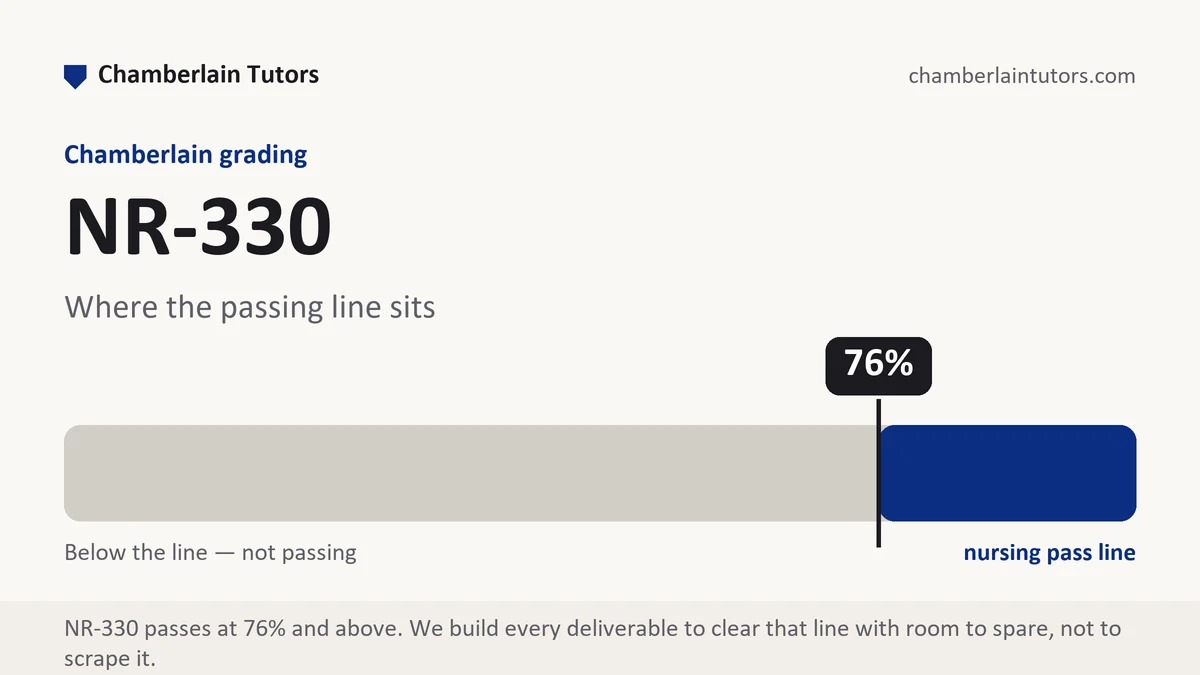
Core nursing courses pass at 76 percent. That number is unforgiving in NR-330 for a reason that has nothing to do with difficulty: six credits weigh more in a term average than anything else you are carrying, so a soft grade here follows you further than a soft grade in a three credit course. Supplementary work cannot rescue a weak weighted average, which means the recovery has to happen inside the graded pieces while they are still in front of you.
The calendar makes that tighter than it sounds. Chamberlain runs sixteen week semesters split into two eight week sessions, with up to six starts a year, and deliverables land weekly. Eight weeks of graded work means every submission is a meaningful fraction of the total, with no long tail at the end to average away a rough start. Add the board rule, that a post cannot be edited once submitted, and the instruction becomes simple. Draft everything somewhere else first. Canvas is where finished work goes, not where it gets written.
Read the scoring guide before the patient story
The prompt tells you what the assignment is about. The scoring guide tells you what it is worth, and only one of those is the instrument your grader uses. Copy the criterion rows out of Canvas into a blank page, one per line, and reduce each to the verb inside it: identify, analyze, prioritize, justify, plan, evaluate. Those verbs are your headings, kept in the order the guide lists them, so a grader working top to bottom meets your sections in the sequence the rows appear.
Then convert the weights into words, because a percentage is a depth instruction with a percent sign attached. Say your week caps the paper at 1,200 words and the guide carries five rows weighted 30, 25, 20, 15 and 10 percent. Multiplying through gives you roughly 360 words for the first row, 300 for the second, 240 for the third, 180 for the fourth and 120 for the last. Write those five numbers in brackets beside your headings and delete each bracket only when the section reaches its share.
The arithmetic will annoy you, and that is the point. The heaviest row here is usually the reasoning or planning row, while the row students most enjoy writing is the background one, where you explain the disease you just spent three shifts watching. Giving background 400 words and the discharge plan 120 inverts the guide precisely.
The shape of a discharge and transition plan
Most graded writing in NR-330 is a plan of care or a discharge and transition document wearing one costume or another. The parts below turn up in nearly all of them, and each one has a job that a grader can either find on the page or fail to find.
| Part | What it has to prove | How the weak version reads |
|---|---|---|
| The patient in two sentences | Age band, admitting problem, the alteration you are working from, and the reason discharge is not simple. No identifiers. | A full chart dump, or a patient so generic the plan would fit anyone. |
| The alteration, named at system level | Which normal process moved off baseline and how far, stated in the terms the course teaches rather than as a diagnosis label repeated. | The diagnosis restated in different words, with no physiology attached. |
| Assessment findings that follow from it | The findings you actually gathered, each one traceable to the alteration above it, including the ones that were normal and mattered. | A vital sign list copied forward with no interpretation. |
| The decision and its justification | What you did or would do first, why that before the alternative, and what evidence or policy supports the choice. | A list of interventions in no particular order, all equally weighted. |
| The discharge plan, made specific | Medications reconciled, teaching topics chosen for this patient's actual risk, follow up owned by a named role, equipment and transport handled. | Generic teaching that would print identically for every patient on the unit. |
| Barriers and the response to them | What could realistically undo the plan at home, cost, literacy, transport, caregiver absence, and the specific adjustment you make for each. | Barriers listed and then never answered. |
| How you would know it worked | The observable marker you would check at follow up, with a time frame on it. | A closing line about continuity of care that measures nothing. |
Evidence and citation craft in adult health
Adult health writing is judged partly on how carefully you handle other people's findings. Four habits carry most of the difference between a paper that reads as evidence based and one that only says it is.
-
Check currency instead of assuming it
Unless your guide says otherwise, treat any source older than five years as needing a reason to be on the page, and put that reason in the sentence. Practice guidelines and drug references age fastest, and a teaching plan built on a superseded guideline is wrong in a way graders here notice immediately. A classic description of a physiologic process earns its place; a fifteen year old readmission figure does not.
-
Say what produced the finding before you say what it found
A result arriving with no history behind it reads as an opinion with a citation stapled to it. Name the design and the sample first. Writing that a randomized trial of 612 adults discharged after a heart failure admission tested a pharmacist led medication review costs you fourteen words and converts a claim into evidence a grader can weigh.
-
Match the verb to the design
Observational work supports was associated with, occurred more often among, and predicted. Only controlled designs support caused, prevented, or reduced. Discharge planning literature is thick with observational studies, so this is the easiest place in NR-330 to overstate. Saying follow up calls prevented readmissions when the study only observed fewer of them is a reasoning error, and it reads as one.
-
Give every rate a denominator and a window
A percentage with no base and no time frame is decoration. Write that 88 of the 740 patients discharged on the regimen returned within thirty days rather than that readmissions ran at 12 percent. The longer version names the population and the clock, and in a course built on transitions the clock is half the meaning.
What separates a passing plan from a strong one
A passing NR-330 submission is accurate. The pathophysiology is right, the interventions are real, the citations exist, and nothing in it is wrong. That is also the exact profile of a paper that sits a few points above the floor all term and leaves you doing arithmetic in week seven.
Strong submissions differ in three visible ways. They commit to one patient and go deep instead of gesturing at a category. Every statement in the back half traces by finger to a finding or an alteration named in the front half, so the plan reads as something that grew out of this patient rather than something picked off a menu. And the recommendations are specific enough to act on: which medication you would have the patient repeat back first, which symptom triggers a call rather than a wait, who owns the follow up and by when. Depth, traceability, consequence.
Six mistakes that cost points in NR-330
- Writing the disease instead of the patient. The course grades alterations in life processes, which means this body, this week. A textbook account of the condition with the patient bolted on at the end inverts the assignment.
- Leaving the decision unjustified. Naming what you did is documentation. Saying why that action came before the obvious alternative is clinical decision making, and only the second one is being scored.
- Generic discharge teaching. Teaching points that would print identically for every patient with the diagnosis tell a grader you never looked at this person's home, budget, reading level or caregiver.
- Posting to a discussion board straight from the box. Posts do not reopen once submitted at Chamberlain. Write it in a document, read it once out loud, then paste the finished version.
- Letting clinical days eat the writing window. A 144 hour block front loads exhaustion. The weeks that go wrong are the ones where the paper starts after the last shift instead of beside it.
- Reference list drift. Every entry has to appear in the text and every in text citation has to appear in the list. Graders check that mechanically, and it is free margin you should never hand back.
What NR-330 students ask us
How much detail about my real patient am I allowed to put in the paper?
My clinical week and my paper are about different patients. Is that a problem?
I keep landing just above 76 and I need the cushion. Where does it come from?
Where NR-330 sits in Chamberlain's programs
Open the exact program map for sequence, credit, and option context. The current student schedule and syllabus remain authoritative after transfer evaluation, electives, state rules, and approved plan changes.
The weeks, one by one
Week 1
NR-330 is Adult Health II carried at 144 clinical hours, the version the catalog flags for California cohorts, and its territory is alterations in life processes, clinical decision making and discharge planning. Read the full Week 1 manual.
Week 2
The written work at this stage asks you to explain why the patient looks the way he looks, in cited mechanism language, before you claim to know what to do about it. Read the full Week 2 manual.
Week 3
The catalog names clinical decision making as a spine of this course, and this is the stage where it becomes a written product rather than a phrase. Read the full Week 3 manual.
Week 4
Alterations in life processes rarely announce themselves in one reading; they drift, and a course backed by 144 clinical hours gives you enough consecutive floor time to watch drift happen and enough material to write about it with authority. Read the full Week 4 manual.
Week 5
A course built on 144 clinical hours puts you inside dozens of real handoffs, and the written version asks you to expose the selection and ordering logic that good ones run on. Read the full Week 5 manual.
Week 6
It is clinical decision making pointed at the future, and the 144 clinical hours behind this course supply the textured floor knowledge that makes a forecast specific rather than generic. Read the full Week 6 manual.
Week 7
The genre tests whether you can translate everything a hospital does automatically into things a household can actually sustain, and the deep clinical exposure of a 144-hour course is what gives your translation its realism. Read the full Week 7 manual.
Week 8
The closing week usually also carries final assessment pressure, so the writing method here includes a budget for studying while a paper is due. Read the full Week 8 manual.