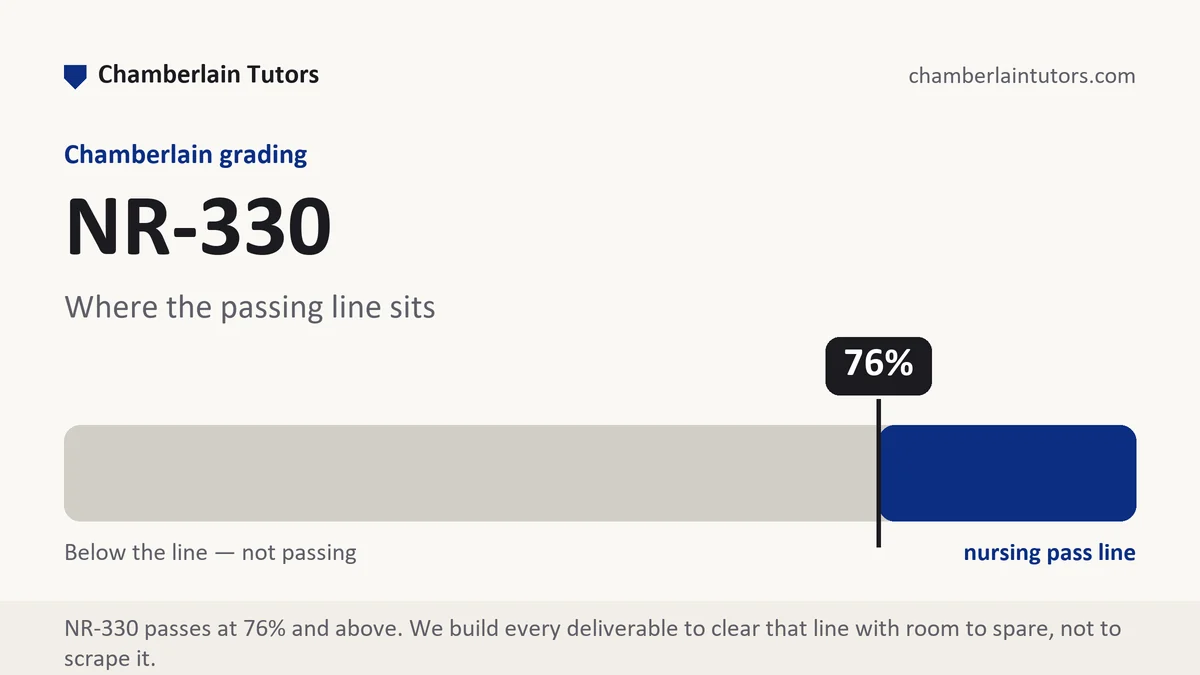
NR-330 Week 3, in our teaching judgment, moves from explaining patients to deciding about them: the clinical decision brief, a short written argument that defends one nursing decision, made under real constraints, with the data, the options, the rule applied and the safety net all on the page. The catalog names clinical decision making as a spine of this course, and this is the stage where it becomes a written product rather than a phrase. Your section may print this as NR 330 or NR330; it is the same course. Chamberlain publishes no syllabi outside Canvas. The placement here is our teaching judgment from the course's catalog arc; your section's rubric decides what your week actually asks.
What NR-330 Week 3 asks for
It is 2100 on a telemetry floor and the medication cart is parked outside room 12. The scheduled antihypertensive is due for a 66-year-old woman two days past a hip replacement, and the blood pressure your tech just handed you is sitting low against her trend. Not alarmingly low. Low enough that giving the dose and holding the dose are both defensible sentences. The order has hold parameters, the reading sits just above them, the patient had her first walk today and drank little since lunch, and the covering provider is one page away. Whatever you decide, the decision has a structure, and this week's written work asks you to expose that structure in prose.
A clinical decision brief is not a care plan and not a reflection. It is an argument with five working parts: the situation compressed to its decision-relevant facts, the genuine options available at that moment, the criteria that separate them, the decision with its rule stated, and the safety net, what you watch afterward and what would tell you the decision was wrong. Faculty set this kind of task in the middle third of an adult health course because it examines something care plans cannot: whether you can reason under a constraint where the textbook answer is give the medication as ordered and the floor answer is it depends, and show your work between the two.
Notice what the deliverable does not ask. It does not ask you to make provider decisions; the nursing decision here is whether to administer within parameters, what to assess first, when to clarify an order and when to call. Writing that boundary accurately is itself graded territory. Briefs that quietly drift into prescribing, changing a dose, choosing a drug, read as a student who has not located the nursing role inside the decision, and that costs more than any amount of confident pharmacology can buy back.
Your clinical days are the quiet fuel here. A course carrying 144 hours puts you next to dozens of these moments, nurses deciding at the cart, at the bedside, at the phone, and the brief you write will be textured by how closely you watched. The hours and everything documented inside them are your own work alone; the brief is the written layer where a manual can help.
The NR-330 Week 3 method, step by step
Six moves that turn a judgment call into a graded argument.
-
Compress the situation to decision-relevant facts
Open with only the data that bears on this decision: the trend, the parameter, the timing, the fluid picture, the mobility event. A brief drowning in full-assessment detail signals that you cannot tell which facts are doing work, and selection is the first skill this format grades.
-
Enumerate the real options, including the unglamorous ones
Give the dose, hold and reassess in thirty minutes, clarify the order, call now. List every option a reasonable nurse would actually consider, with one honest sentence each. Briefs that present a single option and defend it are advocacy; the format wants deliberation.
-
Name the criteria before applying them
State what separates the options: patient safety first, then the parameter's intent, then reversibility, then workload realities last if at all. Criteria declared in advance make your conclusion checkable; criteria invented after the choice make it decorative.
-
Rule, and show the rule touching the data
Write the decision as criteria applied to facts: because the reading sits above the written parameter but the trend is falling and the likely cause is volume, the safest sequence is assessment and fluids conversation before the dose. One paragraph, every clause traceable.
-
Build the safety net in writing
Specify what you monitor after the decision, at what interval, and the exact finding that would trigger escalation. A decision without a net is a bet; a decision with a net is clinical judgment, and the net is often the most heavily weighted paragraph in the rubric.
-
Audit the decision against the wrong-call scenario
Close with two sentences: if this decision is wrong, how will it show, and how quickly is it reversible. This is the maturity move of the brief, and it converts confidence into judgment on the page.
A layout and word budget for a decision brief
The frame below sizes a written product of roughly 900 to 1,100 words. It is our own outline rather than anything the university issues, and your section's rubric outranks it wherever the two disagree.
| Component | What belongs in it | Word target |
|---|---|---|
| Decision moment | The scene at its decision point, de-identified, with only the facts that bear on the call. | 120 to 150 |
| Option field | Three or four genuine options, each with one sentence of honest appraisal. | 150 to 190 |
| Criteria declaration | The ordered principles that will separate the options, stated before any are applied. | 90 to 120 |
| The ruling | The decision argued as criteria meeting data, with the nursing scope boundary explicit. | 180 to 220 |
| Safety net | Post-decision monitoring with intervals, escalation triggers, and who gets called at which finding. | 150 to 190 |
| Wrong-call audit | How error would announce itself, how reversible the decision is, and what you would do differently at the first sign. | 90 to 120 |
Evidence craft for decision writing
Support the criteria, not just the physiology. The mechanism sentences in a brief take textbook citations as usual, but the decision logic deserves support too: safe medication administration practice, clinical judgment frameworks your program teaches, and current practice references all anchor the reasoning layer. A brief cited only at the physiology level is half supported.
Write parameters exactly. Hold parameters, target ranges and thresholds are quoted precisely or not at all, with their source in the sentence, the order set in the case, the reference text, never from memory. A misquoted threshold in a decision brief is the single fastest credibility loss available in this format.
Time-stamp the data doing the work. A falling trend is three readings with times attached, not an adjective. When your argument leans on trajectory, show the trajectory: the values, their spacing, and the interval over which the change occurred.
Keep the provider's reasoning out of your mouth. Write what you would report and ask, not what the provider would decide. The evidence discipline of a nursing decision brief includes staying on the nursing side of every sentence, and graders in this course read for exactly that line.
Five mistakes that cost points in this week's territory
- The single-option brief. Defending the choice you made without displaying the field you chose from converts deliberation into advocacy and forfeits the format's central rubric row.
- Criteria invented after the verdict. Reasoning that appears only in service of a conclusion already reached is visible to any grader who reads the paragraph order.
- Scope drift. Sentences that adjust doses or select therapies place the decision outside the nursing role and cost more than they demonstrate.
- Nets with no mesh. Monitor closely is not a safety net; intervals, parameters and named escalation triggers are.
- Certainty cosplay. A brief that admits no wrong-call scenario reads as a student who has not yet stood at the cart at 2100, and the missing humility is scored as missing judgment.
Before you submit
- Only decision-relevant facts appear in the opening scene
- At least three genuine options are appraised honestly
- Criteria are declared before they are applied
- The ruling paragraph touches both the criteria and the data
- The safety net carries intervals, thresholds and named escalation
- The wrong-call audit says how error would show and how fast
Arguing a decision for NR-330?
Send the scenario and the rubric out of Canvas. A premium original draft comes back in 24 to 48 hours with the option field displayed, the ruling argued inside nursing scope and the safety net built, and revisions run until the grade lands. Clinical hours and signatures stay yours alone.