NR-566 Week 8 gathers the whole course into one patient, or one household: the polypharmacy case, where every class you studied is on the same medication list and the graded act is subtraction as much as prescribing. Expect a reconciliation, an interaction read that reports only what changes decisions, a prioritized problem list, and a deprescribing plan that moves one change at a time. Your section may print this as NR 566 or NR566; it is the same course.
Chamberlain publishes no syllabi outside Canvas. The placement here is our teaching judgment from the course's catalog arc; your section's rubric decides what your week actually asks.
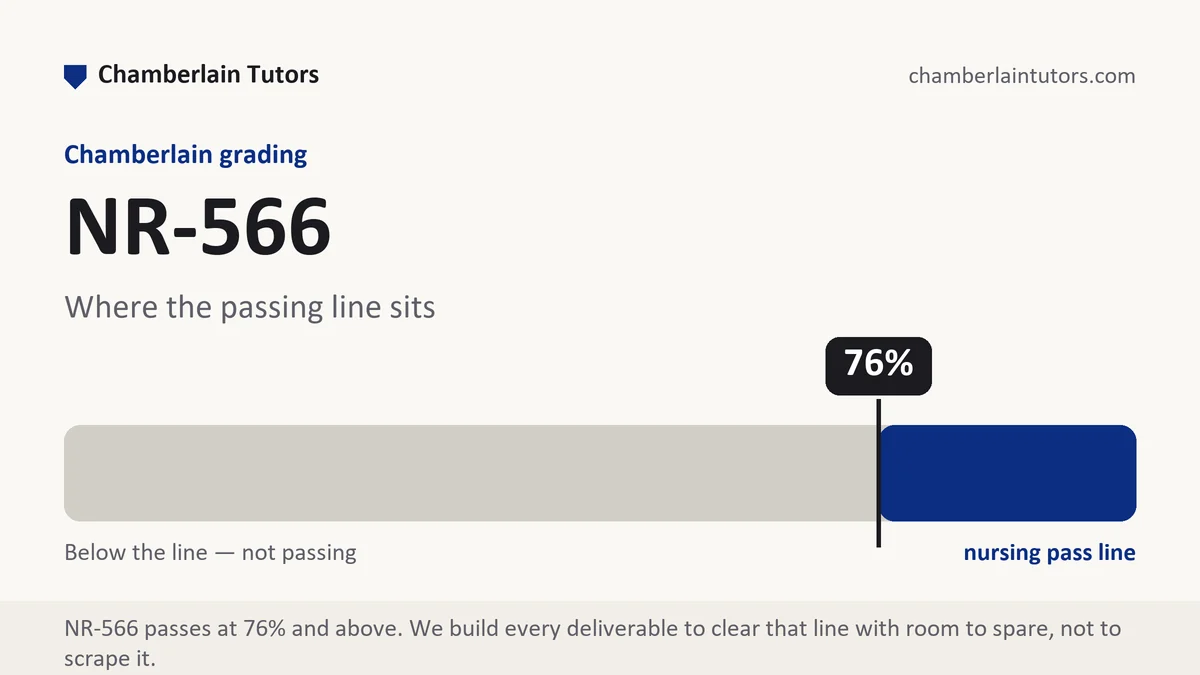
What NR-566 Week 8 asks for
Every applied pharmacology arc ends by putting its weeks in one room. The closing case is typically an older adult on many agents, sometimes a family where a grandmother, a daughter and a child each carry prescriptions that interact with the household's habits and budget, and the assignment is synthesis: seeing the list as a system, deciding what stays, what goes, what changes, and in what order. Our judgment places this in the final week because it cannot be written until the agent classes exist in your head.
Your week's rubric decides the exact wrapper: one extended case response, a staged plan, sometimes a reflective component closing the course. The graded spine, though, is stable: an honest reconciliation including everything bought without prescriptions, an interaction analysis that filters noise from signal, a problem list ranked by risk to this patient, and changes sequenced so that when something shifts, you know which change did it.
The session also ends here, and the arithmetic is unforgiving in both directions: on the specialty scale, 84 closes the course as a pass and 83 does not, so the final deliverable is written with the gradebook open. A strong closing case has rescued many sessions; treat the word budget as the scarce clinical resource it is.
The NR-566 Week 8 method, step by step
Six moves from a crowded list to a sequenced plan.
-
Reconcile everything, including the unprescribed
Every agent with dose and schedule, plus the supplements, the borrowed pills and the leftover courses a real household holds. The reconciliation is the evidence base for the entire response, and its gaps become your plan's blind spots.
-
Screen for interactions, then filter for consequence
Run the full list, but report only the interactions that would change a decision for this patient, each with its mechanism and its clinical meaning. A pasted screening printout is data; the filtered three lines are judgment.
-
Rank the problems by risk to this person
Falls before numbers, bleeding before convenience, the drug causing the symptom another drug now treats. The ranking sentence at the top of your plan tells the grader whether the course's lifespan thinking arrived intact.
-
Deprescribe with the same rigor as prescribing
For each agent leaving: why now, taper or stop, what might return, and what you will watch. Withdrawal has its own pharmacology, and the rubric knows it even when the prompt does not say the word.
-
Sequence one change at a time
Order the changes, date them, and defend the order: the riskiest problem first, the attributable effect preserved. Simultaneous changes are the signature error of synthesis cases because they make every outcome unreadable.
-
Rebuild monitoring and teach the household
The labs and checks the surviving list requires, on a calendar, and the teaching written for whoever manages the pillbox, which is often not the patient. Family-level teaching is the catalog's culture-and-family promise landing in its final week.
A structure for the polypharmacy case response
Desk planning lengths for a 900 to 1,150 word synthesis response. Planning figures rather than Chamberlain rules; where the rubric weights differently, follow it.
| Part | What it carries | Suggested length |
|---|---|---|
| Reconciliation | The complete list with doses, schedules and the unprescribed layer, stated as findings. | 130-160 words |
| Interactions that matter | The filtered, consequential interactions with mechanism and clinical meaning. | 130-170 words |
| Prioritized problem list | The medication problems ranked by risk to this patient, with the ranking defended. | 110-150 words |
| Deprescribing plan | Each departure with its reason, taper decision, rebound watch and safety net. | 140-180 words |
| Sequence and dates | The one-at-a-time order laid on a timeline, with the logic stated. | 90-120 words |
| Monitoring and household teaching | The rebuilt lab calendar and the pillbox-level teaching for the family. | 110-150 words |
Evidence and citation craft for the synthesis case
Use the published criteria for older adults by name and year. The consensus lists of potentially inappropriate medications are versioned documents that change between editions. Citing the current version, and quoting which criterion your patient's agent triggers, is the precise move this week rewards.
Interaction databases are screening tools; the literature is the evidence. When an interaction drives a decision, follow the database flag down to the case reports or studies beneath it and cite those, with their severity grading. The screen justifies looking; the source justifies acting.
Deprescribing has its own evidence base now. Taper protocols and discontinuation trials exist for the major classes, and citing one turns your withdrawal plan from caution into method. Where evidence is genuinely thin, write that, and let the plan's conservatism be its citation.
Keep absolute risk in the family conversation. Telling a household a medication doubles a risk means nothing without the base rate. Per-year, per-thousand framing, with the source's population named, is both the honest teaching and the graded form.
Five mistakes that cost points in the synthesis week
- Reconciliation that stops at the prescription list. The supplements and shared pills are usually where the scenario hid its interaction, and missing them collapses the analysis built on top.
- Reporting every interaction the screen returns. An unfiltered dump proves the button was pressed, not that judgment occurred, and it drowns the three findings the grader was looking for.
- Stopping multiple agents in one move. When anything changes after simultaneous stops, no one can say which change did it, and the rubric reads the plan as unmonitorable.
- Deprescribing without a rebound watch. Symptoms return, rebound effects are real, and a stop order without a what-to-watch-for line is half a clinical decision.
- Teaching addressed to the chart. If the closing education is not written for the person filling the pillbox each Sunday, the family dimension this course promised from its first week never made it to the last.
The closing audit before submission
- The reconciliation includes doses, schedules and every unprescribed agent
- Only decision-changing interactions are reported, each with mechanism and meaning
- The problem list is ranked by risk to this specific patient, and the ranking is defended
- Every stopped agent has a taper decision and a rebound watch
- Changes sit on a dated, one-at-a-time sequence with its logic stated
- Monitoring is rebuilt for the surviving list and the teaching addresses the household
Final synthesis case deciding your session?
Send the case and rubric from Canvas. A reconciled, sequenced, family-taught polypharmacy response returns in 24 to 48 hours, checked against the 84 line while the gradebook still has room. First draft free.