NR-566 Week 7, in our reading, brings the prescriptions that carry the heaviest counseling load: depression, anxiety, sleep and pain in the family-practice setting. The graded writing pairs an agent choice with its warning conversation, matches follow-up to the risk window rather than the routine calendar, and shows the controlled-substance discipline the earlier legal week installed, now applied to a person in distress. Your section may print this as NR 566 or NR566; it is the same course.
Chamberlain publishes no syllabi outside Canvas. The placement here is our teaching judgment from the course's catalog arc; your section's rubric decides what your week actually asks.
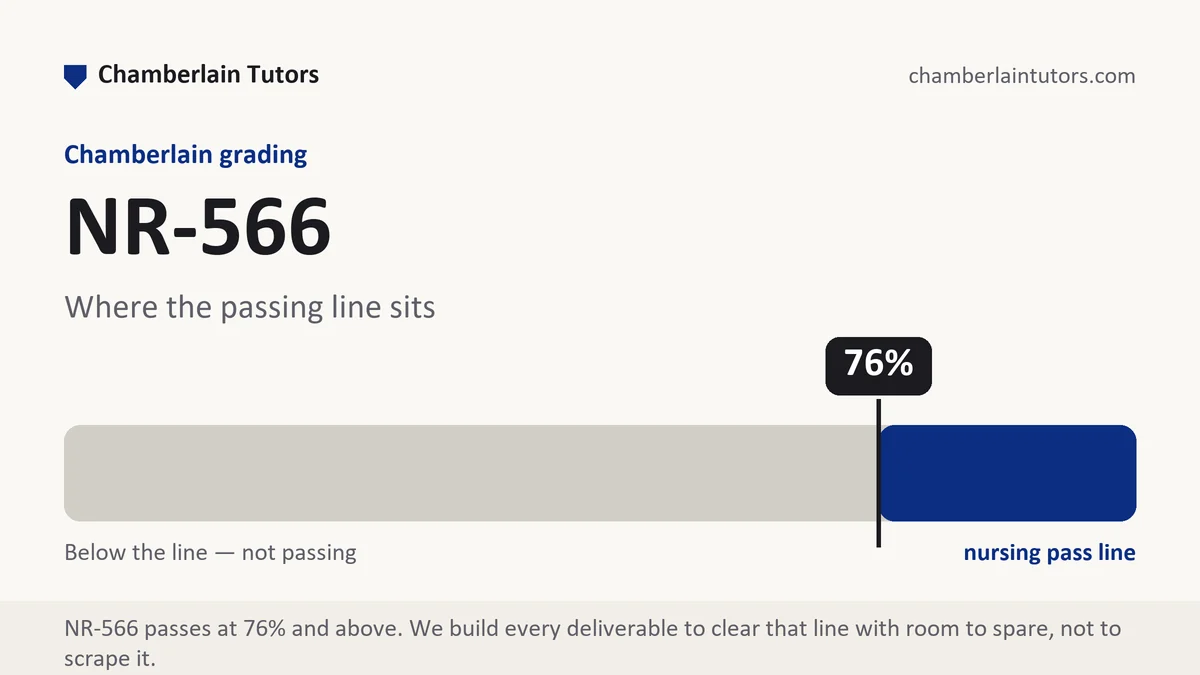
What NR-566 Week 7 asks for
Late in the agent-class run, the arc reaches the territory where pharmacology and communication cannot be separated. Antidepressants work slowly and carry early-phase risks that must be said out loud; anxiety and sleep requests pull toward agent classes the prescriber must sometimes decline; pain sits inside a regulatory and ethical frame the catalog names directly. Case responses here are graded on the pairing: every chemical decision arrives with its human conversation attached.
Likely shapes: a first presentation of depression with screening results supplied, an anxious patient requesting a specific controlled agent, an older adult whose sleep medication is doing more harm than the insomnia, a chronic-pain scenario where the assignment is as much boundary as therapy. Your week's rubric assigns the cases and the format; a discussion, if present, follows the post-once rule that governs every Chamberlain board.
Grading watches two clocks. The first is the risk window: the early weeks after starting or changing these agents are when monitoring must be densest, and follow-up written at routine intervals misses it. The second is the session clock: this is week seven on a scale where 84 passes, and the writing load ahead is known, so precision now is protection later.
The NR-566 Week 7 method, step by step
Six moves where chemistry meets conversation.
-
Read the screening data as given, then add the safety question
Use the scores and history the scenario supplies without inflating them, and document the risk assessment a real visit would include. In this territory, the safety question is part of the prescription, not a separate topic.
-
Match the agent to the person, not the diagnosis alone
Comorbidities, other medications, sleep and appetite pattern, prior response, pregnancy potential, age. First-line classes contain real choices, and the rubric pays for the sentence that says why this one for this patient.
-
Write the warning conversation into the plan
The slow onset, the early side effects that fade, and the boxed-warning discussion for the ages it applies to, phrased as what you would actually say. A warning that lives only in a reference list was never given.
-
Make the controlled-substance decision a decision
If the scenario requests or suggests a scheduled agent, rule it in or out explicitly: the indication, the risks for this patient, the monitoring-program check, and the alternative offered if you decline. Silence on the request is the worst answer available.
-
Compress the follow-up into the risk window
Early contact after initiation, in weeks not months, with what you will ask at that contact. Then the longer arc: when to assess response, when to adjust, when to consider the referral the scenario may be hinting at.
-
Write crisis netting that could actually be used
Specific worsening signs, who to contact and how, stated plainly and respectfully in the patient's language. This paragraph is graded as clinical writing, and generic hotline boilerplate reads as the absence of thought.
A structure for the mental health case response
Desk planning lengths for an 800 to 1,000 word response in this territory. Drafting guides, not Chamberlain specifications; the rubric's weights govern.
| Part | What it carries | Suggested length |
|---|---|---|
| Presentation and screening context | The scenario's scores and history used as given, plus the documented safety assessment. | 110-140 words |
| Agent choice and rationale | The class and molecule matched to this person's comorbidity, age and life. | 130-170 words |
| Risk and warning counseling | Onset expectations, early effects, and the boxed-warning conversation where age requires it. | 110-150 words |
| Controlled-substance handling | The explicit yes-or-no on any scheduled agent, with monitoring checks and the offered alternative. | 100-140 words |
| Crisis netting | Worsening signs and contact instructions, written for the patient, usable at midnight. | 80-110 words |
| Follow-up cadence | The early-window contact with its questions, then the response-assessment schedule. | 90-120 words |
Evidence and citation craft for psychotropic claims
Boxed warnings come from the label; cite the label. The strongest warnings attached to these agents are regulatory text with dates, not textbook paraphrase. Citing current labeling directly, and naming the age bands it covers, is the precision this week is built to teach.
Know who was in the antidepressant trials. Efficacy evidence skews adult and short-term; claims about adolescents, older adults or years-long therapy need sources that actually studied them. Naming the gap when your patient falls in one is graded strength.
Dependence and taper claims need their own sources. How long a scheduled agent can run before dependence, and how it should come down, are studied questions. Cite them separately from efficacy, because they are separate claims doing separate work in your plan.
Suicide-risk language should follow reporting standards. Write about risk plainly, without dramatization, using person-first phrasing and citing the clinical guidance you follow. The tone itself is part of the professional skill being assessed.
Five mistakes that cost points in this territory
- An agent chosen by diagnosis alone. First-line classes hold many molecules, and picking one without a patient-specific reason wastes the row where the week's judgment was supposed to show.
- The boxed-warning conversation skipped for the age it targets. If the scenario's patient sits in the warning's age band, that discussion is mandatory content, and its absence is the heaviest single deduction available here.
- Granting or refusing the controlled request without process. Either decision can be right; what fails is deciding without the risk assessment, the database check and the documented reasoning the earlier legal week taught.
- Follow-up on a routine calendar. A month-out return after starting an antidepressant ignores the window where monitoring matters most, and rubrics in this territory are written to catch exactly that.
- Referral used as an exit. Sending the patient to psychiatry or pain specialty without interim therapy, timeline or reason reads as avoidance. Referral is a plan component with its own justification, not an escape hatch.
Before this response leaves your desk
- The safety assessment is documented, not implied
- The agent carries a reason specific to this patient's body and life
- Onset, early effects and any age-relevant boxed warning are counseled in plan text
- Any scheduled agent is explicitly ruled in or out with process shown
- Crisis netting names signs and contacts in usable patient language
- First follow-up lands inside the early risk window, with its questions listed
Psychotropic case needing careful hands?
Send the scenario and rubric. A response with the warning conversations written, the controlled decision processed and the follow-up compressed into the risk window returns in 24 to 48 hours. First sample free.