NR-546 Week 8 closes the session by adding the variable that changes every earlier answer: who the patient is. The course frame is treatment across the lifespan, and a plan written for a forty year old adult is the wrong plan for a child, a pregnant patient or someone of eighty on six other medications. This is also the week where the whole session gets assembled into one document, so the marking weight shifts toward integration. Your section may print this as NR 546 or NR546; it is the same course.
Chamberlain publishes no syllabi outside Canvas. The placement here is our teaching judgment from the course's catalog arc; your section's rubric decides what your week actually asks.
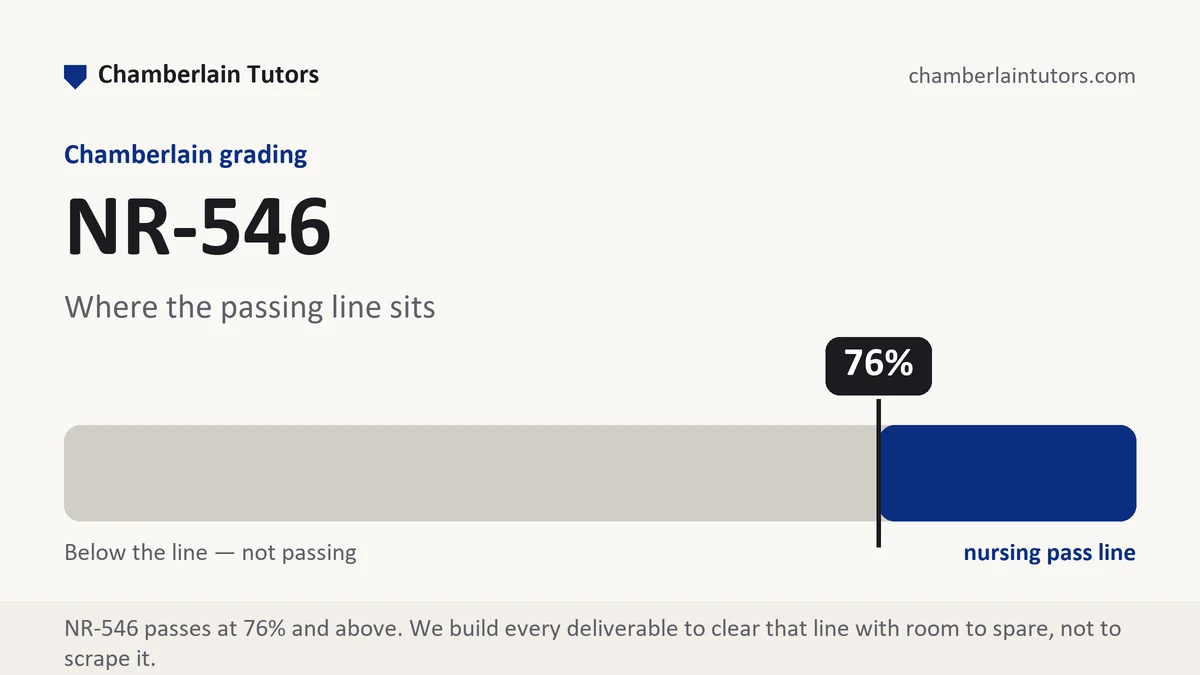
What NR-546 Week 8 asks for
Expect four populations treated as distinct problems rather than as footnotes. Children and adolescents, where much of the prescribing rests on evidence generated in adults and where growth and development have to be tracked. Pregnancy and lactation, where the risk of the medication has to be set beside the risk of untreated illness rather than considered alone. Older adults, where changes in body composition, kidney and liver function, and sensitivity to sedation and to anticholinergic burden all move the calculation, and where the number of other medications is itself a risk factor. Impaired organ function at any age, which changes both how much drug is present and how long it stays.
Expect deprescribing to appear as a positive clinical act. Reviewing what a patient is on, identifying what is no longer earning its place, and stopping it safely is a skill with its own evidence, and final weeks often ask for it directly.
Deliverable shapes here run longer than earlier weeks. A comprehensive plan document that carries assessment, selection, monitoring, education and follow up in one piece is the common shape, and the reference expectations rise with the length. Your week's rubric owns the total.
The NR-546 Week 8 method, step by step
-
Name the lifespan modifier in the first paragraph
Say who this patient is and what about them changes prescribing. If that sentence does not appear early, the paper reads as a generic plan with a demographic detail attached.
-
Restate the target symptoms in that context
The same symptom means different things at different ages, and what a family or a caregiver reports may differ from what the patient reports. Say whose account you are working from and how it was gathered.
-
Adjust the dosing logic, not just the number
Explain what changed physiologically and what that does to starting dose, to titration speed and to the interval at which you would reassess. A halved dose with no explanation answers nothing.
-
Write the risk conversation as a two sided comparison
Medication risk against untreated illness risk, in the same paragraph, both cited. This is the structure that shows shared decision making rather than an assertion that treatment is safe or unsafe.
-
Review the whole list for what should stop
Identify anything on the list without a current indication, anything duplicating another agent's action, and anything whose burden now exceeds its benefit. Then write how it stops.
-
Build a follow up calendar and audit backwards
Dates, what happens at each, and who is involved. Then read the whole plan once per rubric row and submit with hours to spare rather than minutes.
Shape of the comprehensive treatment plan
Our sizing for a plan of roughly 1,500 words. If your week's rubric adds a reflection row, add its words on top rather than taking them from the plan.
| Plan section | What it must integrate | Word target |
|---|---|---|
| Patient and lifespan context | Who this is, and every feature that changes prescribing for them. | 190 |
| Target symptoms and measurement | What you intend to change, whose report it comes from, and the instrument. | 190 |
| Selection with adjusted logic | The agent, the mechanism, and what this population changed about the choice. | 280 |
| Dosing and titration | Starting point, speed, ceiling considerations, and the physiologic reason for each. | 190 |
| Risk comparison | Medication risk and untreated illness risk, side by side, both cited. | 220 |
| Deprescribing review | What comes off the list, why, and the schedule for stopping it. | 200 |
| Follow up and education | The calendar, who is involved, and what the patient and family are told. | 190 |
Evidence and citation craft in a final plan
Say when you are extending adult evidence to a child. Much pediatric psychopharmacology rests on studies conducted in adults. Naming that openly is accuracy, and a psychiatric grader treats it as a strength.
Pregnancy evidence comes mostly from observational sources. Describe the design when you cite it, because presenting registry findings as trial results misstates what is known.
Cite the criteria list you use for older adults by name. Published lists of agents to avoid in older people exist and are citable. Naming yours converts a general caution into a supported recommendation.
Longer papers need denser citation, not thinner. The density that satisfied a short weekly piece leaves a comprehensive plan looking unsupported, and the final week is where reference lists are read closely.
Reusing sources across the session is expected, reusing your own paragraphs is not. Evidence accumulates; text does not. Submitting your own earlier work as new work in the same session is an integrity problem.
Five mistakes that cost points in week 8
- One plan written for a generic adult. If the paper would read identically with the patient's age removed, the central idea of the week is missing.
- Start low and go slow used as the entire geriatric answer. It is a slogan unless you say what changed physiologically and what that does to the schedule.
- Untreated illness risk left out of the pregnancy discussion. A one sided risk paragraph misrepresents the decision and loses the shared decision making row.
- The medication list never reviewed for removals. A final plan that only adds has skipped the skill this week most wants to see.
- Sections that never reference each other. Integration is the marking weight here, so a plan whose parts could be reordered without loss has not integrated anything.
Six checks before this one submits
- The lifespan modifier is named in the opening paragraph
- Dosing adjustments are explained physiologically, not merely stated
- The risk paragraph carries both medication risk and untreated illness risk, cited
- At least one agent is identified for stopping, with a schedule for how
- Citation density matches the length of the document
- The plan was read once per rubric row and submitted with hours to spare
Final plan of the session and everything has to fit in one document?
Send the case and the rubric from Canvas. An original premium plan comes back inside 24 to 48 hours with the lifespan modifier driving every section, the risk comparison written both ways, and revisions free until each row reads clean.