NR-546 Week 4 introduces a variable the earlier weeks did not have: phase. An agent that helps one phase of bipolar illness may do nothing for another and may worsen a third, so treatment here is chosen against where the patient is now and where you intend to keep them later. Add narrow margins, real laboratory monitoring and reproductive considerations, and this becomes the week where a plan without intervals is not a plan. Your section may print this as NR 546 or NR546; it is the same course.
Chamberlain publishes no syllabi outside Canvas. The placement here is our teaching judgment from the course's catalog arc; your section's rubric decides what your week actually asks.
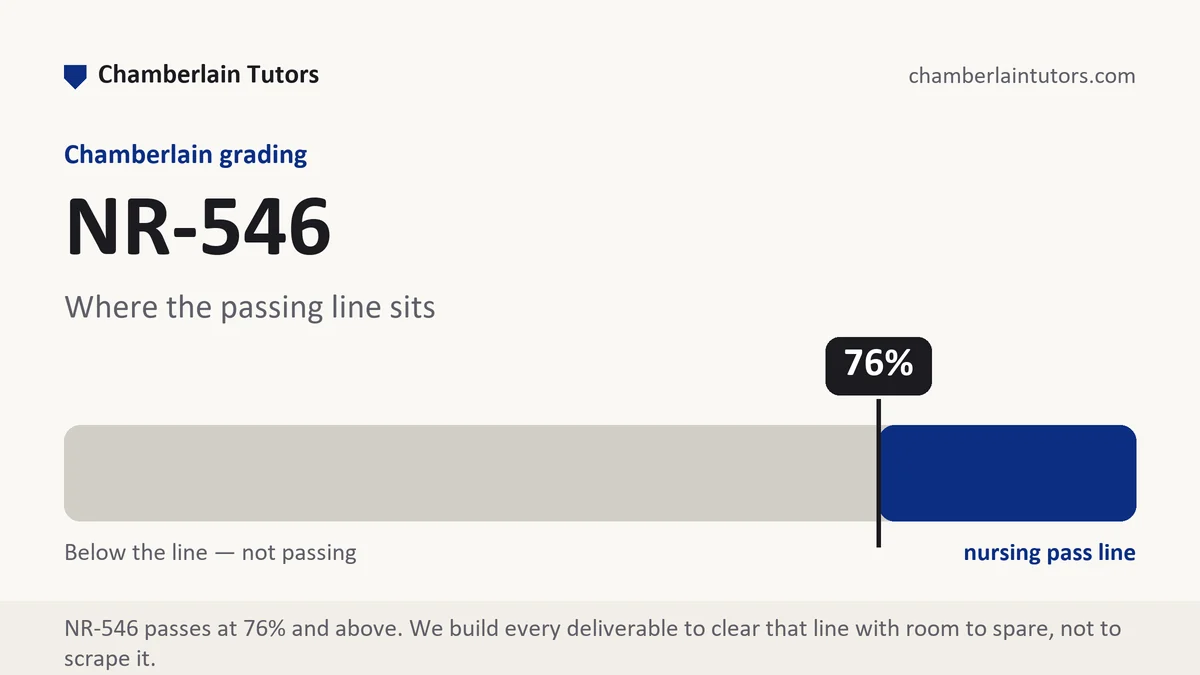
What NR-546 Week 4 asks for
Expect the agents grouped by what they actually do rather than by the label mood stabilizer, which covers several unrelated mechanisms. One agent with a narrow margin and a body of long term evidence behind it. Anticonvulsants whose actions on channels and inhibitory transmission differ from each other enough to matter clinically. Antipsychotic agents used for their effect in acute elevated states and, for some, in maintenance. Expect the three phases treated separately: an acute elevated state, a depressed phase in a patient with this illness, and maintenance, which is the phase most of a person's life is spent in and the one students most often skip.
Expect a serious monitoring layer. Narrow therapeutic margins mean levels, and several of these agents carry organ specific baseline and interval testing. Expect the reproductive discussion, because some of these agents carry documented risk in pregnancy and a large share of patients with this illness are of childbearing age. Expect one clinical hazard specific to this week: an antidepressant added without a stabilizing agent can destabilize the course.
Deliverable shapes at this point commonly ask for a phase specific plan with a monitoring schedule, sometimes alongside a discussion contribution if your section runs one.
The NR-546 Week 4 method, step by step
-
Name the phase in the first paragraph
Acute elevated, depressed, or maintenance. Everything downstream changes with this word, and papers that never state it end up recommending something reasonable for a phase the patient is not in.
-
Set a phase specific goal
Rapid control of agitation and sleep is not the same goal as preventing the next episode over two years. Write the goal in a sentence so the agent can be judged against it.
-
Choose against the phase and the history, not the diagnosis
Which phase dominates this person's course, what has worked before, and what they could not tolerate. A selection argument here is a history argument as much as a pharmacology one.
-
Build the monitoring schedule as a table in your head first
Baseline tests, when the first level or panel is drawn, the interval afterward, and the result that would change the plan. Vague reassurance about monitoring is the most common gap in this week's papers.
-
Write the reproductive conversation for any patient it could apply to
What is known about risk, what contraception discussion follows, and what you would do if pregnancy were planned or discovered. Neutral, cited, and specific to the agent you chose.
-
Finish with the relapse plan
Early warning signs the patient recognizes, who they contact, what changes first. Maintenance treatment without a relapse plan leaves the most important row of a bipolar rubric unanswered.
Shape of a phase specific treatment plan
Our sizing for a paper of roughly 1,250 words. If your week's rubric splits monitoring from adverse effects, divide the fifth row and hold the total.
| Section | What it must pin down | Word target |
|---|---|---|
| Phase and presentation | Where the patient is now, with the features that place them there. | 160 |
| Treatment goal | What success looks like for this phase, in terms you could check later. | 110 |
| Agent rationale | Mechanism, evidence for this phase, and the history that supports the choice. | 260 |
| The option refused | What you did not choose, why, and the change that would reverse it. | 140 |
| Monitoring schedule | Baseline, first check, interval, and the result that changes the plan. | 250 |
| Reproductive considerations | Documented risk, the conversation, and the plan if pregnancy occurs. | 170 |
| Relapse plan and education | Warning signs, contact route, and what the patient does first. | 140 |
Evidence and citation craft in a mood stabilizer week
Level ranges belong to sources and to indications. If you quote a range, name where it came from and what it is for, because acute and maintenance targets are not always identical and laboratories report differently.
Registry data and trial data answer different questions. Pregnancy risk estimates usually come from observational registries, and describing them as trial findings misrepresents the design. Name the source type in the sentence.
Give every risk figure a denominator, a comparison and a window. A rate written alone frightens without informing, which in this territory is a clinical failure as well as a writing one.
Do not extend evidence from one anticonvulsant to another. They differ in mechanism, in the phase they help and in what they do in pregnancy, and treating the group as interchangeable is the fastest way to lose a mechanism row.
Cite the monitoring recommendation, not just the test. Saying a panel is checked is weak. Saying a named source recommends it at a stated interval is a claim a grader can verify and credit.
Five mistakes that cost points in week 4
- No phase named. The single most consequential omission in this week, because every recommendation underneath it becomes unverifiable.
- Mood stabilizer used as if it were one mechanism. The label groups agents that work in completely different ways, and the rows are written about mechanism.
- Monitoring with no intervals. Regular laboratory monitoring is not a plan. Baseline, first check and interval are.
- Reproductive risk skipped or exaggerated. Both fail the same row. What is wanted is the documented risk, the source, and the conversation you would have.
- An antidepressant recommended without addressing destabilization. If your plan includes one, the paper has to say how the risk of a phase switch is managed.
Six checks before this one submits
- The phase is named in the opening paragraph and never drifts
- The treatment goal is written in checkable terms
- Each agent is argued by mechanism rather than by the mood stabilizer label
- The monitoring section names baseline tests, a first check and an interval
- Reproductive considerations are addressed with a cited risk and a plan
- A relapse plan names warning signs, a contact route and a first action
Phase specific plan and the monitoring section keeps going vague?
Send the case and the rubric from Canvas. An original premium plan comes back inside 24 to 48 hours with the phase named, intervals written out, and the reproductive conversation handled in neutral cited language.