NR-546 Week 1 puts you at the synapse, because every psychotropic agent the course covers later acts at one of a small number of points there. Synthesis, storage, release, receptor binding, reuptake, breakdown. Learn to name the point a drug touches and the whole session becomes one repeated argument instead of a memorization exercise. This is also where the psychiatric writing register gets set, and it gets graded from the first submission. Your section may print this as NR 546 or NR546; it is the same course.
Chamberlain publishes no syllabi outside Canvas. The placement here is our teaching judgment from the course's catalog arc; your section's rubric decides what your week actually asks.
What NR-546 Week 1 asks for
The catalog describes this course as neuroscience and psychopharmacology for treating mental health disorders across the lifespan, and neuroscience comes first for a practical reason: nothing after it can be argued without it. Expect the anatomy of a synapse and the sequence of events that crosses it. Expect the transmitters that matter in psychiatry grouped by what they do and where their cell bodies sit: the monoamines, the fast excitatory and inhibitory transmitters, and the neuropeptides that some sections add. Expect receptor families separated by how they work, since a receptor that opens a channel and a receptor that starts a second messenger cascade produce effects on completely different timescales. Expect the transporter, because reuptake is the target of more psychiatric agents than any other single mechanism.
Deliverable shapes in an opening week run small. A board contribution taking one transmitter system and explaining its role is common if your section runs a discussion, sometimes with a short written piece beside it. Length is your rubric's decision.
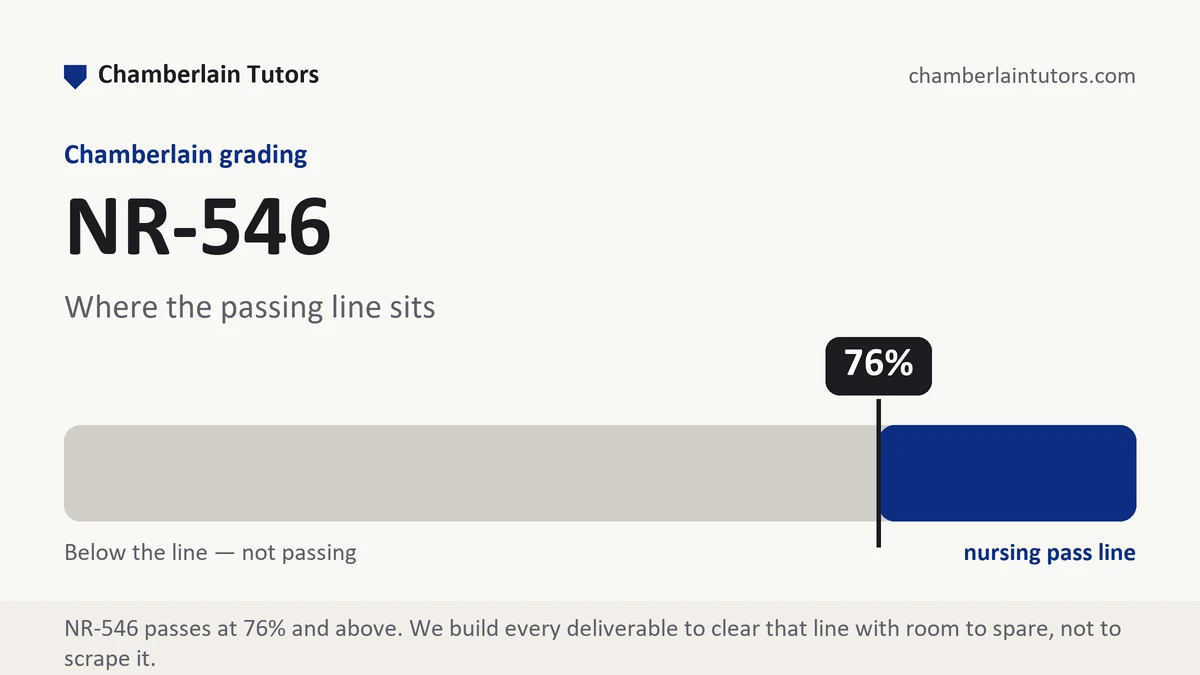
What is not small is the register. The specialty scale applies from the first graded item, with no C band and 84 as the floor, and a Chamberlain board cannot be edited after posting. Precision in week one is cheaper than correction in week two.
The NR-546 Week 1 method, step by step
-
Pick one point on the synapse and write from it
Release, receptor or reuptake. Naming the point in your first paragraph organizes everything after it, and it is the single sentence a mechanism row is looking for in an opening week.
-
Trace the pathway, not just the molecule
A transmitter behaves differently depending on which pathway it is travelling in, and psychiatric reasoning lives in that difference. Name the pathway, name where it starts and where it projects, and the clinical meaning follows.
-
Turn every receptor statement into a symptom statement
Write the receptor sentence, then the sentence that says what a person would experience because of it, immediately after. Two adjacent sentences. A rubric row asking you to apply the neuroscience is testing for exactly that adjacency.
-
Separate what happens in an hour from what happens in a month
Occupancy at a receptor can be immediate while the clinical change is not. Saying so early shows the reading behind your work and prevents the most common overstatement in a first psychopharmacology paper.
-
Label models as models
Where you use an explanatory theory about a transmitter and a disorder, write it as a proposed account with its limits acknowledged. Psychiatric faculty read those sentences closely, and hedging correctly earns rather than costs.
-
Draft outside Canvas and read it aloud once
Boards do not reopen, and neuroscience vocabulary is easy to misplace under time pressure. Reading the draft aloud catches the sentence that sounds right and says something wrong.
Shape of an opening neuroscience piece
Our sizing for a contribution of roughly 750 words. If your week's rubric asks you to compare two transmitter systems, run the middle three rows twice at half length.
| Part | What it has to demonstrate | Word target |
|---|---|---|
| Opening claim | Which transmitter system you are explaining and why it matters clinically. | 70 |
| The synaptic sequence | Synthesis through breakdown, in order, in your own sentences. | 180 |
| Pathway and projection | Where the pathway starts, where it goes, and what that region governs. | 150 |
| Receptor consequences | What binding does at the receptor and what a person experiences as a result. | 170 |
| The intervention point | Where a psychotropic could act on this system, and what that would change. | 120 |
| Close and question | A one sentence summary and a question classmates can answer from reading. | 60 |
Evidence and citation craft in a neuroscience week
Basic neuroscience tolerates age, clinical claims do not. How a transporter works has not changed in a decade. What should be prescribed has. Say in the sentence which kind of claim you are making and the source age question resolves itself.
Cite the pathway claim. Naming where a pathway projects and what it governs is a factual assertion, and it belongs on a cited sentence rather than in a general paragraph reference.
Write hypotheses as hypotheses. Theories linking a single transmitter to a disorder are models that explain some findings and not others. A paper that presents one as settled fact loses credibility with a psychiatric grader in a single sentence.
Do not let a diagram do your explaining. If your section allows images, the surrounding text still has to carry the argument, because rubric rows score writing and a figure with no narration answers nothing.
Keep the vocabulary exact. Agonist, partial agonist, inverse agonist and antagonist are four different things. Using them loosely in week one guarantees confusion in week five when receptor profiles start deciding drug choices.
Five mistakes that cost points in week 1
- A transmitter described with no pathway. The same molecule means different things in different circuits, and a paper that ignores that has described chemistry rather than psychiatry.
- Chemical imbalance language. It is a slogan rather than a mechanism, and using it uncritically signals that the reading was skipped.
- Receptor facts with no human consequence. If no sentence says what a person would feel, the applied neuroscience row has nothing to score.
- Immediate binding presented as immediate benefit. The gap between occupancy and clinical change is a graded idea in this course, not a technicality.
- Posting before proofreading. A misstated mechanism on a board is permanent, and in this specialty it is the error faculty forgive least.
Six checks before this one submits
- One early sentence names the synaptic point the piece is about
- Every transmitter mentioned is placed in a named pathway
- Each receptor statement is followed by the experience it produces
- Any explanatory theory is written as a model with its limits named
- Receptor vocabulary is used precisely, with no loose agonist language
- The draft was written outside Canvas, read aloud, and is being pasted once
First week of the psychopharmacology course?
Send the prompt and the rubric from Canvas. An original premium draft comes back inside 24 to 48 hours in the psychiatric register, with pathways named and every receptor claim landed on a human consequence.