NR-545 Week 8 is the closing week, and closing weeks in an eight week session ask for the whole thing at once: one patient carried through mechanism, examination and treatment without the seams showing. Everything you have practised separately now has to hand off. The test a grader applies is simple, and you can apply it yourself before submitting. Cover the treatment section and read only the mechanism. If the class you chose is not predictable from what is above it, the chain is decorative. Your section may print this as NR 545 or NR545; it is the same course.
Chamberlain publishes no syllabi outside Canvas. The placement here is our teaching judgment from the course's catalog arc; your section's rubric decides what your week actually asks.
What NR-545 Week 8 asks for
The territory is integration rather than new content. Expect a case, often more complicated than the earlier ones, in which the patient has more than one thing going on and the interesting question is how those things interact. Expect the paper to be longer than anything earlier in the session, expect a heavier weighting on the connection between sections rather than on the sections themselves, and expect the reference expectations to rise with the length.
Some sections attach a short reflective element to the final week, asking what changed in your understanding across the eight weeks. Where that appears, it is graded like everything else and answers best with specifics: a habit you built, a mistake you stopped making, a piece of reasoning you can now do that you could not in week one.
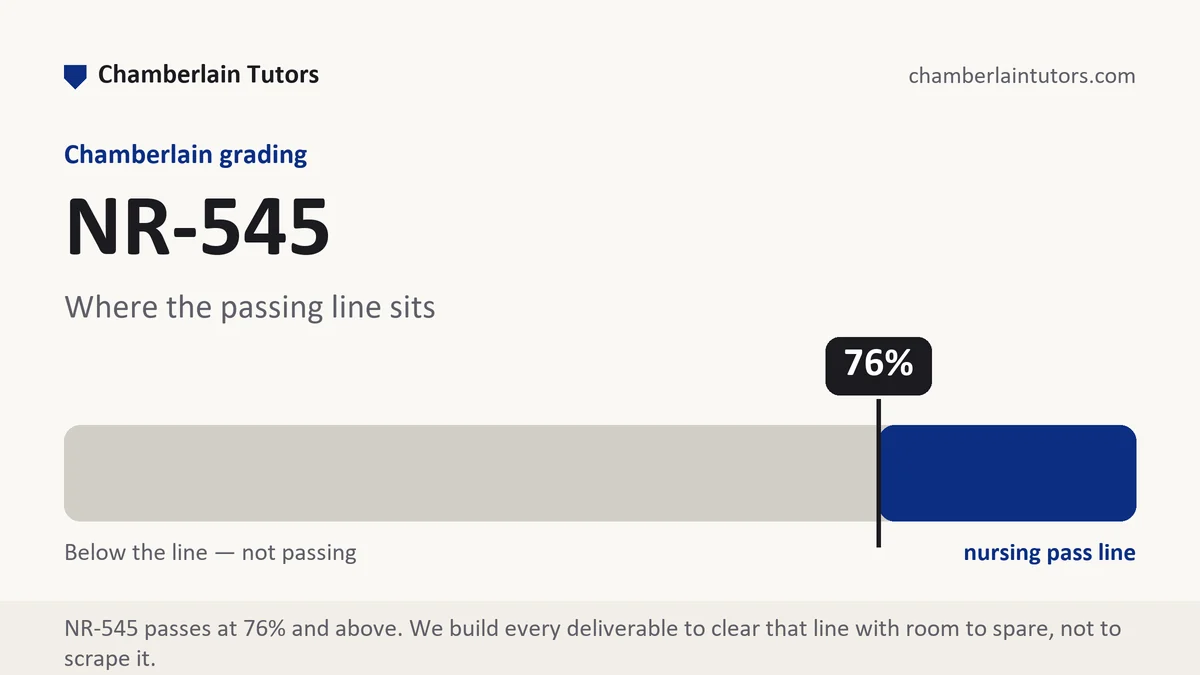
This is also the week where the course's own arithmetic finishes. Chamberlain sets the pass here at 76 percent, and the catalog records that the grade stays out of GPA and that the credit hours do not count toward graduation. What carries forward is the writing standard, because the specialty courses ahead run a scale with no C band where below 84 fails. The final paper is the last cheap place to prove the standard is installed.
The NR-545 Week 8 method, step by step
-
Pick a case that genuinely needs all three domains
If the prompt lets you choose, choose a presentation whose mechanism predicts findings and whose findings point at a class. A case that is mostly one domain will leave two sections thin no matter how well you write them.
-
Outline backwards from the treatment
Write the class you intend to defend, then work upward asking what the examination section must contain to justify it, then what the mechanism section must contain to justify that. Building in reverse guarantees the handoffs exist.
-
Write one hinge sentence between every pair of sections
A hinge names what the section above established and what the section below will do with it. Six hinge sentences in a long paper are worth more than six hundred extra words of content, because integration rows are scored on exactly these joins.
-
Handle the second problem explicitly
If your patient has two conditions, say how each affects the management of the other. This is the paragraph that distinguishes a final paper from a fourth repetition of the week four format.
-
Include the explanation you rejected
Name the other process that could produce this picture, say what would have changed your mind, and say what you would do to find out. It is the cheapest paragraph in the paper and the one most often missing from final submissions.
-
Audit the whole document against the rubric rows, one row at a time
Read the paper once per row rather than once overall. Six focused reads find gaps that one general read never will, and the last read should end well before the 11:59 p.m. Mountain Time cutoff.
Shape of the integrated final case
Our sizing for a paper of roughly 1,600 words. If your week's rubric adds a reflection row, add its words on top rather than taking them from the chain.
| Section | The handoff it must make | Word target |
|---|---|---|
| Case frame | Who the patient is and which problems this paper will follow. No history of the disease. | 120 |
| Mechanism, problem one | Ends by naming what a clinician should therefore be able to find. | 300 |
| Mechanism, problem two | Ends by naming how it interacts with the first, not merely by existing alongside it. | 230 |
| Assessment findings | Opens from the mechanism above and closes by narrowing the treatment target. | 300 |
| The rejected explanation | What else fits, what would separate it, and what you would do to check. | 140 |
| Treatment argument | Opens from the narrowed target, defends a class, and refuses an alternative in writing. | 320 |
| Monitoring, teaching and close | The parameter, the interval, the trigger, and a close that adds nothing new. | 190 |
Evidence and citation craft in a final paper
Split your list by job before you submit. Physiology sources support the mechanism sections and can be older. Treatment sources support the plan and should be current. Reading your own list this way exposes the gap that graders find.
Reusing a source from an earlier week is fine, reusing your own text is not. Sources are meant to accumulate. Paragraphs are not, and submitting your own earlier work as new work in the same session is an integrity problem rather than an efficiency one.
Longer papers need denser citation, not sparser. The temptation in a final paper is to write more from memory. Resist it, because the density that satisfied a 700 word piece leaves a 1,600 word paper looking unsupported.
Every claim about interaction between the two problems needs a source. This is the most original reasoning in the paper and therefore the most exposed. One good reference there is worth three in the background.
Do the list match last, deliberately. Every citation has an entry, every entry is cited, every entry is formatted the same way. It is a five minute task that protects a whole row, and it is the row most often lost in a final week.
Five mistakes that cost points in week 8
- Three good essays stapled together. The sections can each be correct and the paper still fail the integration idea, which is the only thing this week adds.
- Two problems described in parallel and never connected. If the second condition changes nothing about managing the first, the case was chosen badly or the analysis stopped early.
- New material in the closing paragraph. A close that introduces a fresh idea reads as a section that ran out of room, and it undoes the sense of a finished argument.
- Background expanding to fill the higher word count. The extra length belongs to the chain. Introductions should stay near a tenth of the body no matter how long the body gets.
- Submitting at the cutoff. A final paper that uploads at 11:58 p.m. has no margin for a failed upload, and the eight weeks deserve better than that risk.
Six checks before this one submits
- Covering the treatment section still lets a reader predict the class you chose
- A hinge sentence sits at every join between sections
- The interaction between the two problems has its own paragraph and its own source
- The rejected explanation is present with what would have changed your mind
- The reference list splits sensibly into mechanism sources and current treatment sources
- The paper was read once per rubric row, and it is submitted with hours to spare
Final week and the sections will not join up?
Send the case and the rubric from Canvas. An original premium final paper comes back inside 24 to 48 hours with the chain built backwards from the treatment, the hinges written, and revisions free until every row reads clean.