NR-545 Week 1 sits underneath every organ system the course reaches later: the cell, what injures it, and the inflammatory response that injury sets off. This is the vocabulary layer, and a mechanism paragraph in week six gets built out of the words you fix here. Below is the territory the opening week tends to cover, a six step method, a structure with word targets, and the errors that leak marks before the course has properly started. Your section may print this as NR 545 or NR545; it is the same course.
Chamberlain publishes no syllabi outside Canvas. The placement here is our teaching judgment from the course's catalog arc; your section's rubric decides what your week actually asks.
What NR-545 Week 1 asks for
This is a graduate placement course carrying pharmacology, physical assessment and pathophysiology at once, and a course with three subjects and eight weeks cannot open in the middle of any of them. So week one usually sits at the level of the cell. Expect the forms of injury a clinician can name apart: hypoxic and ischemic, oxidative from free radicals, chemical, infectious, physical. Expect the reversible and irreversible boundary, which is the line that makes intervention worth attempting at all. Expect apoptosis set beside necrosis, not as two definitions but as two endings with different consequences for the tissue around them. And expect acute inflammation split into its vascular events and its cellular events.
Deliverable shapes at this point in an eight week session run small and vocabulary heavy. If your section runs a discussion this week, the initial contribution usually asks you to take one injury process and explain it, then answer classmates who took different ones. A short written explanation is also common in an opening week. Your week's rubric owns the length and the sections; the numbers here are planning figures.
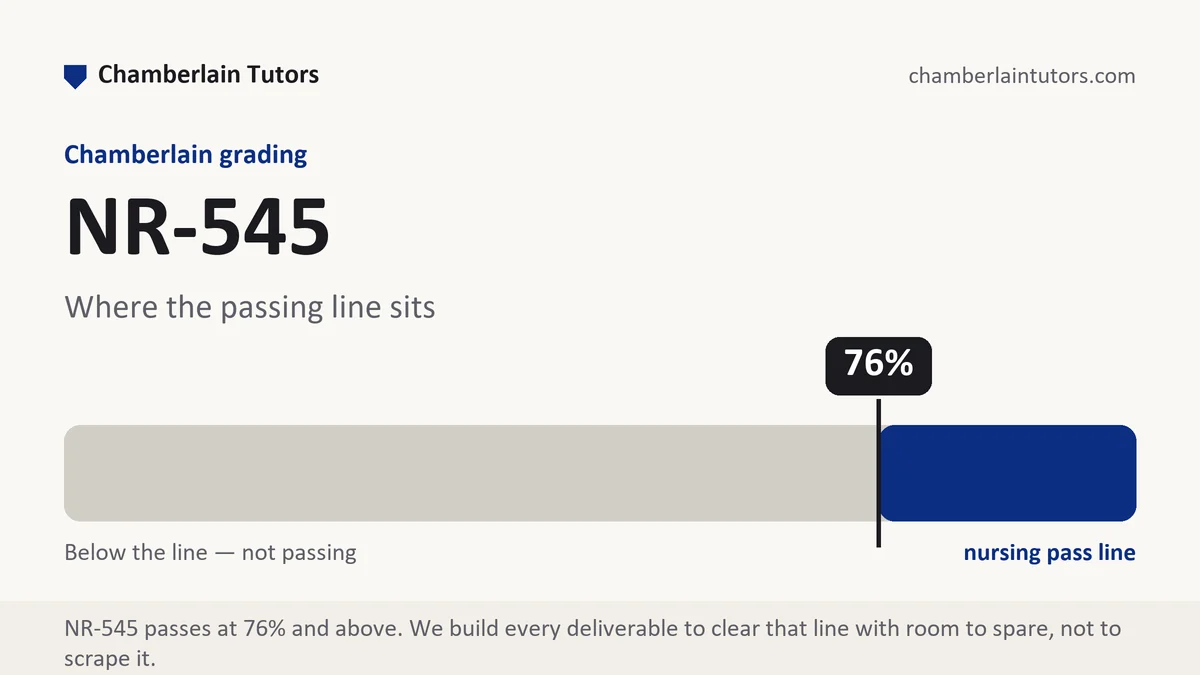
Chamberlain sets the pass for this course at 76 percent, and the catalog records that the grade stays out of GPA and that the credits do not count toward graduation. Read quickly that sounds like room to coast. It says the opposite. This is the course where the graduate standard is taught rather than charged for, because the specialty courses after it run a scale with no C band, where below 84 fails.
The NR-545 Week 1 method, step by step
-
Turn the rubric rows into headings first
Copy each criterion row from Canvas into a blank file and let the rows stand as your sections before a sentence exists. The prompt names the subject. Only the rows say what the grade is made of, and in an opening week the two are rarely the same document.
-
Take one injury process and stay inside it
Ischemia alone will fill an opening deliverable if you write it properly. A post that surveys hypoxia, toxins, radiation and infection has spent its whole budget on definitions and has nothing left for the explanation the rows actually pay for.
-
Write the chain in one direction
Insult, then the cellular event, then the tissue result. Every sentence should move one step forward. If a paragraph doubles back to restate the insult, it is padding, and graders read padding as a writer who has run out of mechanism.
-
Keep the vascular phase and the cellular phase apart
Vasodilation, increased permeability and exudate belong to one phase. Margination, adhesion and the arrival of neutrophils belong to another. Blending them into a single paragraph of redness and swelling loses the exact distinction the week exists to teach.
-
Attach one observable to each step
After each mechanism sentence, name what a clinician could see, feel or measure because of it. This is the habit that turns a biology paragraph into a nursing paper, and it is the same habit every later week of the course will demand.
-
Draft in a file, read it cold, paste once
Discussion posts in Canvas cannot be edited after they are submitted. Write elsewhere, leave the draft for an hour, read it against the rubric rows, and paste one time. There is no version of this week where drafting in the reply box pays.
Shape of an opening mechanism piece
Our sizing for a written explanation of roughly 800 words. If your week's rubric weights inflammation more heavily than injury, take the words from the opening frame rather than from the observables.
| Section | What it has to establish | Word target |
|---|---|---|
| Opening frame | Which injury process this piece is about and why it is worth explaining at cell level. | 60 |
| The insult | What reaches the cell, by what route, and how much of it matters. | 100 |
| Cellular response | Energy failure, ion shifts, swelling, and the point where adaptation gives out. | 180 |
| Reversible or not | The specific change that marks the boundary, and what a clinician gains from knowing where it sits. | 110 |
| Vascular phase | Flow, permeability and exudate, with the mediators named rather than implied. | 130 |
| Cellular phase | How leukocytes reach the tissue and what they do once they arrive. | 130 |
| What is observable | Two or three findings the chain above predicts, each traced to a step. | 90 |
Evidence and citation craft in a pathophysiology week
Physiology ages slowly, guidance does not. A ten year old pathophysiology text is a legitimate source for how a cell swells. The same text is a weak source for what should currently be done about it. Say in the sentence which job the source is doing and the age question stops being a problem.
Cite the mechanism, not just the conclusion. A citation parked at the end of a paragraph tells a grader nothing about which claim it supports. Place it on the sentence that carries the mechanical step, which is also the sentence most likely to be challenged.
Define each term once, in your own words, then use it. Redefining hypoxia three times reads as filler. Never defining it reads as copying. One clean definition early buys you the right to use the word freely afterward.
Match your verbs to a mechanism claim. Leads to, produces and results in are fair when you are describing an established pathway. They are not fair when you are describing what tends to happen in patients, which is observational language and needs observational verbs.
Paraphrase by explaining, not by rearranging. If your paragraph collapses when someone asks why one step causes the next, it is the textbook with the clauses moved. Faculty have read the same textbook, and this is the most detectable weakness in a first week.
Five mistakes that cost points in week 1
- Writing a glossary. Six terms defined in six sentences answers nothing. One process explained through its steps answers every row a mechanism rubric contains.
- Necrosis and apoptosis used as synonyms. They differ in trigger, in membrane behaviour and in whether inflammation follows, and that last difference is why the course separates them at all.
- Inflammation written as a symptom list. Redness, heat, swelling and pain are the output. The row wants the events that produce them, in order.
- No clinical landing. A perfect cell biology essay with no observable finding anywhere in it has answered a biology course, not a nursing one.
- Posting before reading it cold. The board does not reopen, and a misstated mechanism in week one is visible to your faculty member for the rest of the session.
Six checks before this one submits
- Every criterion row in your rubric has a passage written under it
- One injury process carries the whole piece, start to finish
- The vascular and cellular phases of inflammation appear as separate accounts
- Each mechanism step has an observable consequence attached within a sentence or two
- Source ages are matched to the job each source is doing, and said so in the sentence
- The draft was written outside Canvas and is being pasted once
First graded week of the placement course?
Send the prompt and the rubric from Canvas. An original premium draft comes back inside 24 to 48 hours, floor checked, with the mechanism chain built the way every later week of this course will expect.