NR-545 sits in Chamberlain's The provisional-admission ramp course, on the MSN-NP core path. This is its help page: what the course really grades and how our team carries it, floor check included.
What NR-545 actually grades
The course added for provisional NP admits who score under 70 on the placement assessment, which makes it a message as much as a class: the program believes your writing needs reinforcement before the scale starts biting. It is the cheapest warning Chamberlain will ever give you.
How we help in this course
We treat 545 as exactly that warning, heeded: drafts that model graduate writing while the walkthroughs teach it, so the ramp does its job before NR-581's gate makes the same point expensively.
Deliverables run the standard promise: a premium original draft in 24 to 48 hours, targeted at the A band of your course's actual scale, through the eight-person pipeline with both QA passes and the floor check, revised free until it lands.
How three domains become one paper
Chamberlain does not publish its syllabi anywhere a student can read them, so nobody can honestly hand you a week-by-week manual for NR-545. What follows is more useful, because it works against whatever your scoring guide says this week. This course asks one thing repeatedly in different clothes: take a disease process, explain the mechanism, say what that mechanism should produce when you put hands on the patient, then defend a drug class against the mechanism rather than against the symptom name. Everything below teaches that chain and the writing habits that keep points attached to it.
In NR-545 right now?
Send the week and the rubric from Canvas. First premium sample free, floor-checked, back in 24 to 48 hours.
Reading the ramp course for what it is
NR-545 exists for provisional NP admits who scored under 70 on the placement assessment, which makes enrollment in it a message from the program: your writing needs reinforcement before the specialty scale starts grading it. Taken seriously, it is the cheapest warning Chamberlain issues, because the courses after it run the no-C ladder where 83 fails and failures feed the two-strike dismissal math. The desk treats every 545 order as that warning heeded early rather than regretted later.
How the drafts teach while they score
Each deliverable comes back written in the graduate register the later courses will demand, and the walkthrough annotates the moves: why this structure, why this source placement, why this tone. The draft protects the current grade; the walkthrough builds the writer who will not need the desk as often by NR-581NP's progression gate. Delivery holds the site standard, 24 to 48 hours, both QA passes, free revisions until the target letter posts. The ramp is the rare course where the teaching value outweighs the grade value, and the pacing respects that.
Starting today with nothing but the syllabus
If the course just opened, send the syllabus and the first week's prompt and the desk maps the whole ramp in one reply: what each week asks, which pieces carry weight, where the Mountain-Time cutoffs land in your own time zone. The first sample is free, and in this course it doubles as a preview of what graduate-level work is supposed to look like.
Start where the marks are, not where the prompt starts
A prompt describes the assignment. A scoring guide describes the grade, and in this course those are not the same document. Open the guide first, copy its criterion rows into an empty file, and let them stand as your section headings before you write a sentence. A paper built that way cannot spend three paragraphs on a row worth ten points while the row worth thirty-five gets two.
Then convert weights into a word budget. Take the body length you are aiming at, hold back a tenth for the opening frame and the close, and split the rest in proportion. Worked on a 1,400-word body with a four-row guide:
| Criterion row | Weight | Words | What that buys |
|---|---|---|---|
| Pathophysiologic mechanism | 35 | 490 | Room to move from the initiating insult to the cellular change to the system-level result, in developed paragraphs rather than summary. |
| Physical assessment correlation | 25 | 350 | The findings that mechanism predicts, plus the technique that elicits each one. |
| Pharmacologic treatment rationale | 25 | 350 | Class, action against the process you just described, and the monitoring that follows from it. |
| Scholarly writing and sources | 15 | 210 | Nothing visible. This row is paid in care spread across the other three, never in a paragraph about your own writing. |
Substitute your own rows and ceiling; the arithmetic does not change. Weight as a decimal, times body words. What matters is the gap between budget and draft, which takes ten seconds to check before submitting and cannot be checked afterward.
The shape of a synthesis paper here
Most graded writing here is a synthesis: one process carried through three domains without the seams showing. Each part has a job, and graders notice a missing job faster than a missing paragraph.
| Section | What it must demonstrate | How it usually fails |
|---|---|---|
| Opening frame | That you know which patient and which process this paper is about. | A general history of the disease, eighty words spent before the paper starts. |
| Mechanism | That you can walk from initiating event to cellular change to clinical result in your own sentences. | The textbook's sentences with the clauses reordered. Faculty have read the source too. |
| Predicted findings | That the mechanism, not the diagnosis label, produces the finding you expect. | A list of signs true of anyone with that diagnosis, linked to nothing above it. |
| Technique | That you know how each finding is elicited and what you would find if the process were absent. | Naming the sign and skipping the maneuver, which reads as reading rather than assessing. |
| The alternative | That you considered another explanation and can say what would have changed your mind. | Absent. The cheapest paragraph in the paper and the one most often left out. |
| Pharmacologic rationale | That the agent class acts on the mechanism you described, with dose logic and a reason for this class over the neighboring one. | A brand name, a sentence of indication, no thread back to section two. |
| Monitoring and teaching | What you would watch, what result would change your course, and what the patient needs to hear. | The phrase monitor for side effects, standing where a plan belongs. |
| Close | That the chain held from first paragraph to last. | New material in the final paragraph, which reads as a section that ran out of room. |
Sources, and the verbs you attach to them
Graduate science writing is judged less on how many sources sit in the list than on whether the sentences around them are honest. Four habits carry that row.
- Date the claim, not just the citation. Physiology ages slowly and prescribing guidance does not. A fifteen-year-old text is fine for describing a receptor and weak for what is currently recommended, and saying which job you are using it for earns rather than costs.
- Lead with the study, arrive at the number. What kind of study, in whom, across how long, and only then the result. A finding that shows up without those three is an assertion wearing a citation.
- Match the verb to the evidence. An observational design earns phrases like was more frequent among, tended to precede, or tracked with. Causes, prevents and eliminates belong to designs built to test them. Swapping the two sets loses a writing row while sounding confident.
- Never state a rate without its denominator and window. Forty percent of whom, measured how, across what period. A number missing either one is not a rate, and a grader who has to ask has already marked the row down.
Watch it work on one sentence. Before: this drug often causes low sodium. After: in a cohort of older adults followed through the first month of therapy, low sodium was recorded more often among treated patients than among untreated comparison patients. The second names the population, the window and the comparison, and it steps causes down to something the design can support. Fill in the figures from your own reading and the row is earned.
What separates a pass from a strong paper here
A passing paper in this course contains three competent sections sitting beside each other. A strong one makes each section hand something to the next. Test it yourself: cover the pharmacology section and read only the mechanism. If a reader could not predict the drug class you are about to choose, the chain is decorative, and the synthesis row is where you will feel it.
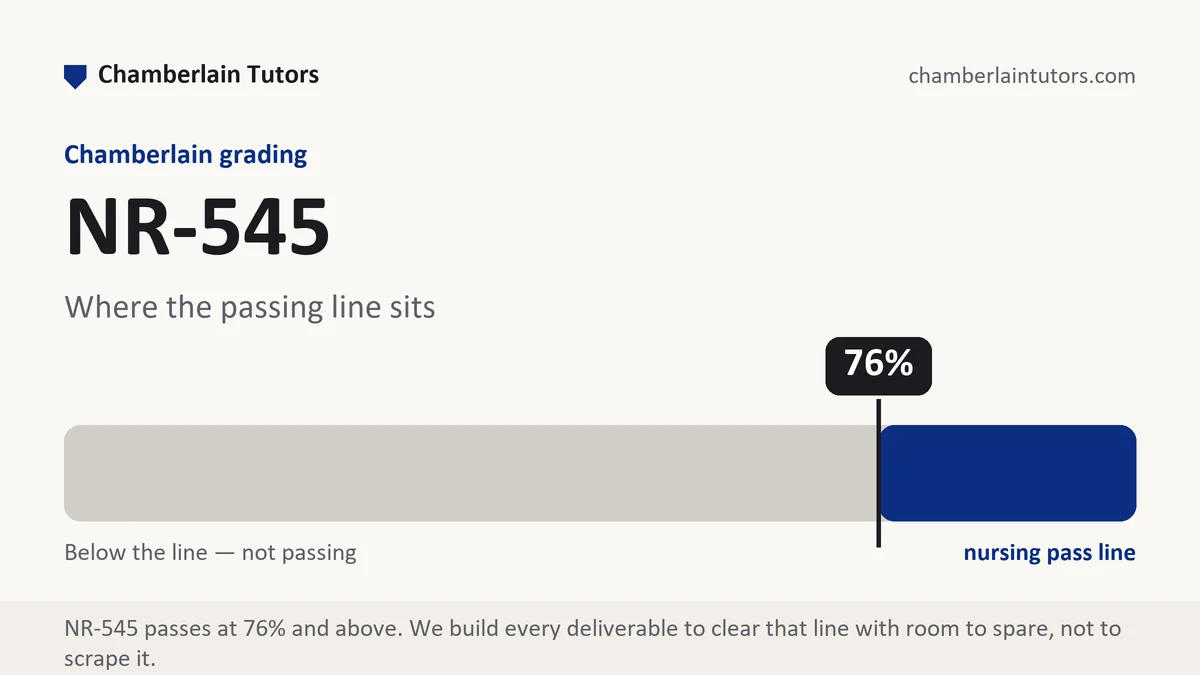
The second difference is register, and this is where it gets set. The catalog entry puts the passing minimum at 76 percent and states that the final grade is not used in GPA calculations and its credit hours do not count toward graduation. Read quickly, that sounds like permission to coast. Read properly, it says the reverse: this is the one course where the standard is taught rather than charged for, and the specialty courses that follow apply the same expectations on a ladder that has no C band at all, so an 83 there becomes a repeat. Spend the cushion learning the register, because there is no cushion after it.
Six mistakes that cost points in NR-545
- Writing at the level that produced the placement result. The course exists because a score said the writing needed rebuilding. The same sentences, longer, reproduce the score.
- Paraphrasing a mechanism instead of explaining it. If the paragraph collapses when someone asks why one step leads to the next, it is a summary rather than an explanation.
- Findings with no technique attached. Naming a sign is reading. Naming how you elicit it, and what you would find if the process were absent, is assessing, and the row is written for the second one.
- A drug name where a class and a mechanism belong. The grader is checking whether the agent acts on the process described in your own second section. A brand name cannot answer that.
- Spending the budget on background. Introductions are the easiest words to write and the cheapest to lose. Cap the opening at a tenth of the body and hand the difference to the heaviest row.
- Pasting a discussion contribution before reading it cold. Boards in Canvas cannot be edited once submitted. Draft outside the box, leave it an hour, read it against the prompt, then paste once.
Three questions NR-545 students send us
The catalog says this grade does not count toward my GPA. Does the course matter?
My scoring guide has a criterion row I do not understand. What now?
How much of the mechanism am I supposed to explain, and where do I stop?
The weeks, one by one
Week 1
NR-545 Week 1 sits underneath every organ system the course reaches later: the cell, what injures it, and the inflammatory response that injury sets off. Read the full Week 1 manual.
Week 2
NR-545 Week 2 moves from the cell to the patient in front of you: how a graduate level history is taken, how findings are elicited, and how both get written down in language a colleague could act on. Read the full Week 2 manual.
Week 3
NR-545 Week 3 turns on the third strand of the course: what a drug does once it arrives at its target, and how a class gets defended against a mechanism rather than against a symptom name. Read the full Week 3 manual.
Week 4
NR-545 Week 4 is where the three strands first have to work as one document, and the cardiopulmonary systems are where that usually happens because their mechanics are visible on examination. Read the full Week 4 manual.
Week 5
NR-545 Week 5 changes the kind of mechanism you are asked to explain. Read the full Week 5 manual.
Week 6
NR-545 Week 6 asks a question the earlier weeks did not: where is the lesion. Read the full Week 6 manual.
Week 7
NR-545 Week 7 sets the host against the organism and asks you to write both sides. Read the full Week 7 manual.
Week 8
NR-545 Week 8 is the closing week, and closing weeks in an eight week session ask for the whole thing at once: one patient carried through mechanism, examination and treatment without the seams showing. Read the full Week 8 manual.