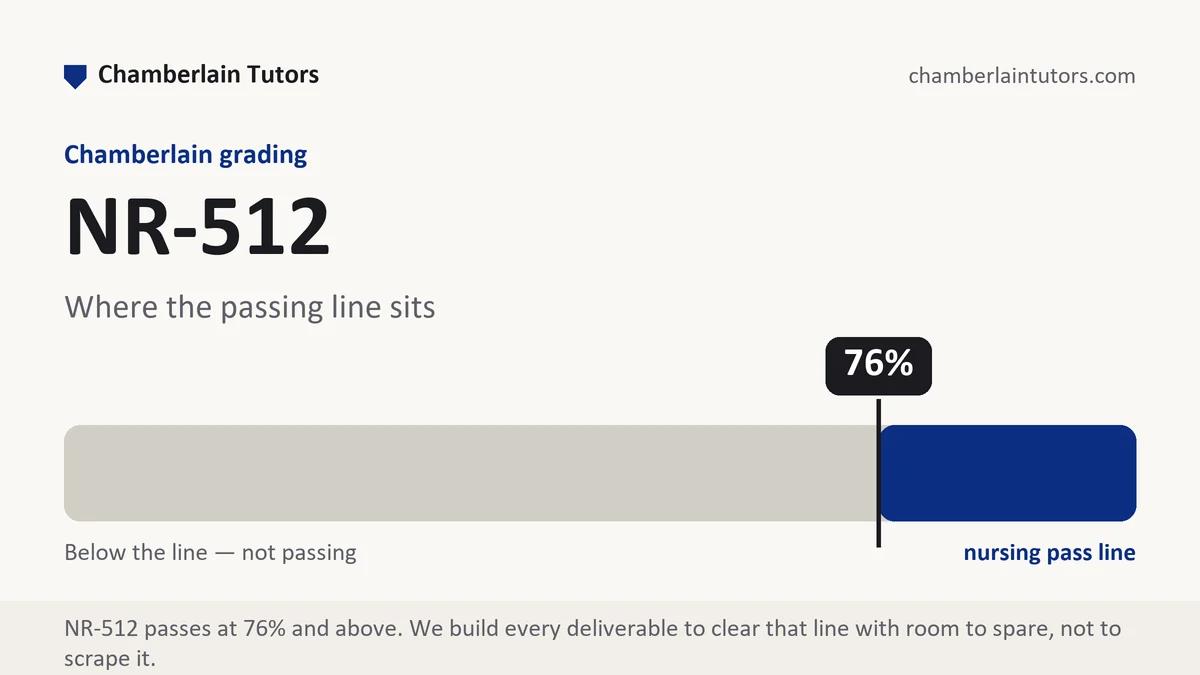
NR-512 Week 2 is the week the catalog line about practicing basic skills inside a virtual learning environment turns into graded writing, which surprises students who expected an orientation and got an assignment. Your section may print this as NR 512 or NR512; it is the same course. Chamberlain publishes no syllabi outside Canvas. The placement here is our teaching judgment from the course's catalog arc; your section's rubric decides what your week actually asks.
What NR-512 Week 2 asks for
The territory is professional conduct and skill inside an online workspace. That includes finding literature through a library rather than through a general search engine, judging what you found before you keep it, writing in shared spaces where text persists and is quotable, and holding a line between a personal online presence and a clinical role. None of it is about software features. All of it is about the habits that make an online professional trustworthy, which is why the reflection this week is graded rather than collected.
The deliverable usually pairs a reflective piece about working in the environment with a small evidence exercise: find sources on a topic, evaluate them, and explain the choices. Treat both halves as graded writing. If your section runs a discussion this week, expect it to double as a demonstration of the writing standards the rest of the session will hold you to, and remember that Canvas posts cannot be edited once submitted.
The reliable upgrade here is artifacts. A reflection saying that you improved your search skills is unscoreable. A reflection saying you began with a phrase that returned several thousand results, added a filter for the last five years and a limit to peer reviewed work, moved to controlled subject terms after noticing the phrase was ambiguous, and finished with fourteen candidates of which you kept four, is evidence. Same experience, different currency.
The NR-512 Week 2 method, step by step
Six moves that make a reflective assignment behave like an evidence assignment.
-
Search the way the field searches
Start inside the library rather than in a general engine. Break your question into its parts, look up the subject headings the database actually uses for each, combine them deliberately, then apply limits for date and publication type. Write the string down as you build it, because you will need it later.
-
Score each source before you keep it
For every candidate, note who wrote it, who paid for it, what year it appeared, whether it reports how it was done, and whether it is reporting original work or summarizing somebody else's. Four short notes per source take a minute and turn the selection section into something a grader can follow.
-
Keep the rejections
The sources you discarded are worth more in a reflection than the ones you kept, because rejecting a source requires a reason and reasons are what the rubric can score. Name two you dropped and say exactly what disqualified each.
-
Draw the line around your professional presence
Decide and then state where your clinical role ends and your personal accounts begin: what you would never post, what you would never photograph, what you would not discuss even in a closed group. A stated boundary with an example behind it is analysis; a promise to be careful is not.
-
Write as though the text is permanent
Anything posted in a shared academic space can be quoted, exported and read later out of context, and a submitted post in Canvas cannot be pulled back for a rewrite. Compose in a document, read it once as a stranger would, then submit.
-
Close on one habit you are changing
End with a single specific change to how you will work for the rest of the program: a database you will start in, a limit you will always apply, a rule about what you post. One changed habit described concretely beats a paragraph of general resolve.
A layout and word budget for a practice environment reflection
The frame below is what our writers use when a week asks for a reflective piece with an evidence exercise attached, sized for about 1,000 to 1,200 words. It is a working outline of ours, and any structure your assignment specifies takes priority over it.
| Section | What belongs in it | Word target |
|---|---|---|
| Opening frame | What the piece is about and what you set out to find, without a paragraph of preamble about technology in education. | 80 to 100 |
| The environment, described | The working conditions of an online graduate course as they affect your practice, not a tour of menus and buttons. | 150 to 180 |
| The search, with artifacts | The question broken into parts, the terms used, the limits applied, and the counts at each stage. | 230 to 270 |
| Judging what came back | Your criteria applied to specific sources, including at least two you rejected and why. | 200 to 230 |
| The professional boundary | Where your clinical identity meets your online presence, with a concrete example of a line you hold. | 170 to 200 |
| Close | The one habit you are changing, stated so that somebody could check whether you did it. | 90 to 120 |
Evidence and citation craft for source evaluation
A search is reproducible or it is an anecdote. Record the database, the terms, the limits and the date you ran it. Somebody following your description should be able to get roughly your result set. That is the standard a reflection about searching is measured against.
The end of a web address is a weak signal. Treating anything ending in one suffix as trustworthy and everything else as suspect is a shortcut that fails in both directions. Judge by author, funding, method and date, and say which of those four decided each case.
Encyclopedias and search summaries are maps. A general reference article or a generated summary can point you toward a real source, and it belongs nowhere in your reference list. Follow the citation to the original, read it, and cite that.
If you used an appraisal tool, name it. Structured checklists for judging a study exist and have names and authors. Citing the one you applied makes your evaluation a method rather than an opinion, and it gives the grader something to check your reasoning against.
Course materials are not literature. Announcements, lecture slides and classmates' posts are not citable evidence for a claim about the world. Cite the sources those materials point to, and keep your reference list to published work.
Five mistakes that cost points in this week's territory
- A reflection with no artifacts in it. Adjectives about growth cannot be scored. Counts, terms, filters and named rejections can, and they take up the same amount of space.
- Sources sorted by address rather than by content. Judging credibility from the last three letters of a link is the exact habit this week exists to break.
- The environment written as a software review. Descriptions of where the buttons are and how the calendar works answer a question no criterion row asked. The subject is how you work, not what the tool looks like.
- Personal material that belongs in a journal. Family circumstances and study stress are real and unscored. Keep the reflection to professional conduct and the skills the assignment names.
- References gathered after the writing is finished. Retrofitting citations onto finished paragraphs produces sources that do not quite support the sentences above them, which is the pattern graders in this course spot fastest.
Before you submit
- The search is described precisely enough that somebody else could repeat it
- At least two rejected sources appear with the reason each was dropped
- Every kept source has its author, date and funding accounted for
- The professional boundary is illustrated with a concrete example
- No course announcement, slide deck or classmate post appears as a citation
- The closing habit is written so that its completion could be verified
Writing the reflection this week?
Send the prompt and the criterion rows from Canvas. Our writers return a premium original draft in 24 to 48 hours with a documented search, real rejection reasons and a boundary section that argues rather than promises, revisions included.