NR-512 is the three theory hour foundations course in nursing informatics, and the catalog is explicit that the basic skills are practiced inside a virtual learning environment. The graded output is still writing. What it rewards is the ability to describe how information moves through a clinical process, step by step, with the same discipline a pathophysiology course expects for a disease process.
What NR-512 actually grades
Two things sit under almost every rubric row. The first is vocabulary used correctly: data, information, knowledge and wisdom are not synonyms in this field, and a paper that treats them as interchangeable signals to a grader within the first paragraph that the foundational reading did not land. The second is process description. You are being asked to take something you do without thinking, an admission, a handoff, a medication pass, a discharge, and write down where each piece of information originates, who enters it, what system holds it, who retrieves it, and where it breaks.
Nurses find the second harder than expected. Years of practice make a workflow invisible. The paper that scores well is the one that slows down enough to notice that a single vital sign passes through three hands and two systems before a physician sees it, and that the delay everyone complains about lives in one of those handoffs rather than in the software as a whole.
Because the skills work is practiced virtually, expect deliverables that ask you to reflect on the practice environment itself. Treat those as graded writing rather than as a note to your instructor.
How we help in this course
NR-512 carries no clinical hours, so nothing here touches placements, preceptors or logs of any kind. We do not sit assessments or enter anything on your behalf inside a learning environment. What we build is the written layer.
Send the week's prompt and rubric out of Canvas and a premium original draft returns in 24 to 48 hours, planned against the criterion rows, with the workflow described in an order a reader can follow. Nothing ships without both quality passes and the floor check, and revising costs nothing until the piece lands.
Writing this course's deliverables from the rubric
The sequence that works here is rubric, then process map, then prose. Writing prose first produces a fluent paper about the importance of technology that never describes a single step of anything.
In NR-512 right now?
Send the week and the rubric from Canvas. First premium sample free, floor-checked, back in 24 to 48 hours.
The 76 percent floor in a foundations course
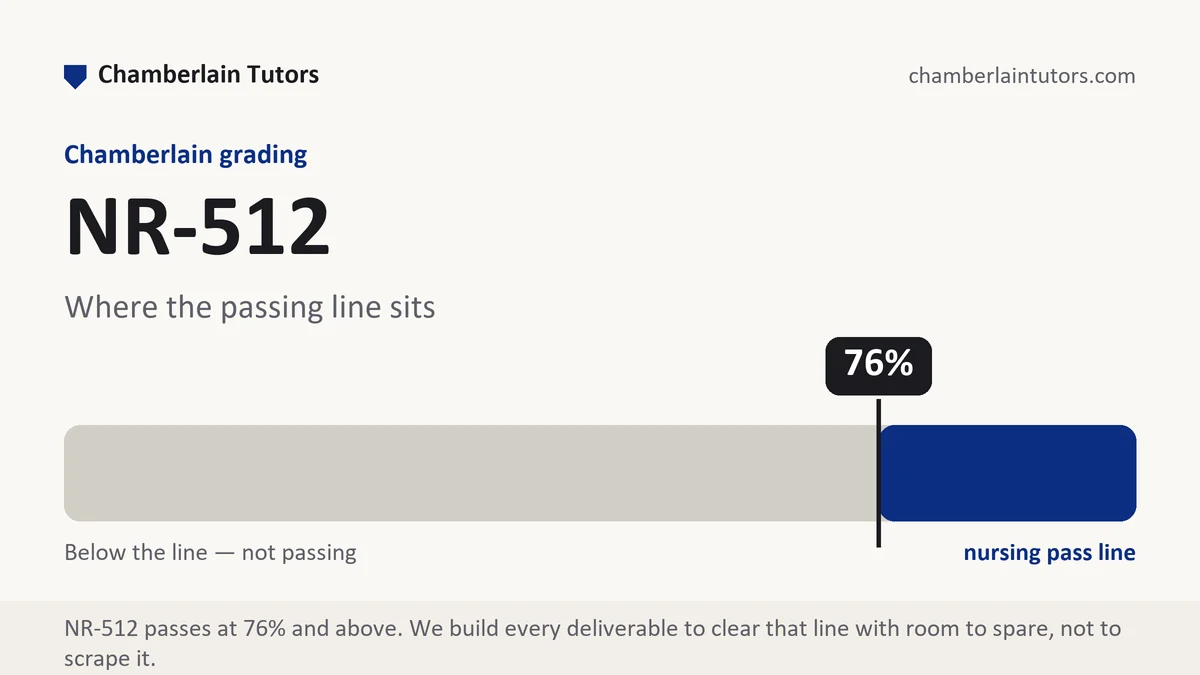
Core nursing courses pass at 76 percent, and if your track uses the nurse practitioner specialty scale there is no C at all, which puts the last passing number at 84. Foundations courses are where students spend their cushion without noticing, because the content feels like background rather than clinical work.
The calendar gives no room to recover. Chamberlain runs sixteen week semesters split into two eight week sessions with up to six starts a year, and something is due every week. Supplementary work cannot rescue a weak weighted average, so a pair of thin weeks in an eight week session is not a dip, it is the grade.
Turn the criterion rows into a section plan
Open the scoring guide first. Copy the rows into a blank file in printed order and reduce each to the verb driving it: define, describe, analyze, apply, evaluate. Those verbs are your headings, and leaving them in the guide's sequence means the grader always finds the section they were about to look for.
Then convert weight into a word budget. Suppose the week caps you at 1,200 words with four rows weighted 40, 30, 20 and 10 percent. That is roughly 480 words for the first row, 360 for the second, 240 for the third and 120 for the last. In an informatics foundations paper the 40 percent row is nearly always the analysis of a process or a system, and 480 words means a genuine walk through the steps rather than a paragraph of description. The 120 word row is usually a definition or a reflection, and it is exactly one tight paragraph, not the page students often give it because definitions are comfortable to write.
Keep each target beside its heading while drafting. If your guide excludes the title page and references from the count, note that too, so you are not padding toward a limit that never included them.
The shape of a workflow analysis
Most graded writing in NR-512 is a workflow or process analysis in some form: a paper, a case response, a discussion post about a system that frustrates your unit. A grader works down this list, and an absent part reads as an absent thought.
| Part | What it has to establish | How the thin version reads |
|---|---|---|
| The process, bounded | Where the workflow starts and stops, named in one sentence, so the reader knows what is being examined. | A general statement about documentation in healthcare. |
| The actors | Every role that touches the information, including the ones nobody thinks of, such as unit clerks and transport. | Nurses and physicians only. |
| The data, followed | What is captured, in which system, by whom, and what happens to it next, in order. | A list of the systems the unit uses. |
| The break point | The specific step where information stalls, duplicates or degrades, identified rather than implied. | A claim that the system is inefficient. |
| The evidence | Literature or standards showing this kind of break matters, described before it is used. | A citation dropped at the end of a paragraph it does not support. |
| The proposed change | One alteration at a named step, with who would have to agree and what you would measure afterwards. | A recommendation to buy better software. |
Evidence and citation craft in informatics
The literature in this field ages faster than in almost any other nursing subject, which changes how you have to handle it.
- Currency is stricter here than elsewhere. A five year old paper about a clinical system may describe software two versions out of date. Where you cite anything older, the sentence should say why the point survives, and for conceptual models it usually does while for adoption figures it usually does not.
- Vendor material is a source about a product, not about outcomes. White papers and case studies published by the company selling the system are evidence of a claim being made. Label them that way and pair them with something independent.
- Design and setting before the result. Write that a pre and post implementation study on four medical surgical units measured documentation time before and after a new charting template, then give the finding. Without the setting the number could mean anything, because informatics results rarely transfer between settings.
- Keep the verb honest. Most implementation evidence is observational and confounded by training, staffing and go live effects at once. Units using the alert reported fewer missed doses is defensible. The alert reduced missed doses is a claim only a controlled design can pay for.
- Every rate needs a denominator and a window. Write that 918 of the 6,200 orders placed during a three month period triggered an override, rather than that 15 percent did. Override and adoption figures are meaningless without the base and the period.
The gap between a passing paper and a strong one
A passing NR-512 paper defines the terms correctly, names a system, and argues that technology improves care. It is accurate, general and forgettable, and general is the failure mode this course produces most reliably.
Strong papers are narrow on purpose. They pick one process on one unit and follow it far enough that the reader could redraw it from the text. They locate the failure at a step rather than in a system, because a step can be changed and a system cannot. And they propose something small enough to be true: a field moved earlier in a template, a handoff item added, one duplicate entry removed, with a stated way to check whether it helped.
Six mistakes that cost points here
- Using data, information and knowledge as synonyms. The foundational vocabulary is graded. Mixing the levels reads as unread material, however good the rest of the paper is.
- Describing software instead of workflow. A screen by screen tour of a system is not an analysis. The marks are in what people do with it and where that breaks.
- Naming your employer's system without care. Keep the description functional rather than identifying, and never include a screenshot with real patient data or real staff names in it.
- Proposing a purchase. Recommending new software is the recommendation nobody can act on. Change a step, a field or a rule instead.
- Submitting a board post from the text box. Chamberlain posts do not reopen once submitted. Draft in a document, check the citation, then paste.
- Skipping the reflection row. Where a rubric row asks about the virtual practice environment, that row is worth its weight whether or not it feels like real content.
Questions NR-512 students ask
I am not technical. Is this course going to sink me?
How much detail about my workplace system is safe to include?
Do I need a diagram, and does it count toward the word limit?
The weeks, one by one
Week 1
NR-512 Week 1 begins where the field begins, with four words most nurses use as though they were the same word and this course grades separately: data, information, knowledge and wisdom. Read the full Week 1 manual.
Week 2
NR-512 Week 2 is the week the catalog line about practicing basic skills inside a virtual learning environment turns into graded writing, which surprises students who expected an orientation and got an assignment. Read the full Week 2 manual.
Week 3
NR-512 Week 3 reaches the record itself, and with it the fact that decides most of this course: what you type into a free text box is invisible to every measure your organization reports, while the checkbox beside it is counted. Read the full Week 3 manual.
Week 4
NR-512 Week 4 asks for the hardest easy thing in the course: write down, step by step, something you have done a thousand times without thinking, and then find the exact place where the information stalls. Read the full Week 4 manual.
Week 5
NR-512 Week 5 takes on the part of the record that talks back, and the reason clinicians stop listening to it: decision support that fires on everybody teaches an entire unit to dismiss it without reading. Read the full Week 5 manual.
Week 6
NR-512 Week 6 separates two words the rest of the world treats as one. Read the full Week 6 manual.
Week 7
NR-512 Week 7 turns the record outward, toward the side of the system the patient actually touches, and toward the uncomfortable finding that the people most helped by remote care are frequently the least able to reach it. Read the full Week 7 manual.
Week 8
NR-512 Week 8 closes the session where the whole ladder was heading, at the number on a dashboard, and at the question nobody upstairs asks: who typed the values this number was built from, and what were they doing at the time. Read the full Week 8 manual.