NR-501NP Week 8 closes the session by asking you to state a position and defend it: what you believe about the person you treat, about health, about the setting you work in, and about the practitioner's part in all three, argued through the theory you spent the session reading. The genre is a philosophy of practice or a synthesis paper, and the trap is sincerity without structure. A closing paper that reads as heartfelt and cites nothing scores badly on a graduate scale. Your section may print this as NR 501NP or NR501NP; it is the same course. Chamberlain publishes no syllabi outside Canvas. The placement here is our teaching judgment from the course's catalog arc; your section's rubric decides what your week actually asks.
What NR-501NP Week 8 asks for
A closing paper in a theory course is a claim with a spine. The spine is usually the four elements of the discipline's metaparadigm, each given a position rather than a definition: what you take the person to be, what you take health to be, what counts as the environment in your setting, and what the advanced practice nurse contributes that nobody else in the room does. Each position then has to be traced to a theory you can name, and challenged once by a view you do not hold.
The synthesis obligation is the part students underestimate. A closing piece is not a tour of the session. It is a demonstration that the material has settled into a position, which means using the theories selectively: the two or three that shaped how you now see practice, argued at depth, with the rest left out. A paper that mentions eight theorists in eight paragraphs has summarized rather than synthesized.
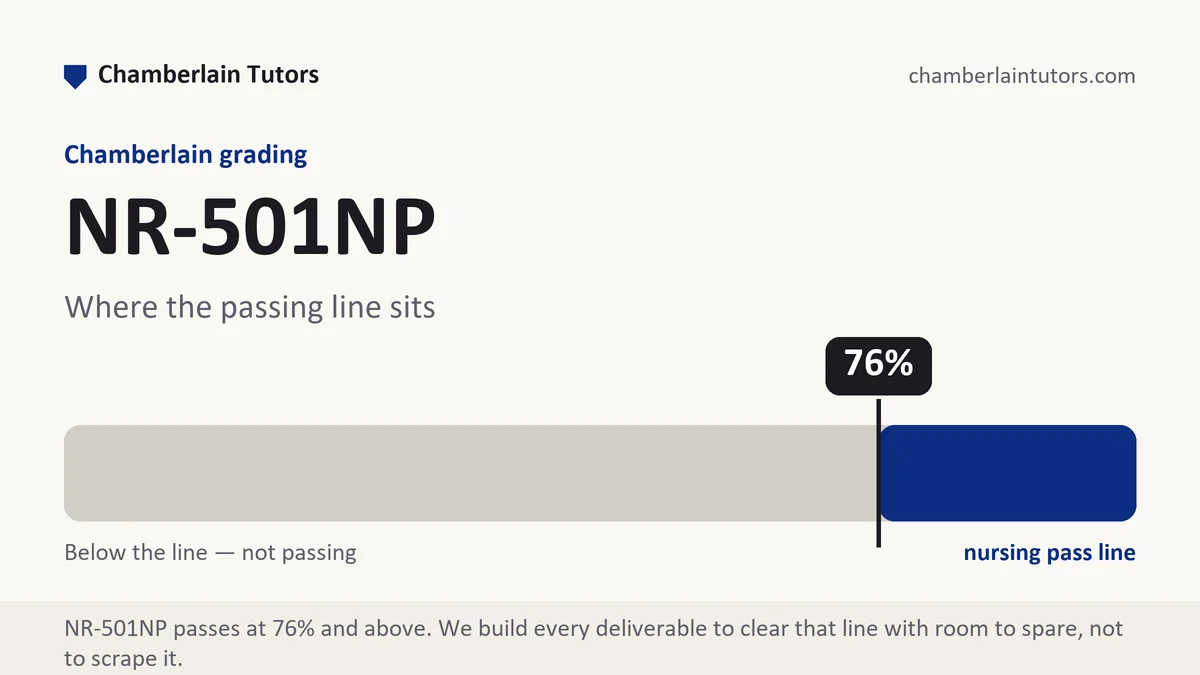
Final deliverables in an eight-week session are the heaviest of the set, commonly six to eight pages, and they land in the week when time is shortest and the weighted average is already mostly decided. On the nurse practitioner scale there is no C band, so a specialty grade below 84 does not pass, and a closing paper cannot be repaired by later work because there is no later work.
The NR-501NP Week 8 method, step by step
Six moves that turn a session of reading into a defended position.
-
Write your thesis as a sentence you could be wrong about
Not a statement everyone agrees with. A position with an alternative: that advanced practice is best understood as sustained partnership rather than as episodic problem solving, and here is what follows if that is right. If nobody could disagree, it is not a thesis and the paper has nothing to defend.
-
Take a position on each metaparadigm element
Person, health, environment and nursing, one paragraph each, written as claims rather than as definitions. Health as a fixed state, health as a capacity to meet demands, and health as something negotiated with a body that has changed are three different positions, and yours should be recognizable as one of them.
-
Anchor each position in a named theory
Say which framework your view of the person comes closest to, and where you part from it. Borrowing a theorist's shoulder is legitimate scholarship; adopting a theory wholesale without saying where you differ is what makes a philosophy paper read like a book report.
-
Argue against yourself once, properly
Give a competing view its best form, then say why you still hold your position. One well-made counterargument raises a closing paper more than three additional supporting paragraphs, and its absence is the most reliable marker of an undergraduate philosophy statement.
-
Make the position pay in a concrete practice change
Say what a patient would notice. Different opening question, different sequence in the visit, different follow-up interval, different person invited into the room. A philosophy that changes nothing observable is a preference, and a grader will read it as one.
-
Close on what you will test, not on what you believe
End with the part of your own position you are least sure of and what would change your mind about it. It is the most professional way to finish a graduate paper, and it also stops the last paragraph from turning into the inspirational summary this genre attracts.
A layout and word budget for a philosophy of practice paper
Sized for a closing paper of roughly 1,700 to 2,000 words. It is our own outline rather than a university-issued template, and your week's rubric outranks it wherever the two disagree.
| Section | What belongs in it | Word target |
|---|---|---|
| Thesis | The position in one or two sentences, with the alternative it is arguing against visible. | 110 to 140 |
| Person and health | Two positions stated as claims, each anchored to a named theory and each departing from it somewhere. | 380 to 450 |
| Environment and the practitioner's part | What counts as the environment in your setting, and what advanced practice contributes that another role does not. | 380 to 450 |
| Counterargument | A competing view given its strongest form, then answered on grounds rather than by restating your thesis. | 250 to 300 |
| What changes on Monday | Two or three concrete changes a patient would notice, each traced to a position you argued above. | 300 to 360 |
| What you will test | The least settled part of your own position and what evidence or experience would revise it. | 150 to 190 |
Evidence craft for a closing synthesis
A philosophy paper still carries citations. Beliefs are yours; the theoretical positions you are drawing on belong to their authors. Every paragraph that leans on a theorist should say whose idea is being leaned on, and the scholarly writing row is where an uncited philosophy paper loses points quietly.
Depth beats coverage in the source list. Two or three frameworks used seriously, with primary sources, outperform a reference list assembled to demonstrate that you did the readings. If a theorist shaped your position, cite the theorist rather than the course text summarizing them.
Keep empirical claims out of the philosophical passages. If you assert that patients in your setting behave a certain way, that is a claim about the world and it needs support with a design and a sample behind it. Positions about what health is do not need that support, and mixing the two makes both harder to assess.
Write the practice changes at a level you actually control. A closing paper that promises to transform a health system reads as unserious. What you control is the opening question, the sequence of a visit, the follow-up interval, who gets invited, and what you document, and a change written at that level is checkable.
Five mistakes that cost points in this week's territory
- Sincerity substituted for argument. Warm writing about why you became a nurse, with no defended position, is the most common shape of a low-scoring closing paper.
- A tour of the session. Every theory covered gets a paragraph and none gets an argument, which is the difference between a summary and a synthesis.
- Positions written as definitions. Saying what health means in the literature, rather than what you take it to be and why, leaves the metaparadigm section with nothing to grade.
- No counterargument. A paper that never meets an objection has not shown that the position was chosen rather than absorbed.
- Practice changes stated as aspirations. Advocating for holistic care is not a change. Beginning every follow-up visit with what the week has been like before reviewing the numbers is.
Before you submit
- The thesis is a claim someone could reasonably dispute
- All four metaparadigm elements carry a stated position rather than a definition
- Each position is anchored to a named theory and departs from it somewhere
- One counterargument appears in its strongest form and is answered
- At least two practice changes are specific enough for a patient to notice
- The close names what you are least sure of and what would revise it
Final paper due this week?
Send the prompt, the rubric and the theories that stayed with you. A premium original synthesis comes back in 24 to 48 hours with the position argued and the counterargument built, floor-checked before delivery.