NR-501NP is the nurse practitioner track's theory course. The material is the critique of nursing and related theories, and the pressure on an NP section is different: your graded writing has to land theory on a clinical problem you will meet in practice, without either dismissing theory as academic decoration or claiming more for it than a framework can deliver. This page is the manual for making that landing.
What NR-501NP actually grades
The scoring rows in an NP theory section keep circling one question: can you show a theory changing how a problem is understood, and therefore how a practitioner acts. That breaks into parts. You have to select a theory and defend the selection against alternatives. You have to translate the theory's abstract concepts into things observable in a clinical situation. You have to keep the theory's own logic intact while you do it. And you have to stop where the theory stops, because a framework that explains why a patient behaves a certain way does not by itself tell you what to prescribe or what to order.
Students arrive with strong clinical instincts and use theory as a label applied afterwards. The gradebook reads that immediately, because a theory applied afterwards leaves no marks on the reasoning it supposedly guided.
How we help in this course
Send the prompt, the scoring guide from Canvas, and the clinical problem or population you want to work with, since specificity here is what the rows pay for. The draft comes back with the theory selected on stated grounds, its concepts mapped to observable features of the problem rather than mentioned beside it, and the practice implications written at the level of what a practitioner could actually change. Where the theory runs out, the draft says so, because a stated limit scores better than an overreach.
Orders run the full route: guide decoded row by row, core work tagged apart from supplemental, a writer matched to theory and advanced practice material, a rubric pass followed by an independent APA and originality pass, the scale check against your section's floor, delivery inside 24 to 48 hours. What stays outside the service is the clinical record: hours, preceptor contact, site paperwork and logs are yours alone, and we do not touch any of them.
How to write this course's deliverables
Chamberlain publishes no syllabi outside Canvas, so nothing here pretends to know your week. The manual below is built from craft that survives any prompt: converting the scoring guide into a plan with a per point word rate, the mapping that turns theory into an application section with substance, and how to keep conceptual claims and empirical claims separate on the page.
In NR-501NP right now?
Send the week and the rubric from Canvas. First premium sample free, floor-checked, back in 24 to 48 hours.
No C band, and eight weeks to average
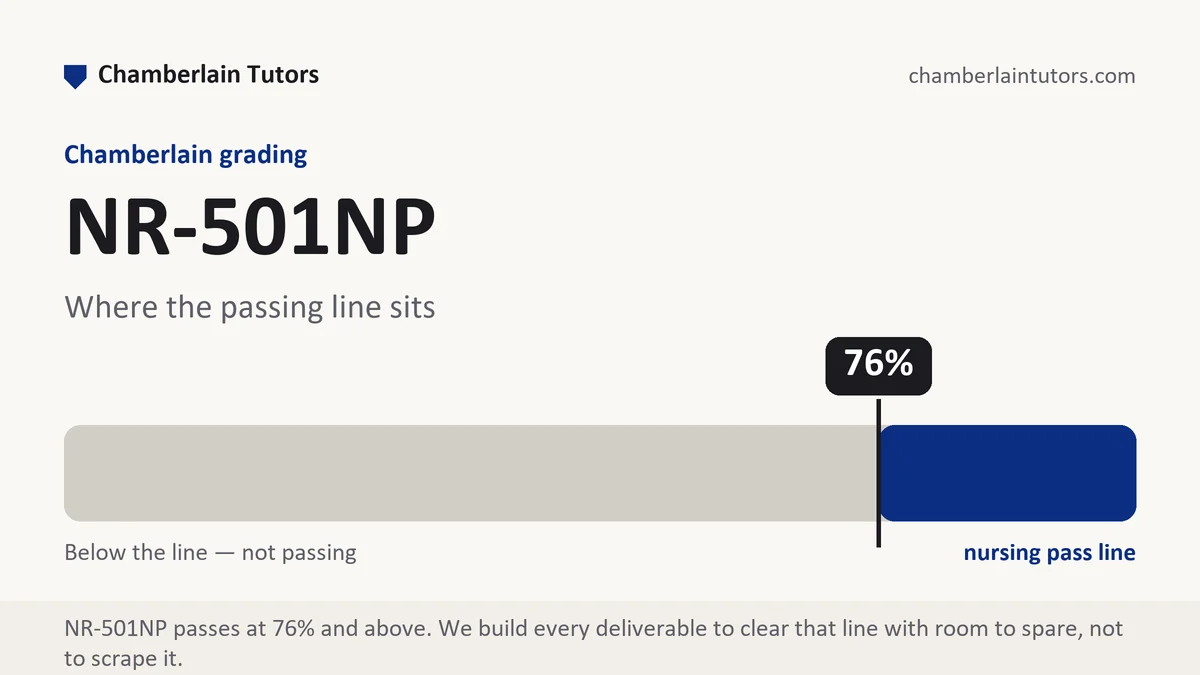
Specialty coursework on the NP scale has no C. The practical meaning is blunt: anything under 84 fails, so a paper that would have been a comfortable C in an undergraduate program is a failed submission here. A theory course is a common place for that to happen, because the work feels soft and the grading is not. Supplementary points cannot repair a weighted average that has already gone under, which puts the whole burden on the graded pieces as they are written.
The calendar leaves no slack either. Sessions run eight weeks inside a sixteen week semester, with something due every week, so a slow first fortnight is a quarter of the course. Boards are one shot at Chamberlain: once a post is submitted it does not reopen, and a misnamed concept then sits there permanently.
Convert the guide into a word rate
Read the scoring guide before you read the prompt twice. The prompt describes a task, the guide prices it, and in theory courses the prices are counterintuitive. Copy each row into a blank file as a heading in the guide's order, then reduce each to the verb it demands. Select and defend is a different job from describe. Map is a different job from discuss.
Then build a rate rather than percentages. Suppose the paper is capped at 1,500 words and the guide totals 100 points across five rows: the practice problem at 20, theory selection and rationale at 25, concept mapping at 25, application to advanced practice at 20, and APA and scholarly writing at 10. Set the APA row aside, since it is earned across the whole document. Hold back 150 words for the frame at either end. That leaves 1,350 words against 90 points, or 15 words per point. The problem section gets 300 words, selection and rationale 375, mapping 375, application 300.
The number worth staring at is 375 for selection rationale. Most students spend forty words saying they chose a theory because it fits, and the guide has just told you that sentence is worth a quarter of the paper. A rationale at full length names the alternatives you set aside and says why each fit worse. Work your own guide's figures rather than copying these.
Mapping a theory onto a clinical problem
The application section is where NP theory papers are won and lost. Build it as a mapping rather than a narrative, working left to right across the table below.
| Step | What it produces | What a grader sees when it is skipped |
|---|---|---|
| State the clinical problem narrowly | One population, one setting, one recurring difficulty, in three sentences | A problem broad enough that no theory could be shown working on it |
| Name the theory and its level | Whose theory, and whether it operates broadly or at middle range, which sets how much detail it can supply | A grand theory used where a specific mechanism was needed |
| Defend the selection | Two alternatives considered and set aside with reasons tied to the problem | A single sentence saying the theory is appropriate for this issue |
| Map concepts to observables | Each major concept paired with something you could actually see, ask about or measure in that population | Concepts listed in one paragraph and never used again |
| Carry a proposition through | A relationship the theory claims, restated as what you would expect to find in this problem | Description with no prediction, so nothing could be confirmed or contradicted |
| Say what practice changes | What a practitioner would ask, prioritize, teach or follow up differently because of the framework | A recommendation any provider would already make without the theory |
| Mark where the theory stops | The part of the problem the framework does not address, and what else you would need | A theory presented as if it covered diagnosis, treatment and adherence at once |
Keeping conceptual and empirical claims apart
Theory writing at NP level goes wrong in evidence handling more often than in reasoning. Four habits fix most of it.
Say which kind of claim you are making. A theory claim is about how concepts relate. An empirical claim is about what was observed in people. They take different support, and blending them produces sentences that sound authoritative and cannot be checked. Attribute the framework to its author and the finding to its study, in separate sentences if necessary.
Go to the theorist for the theory and to the literature for the evidence. A course text summarizing a theory is a reasonable starting point and a poor citation for a definition. If the theorist's own work is what you read, cite it. If you read a summary, attribute the summary. For the empirical half, where your guide sets no recency rule, keep sources inside five years unless the sentence itself explains why an older one still holds.
Report design and sample before any finding. Nine words of provenance change an assertion into evidence. In a cohort of 412 adults followed for eighteen months is the setup that lets the finding after it mean something. And match the verb to the design: observational work supports was associated with, occurred more often among and predicted, while caused, reduced and improved require a study that changed something deliberately and measured the outcome.
Every rate needs the count it came from and the window it covers. Write 34 of the 260 patients seen over one quarter rather than 13 percent of patients. Application sections lean on prevalence figures to justify the problem, and a figure with no base and no period cannot justify anything.
Passing paper, strong paper, in NR-501NP
A passing NR-501NP paper picks a recognized theory, describes it correctly, and applies it to a clinical topic in general terms. It is accurate, it is safe, and on a scale without a C band it sits uncomfortably close to the line.
A strong paper does three things a grader can point to. It argues the selection, treating the choice of theory as a claim that needs defending rather than a preference. It commits to a prediction, saying what the theory leads you to expect in this population, which is the difference between using a framework and mentioning one. And it draws the boundary, naming what the theory does not explain and what would have to come from evidence, guidelines or clinical judgment instead. Practitioners who mark these papers respond to that boundary, because overclaiming is the habit the course is trying to train out.
Six mistakes that cost points here
- Choosing a theory too broad for the problem. A wide framework applied to a narrow clinical question produces paragraphs that could describe anything.
- Selection with no rationale. If the guide weights selection, a sentence saying the theory fits is leaving a quarter of the paper on the table.
- Concepts named but never mapped. An application section that does not use the theory's own terms has not applied the theory.
- Theory used to justify a clinical decision it cannot reach. Frameworks explain patterns. They do not select therapy, and claiming they do is the overreach graders flag.
- Empirical and conceptual claims blended. Mixing what a theorist proposed with what a study found makes both unverifiable.
- Posting a board reply straight from the reply box. Posts do not reopen, and a misattributed concept stays visible for the whole session.
Questions NR-501NP students ask
Do nurse practitioners actually use nursing theory, or is this a hoop?
Is a middle range theory a safer choice than a grand theory?
How do I connect theory to my clinical reasoning without overclaiming?
The weeks, one by one
Week 1
NR-501NP Week 1 asks what counts as knowledge in nursing before it asks you to use any of it. Read the full Week 1 manual.
Week 2
NR-501NP Week 2 moves from what knowledge is to what a single word means, because theories are built out of concepts and a concept nobody has pinned down cannot hold a theory up. Read the full Week 2 manual.
Week 3
NR-501NP Week 3 takes on the largest structures the discipline built: the conceptual models and grand theories that tried to describe nursing as a whole. Read the full Week 3 manual.
Week 4
NR-501NP Week 4 drops from theories that describe all of nursing to theories that describe one thing well. Read the full Week 4 manual.
Week 5
NR-501NP Week 5 turns to the frameworks nursing did not build and uses anyway: health behavior models from public health, stress and coping from psychology, systems thinking from biology and management, adult learning theory from education, diffusion of innovation from sociology. Read the full Week 5 manual.
Week 6
NR-501NP Week 6 is the stage where the theory has to do work. Read the full Week 6 manual.
Week 7
NR-501NP Week 7 joins the two halves of graduate nursing that students usually keep apart: the theory that says why something happens and the evidence that says whether an intervention works. Read the full Week 7 manual.
Week 8
NR-501NP Week 8 closes the session by asking you to state a position and defend it: what you believe about the person you treat, about health, about the setting you work in, and about the practitioner's part in all three, argued through the theory you spent the session reading. Read the full Week 8 manual.