NR-501 Week 3 works the top of the ladder, where conceptual models and grand theories describe nursing as a whole rather than one problem inside it. Your section may print this as NR 501 or NR501; it is the same course. Chamberlain publishes no syllabi outside Canvas. The placement here is our teaching judgment from the course's catalog arc; your section's rubric decides what your week actually asks.
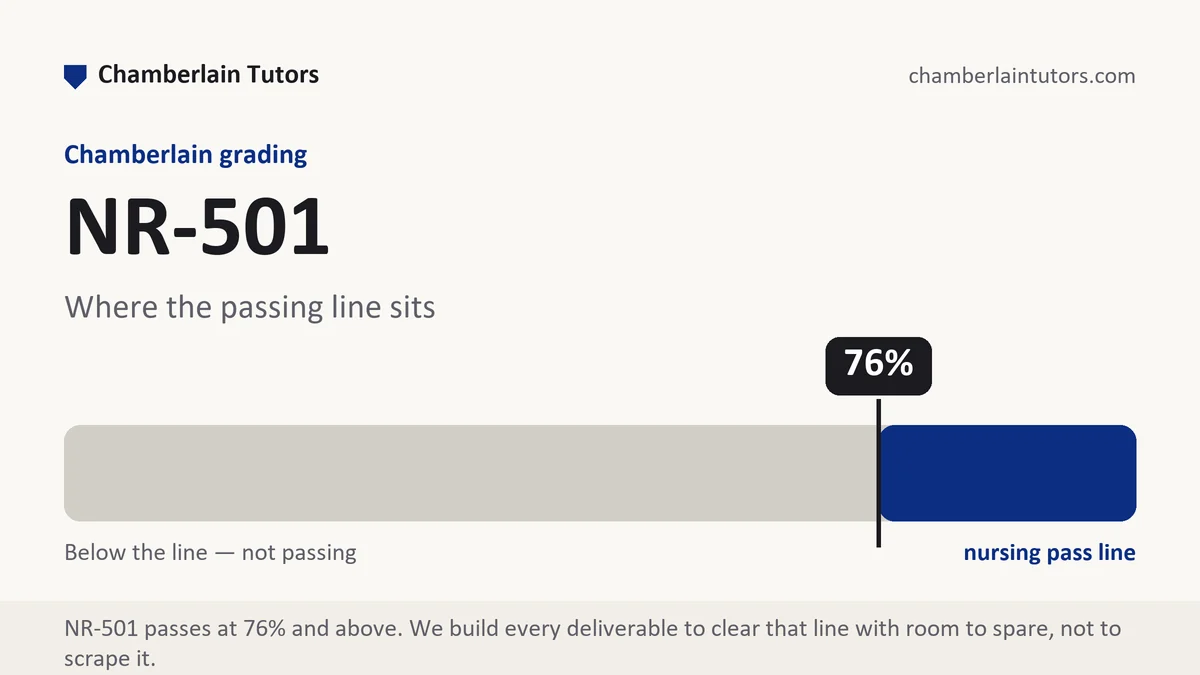
What NR-501 Week 3 asks for
A grand theory is built to cover the discipline. It names what nursing is for, what a person is, what the nurse is doing when care happens, and it does so at a level of generality that no single study could test. Conceptual models sit alongside them as organized sets of ideas that orient practice without claiming the tight relational structure a theory claims. The stage asks you to handle that scale honestly rather than shrinking it to a slogan.
The reasoning being scored is structural. Read a grand theory and you should be able to state its assumptions, its major concepts, the relationships it proposes between them, and what it takes to be the goal of nursing action. Then you should be able to say what follows for practice, which is harder than it sounds, because a theory covering everything gives you no instructions about anything until you supply the specifics yourself.
Deliverables in the middle stages of an eight-week session typically grow from a short response into a fuller written analysis, and this is often where the first substantial paper of the course lands. If your section runs a discussion this week, note that posts do not reopen once submitted in Canvas, and grand theory vocabulary is unforgiving: using a theorist's term in its ordinary English sense is visible to a specialist reader in one line.
The NR-501 Week 3 method, step by step
Six moves that keep a large theory from collapsing into a summary.
-
Turn your week's rubric into the paper's skeleton
Rows in a theory analysis are usually parts rather than qualities: assumptions, concepts, relationships, application, evaluation. Use them as headings in the guide's order, because a grader scoring the assumptions row should not have to find it inside a narrative.
-
Start with the problem the theorist was answering
Every grand theory was built against a background: a view of care that its author found insufficient. Naming that background in two sentences explains the theory's shape better than any list of concepts, and it sets up your evaluation later.
-
State assumptions before concepts
Assumptions are what the theory takes as given and does not argue for. They are also where a theory can be challenged most fairly, and a paper that lists concepts without ever surfacing an assumption has skipped the most analytical section available to it.
-
Draw the relationships as sentences with direction
Concepts alone are vocabulary. Write the propositions in the form this influences that under these conditions, using the theorist's own terms. If you cannot write three such sentences, you have a description of the theory rather than an account of it.
-
Descend to a practice question and supply the specifics
Choose one narrow advanced practice problem and translate each major concept into something identifiable in that situation. The translation is the work: the theory supplies the categories, you supply the particulars, and the paper shows the join.
-
Judge the theory on scope rather than on taste
A grand theory buys reach by giving up precision, so evaluate it on what that trade costs. Say where the generality helps a nurse see something they would have missed, and where it leaves a decision underdetermined.
A layout and word budget for a grand theory analysis
Below is the frame our tutors keep beside this work, sized for a paper of roughly 1,500 to 1,800 words. It is our own outline rather than anything the university issues, and your week's rubric outranks it wherever the two disagree. Scale each target proportionally if your assigned length differs.
| Section | What belongs in it | Word target |
|---|---|---|
| Theory and context | The theory named, placed on the ladder, and the practice problem of its era that it was built to answer. | 150 to 190 |
| Assumptions | What the account takes as given about persons, health and care, stated as the theorist stated them. | 200 to 240 |
| Major concepts | The theory's own terms, defined in its vocabulary, with any term that differs from ordinary usage flagged. | 280 to 330 |
| Propositions | Three or four directional statements linking the concepts, written as claims that could in principle be wrong. | 230 to 270 |
| Application to one problem | A single narrow practice situation with each concept given a concrete referent inside it. | 350 to 420 |
| Scope, limits and close | What the theory's breadth buys, what it costs, and one decision it cannot settle on its own. | 200 to 250 |
Evidence craft for high abstraction work
Go to the primary work for the theory's own claims. Grand theories have been summarized thousands of times and the summaries have drifted. Where you are stating what the theory says, the theorist's own text or a scholarly edition of it is the source, and a chapter summary is a fallback you should name honestly when you use it.
Use current literature for the application, older work for the framework. A theory published decades ago is not out of date as a framework, but a study you use to show it operating in a modern setting should be recent. Where your guide sets no rule, treat five years as the boundary for empirical sources and defend any older choice in the sentence.
Do not upgrade a theory into a finding. A grand theory proposes and orients. It does not demonstrate, prove or establish, and writing that it does is the single error a theory grader marks most reliably. Keep two verb families running and never let them mix in one sentence.
Attribute later interpreters separately from the theorist. Scholars extend and reinterpret grand theories, sometimes substantially. If your account leans on an interpretation, cite the interpreter for that part rather than folding it into the original attribution, because a reader who knows the primary text will notice the difference.
Five mistakes that cost points in this week's territory
- Biography in place of structure. Where the theorist trained and what awards followed is background. The graded material is what the theory claims and how the claims connect.
- Concepts without direction. A list of terms with no proposition linking them leaves the analysis row empty however accurate the definitions are.
- Demanding testability from a grand theory. Criticizing a theory of this scale for not being measurable evaluates it against the wrong standard and shows the ladder was never understood.
- An application that stays general. Applying a broad theory to a broad problem produces two layers of abstraction and no analysis. Narrow the problem until specifics are forced.
- Ordinary meanings quietly substituted. Words like system, adaptation, environment and self-care carry technical definitions in these accounts, and using the everyday sense rewrites the theory without telling the reader.
Before you submit
- The theory is placed on the ladder in the first paragraph
- Assumptions appear as their own section before the concepts
- At least three propositions are written with direction and conditions
- Every technical term is used in the theorist's sense throughout
- The application names one narrow problem, not a category of problems
- The evaluation judges scope rather than offering approval
Grand theory paper due in NR-501?
Send the instructions and the rubric out of Canvas. A premium original draft comes back in 24 to 48 hours with assumptions surfaced and propositions written out, and revisions run until the grade lands.