NR-501 Week 1 sets the map before any single theory is examined: the four concepts nursing theories all address, and the tiers of abstraction that separate a philosophy from a bedside protocol. Your section may print this as NR 501 or NR501; it is the same course. Chamberlain publishes no syllabi outside Canvas. The placement here is our teaching judgment from the course's catalog arc; your section's rubric decides what your week actually asks.
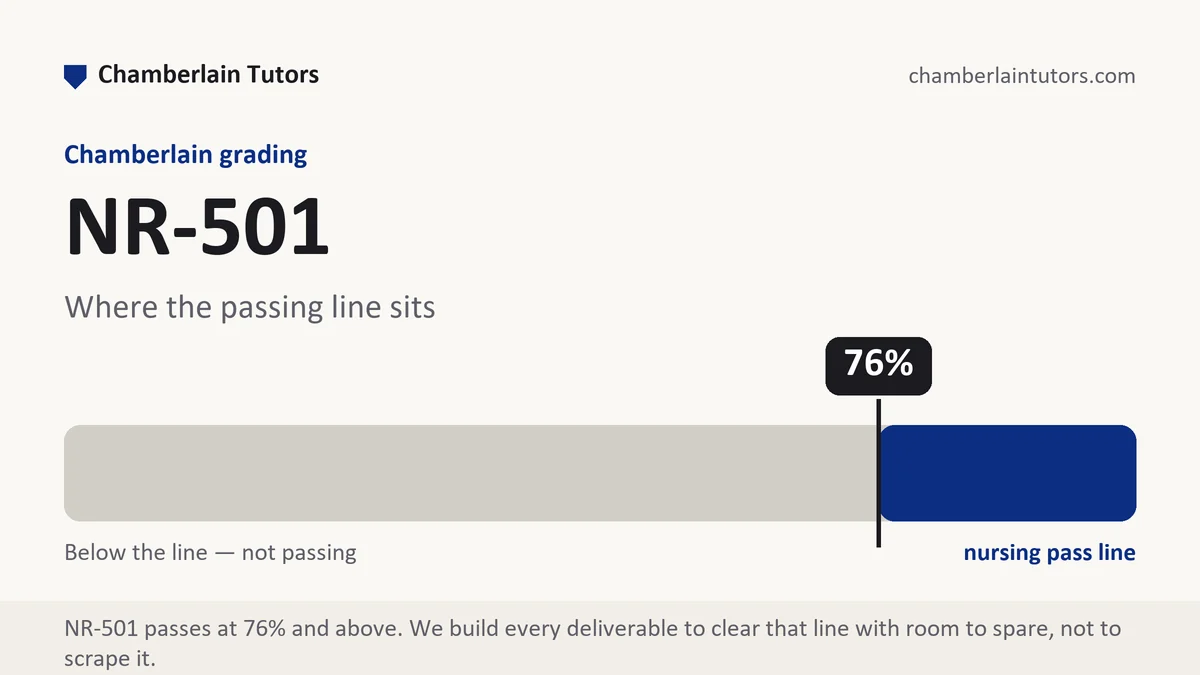
What NR-501 Week 1 asks for
Two structures carry the opening stage of a theory course. The first is the metaparadigm: person, environment, health and nursing, the four concepts every nursing theory says something about, whether or not it names them. The second is the ladder of abstraction, running from philosophies through conceptual models and grand theories down to middle range and practice level theory, where each rung trades generality for testability.
Graduate work here is not a set of definitions. The reasoning being bought is comparative: given a theory, can you say what it treats person as, what it counts as environment, whether health is a state or a process in its account, and what it takes nursing to be for. Two theories that both use the word health can mean very different things by it, and noticing that difference is the whole skill the stage installs.
Opening stages in an eight-week session usually carry a short written response or a posted response in the classroom, sometimes both, because faculty want a reading of how you handle abstraction before the heavier analysis stages land. If your section runs a discussion this week, note that posts do not reopen once submitted in Canvas, and misattributing a concept in a theory course is the error most visible to a specialist reader.
The NR-501 Week 1 method, step by step
Five moves that turn abstract material into writing a grader can follow.
-
Convert your week's rubric into headings before reading the theory
Each scoring row becomes a heading in the order the guide prints it, stripped to its verb. In theory work, compare and differentiate are the rows that pay, and a paper organized as definitions will not reach them no matter how accurate the definitions are.
-
Fix the rung on the ladder first
Say at the outset whether the material you are handling is a philosophy, a conceptual model, a grand theory or a middle range theory. The rung sets what you can fairly demand of it, because asking a grand theory for testable predictions is a category error and reads as one.
-
Fill the four concepts one at a time, in the theory's own words
Person, environment, health, nursing. Write what each one means inside the account you are examining, using the vocabulary the author used rather than a synonym. Where a theory is silent on one of the four, say so plainly, because silence is itself a finding.
-
Put two accounts side by side and find the disagreement
Comparison earns points that summary cannot. Choose one of the four concepts and show two theories treating it differently, then say what the difference implies for a nurse who adopts one of them.
-
Bring it down one rung to practice
Close by taking the abstract account and asking what it would change about a single decision an advanced practice nurse makes. That descent is the move the course is training, and the earlier you practise it the less mechanical it feels later.
A layout and word budget for an orientation piece
Below is the drafting frame our tutors keep beside a first theory submission, sized for roughly 900 to 1,100 words. It is our own outline rather than anything the university issues, and your week's rubric outranks it wherever the two disagree. Scale each target proportionally if your assigned length differs.
| Section | What belongs in it | Word target |
|---|---|---|
| Opening frame | Why a discipline needs shared concepts at all, stated in two sentences and never repeated later. | 70 to 90 |
| The four concepts defined | Person, environment, health and nursing, each given the meaning the source you are using assigns it. | 200 to 240 |
| Levels of abstraction | The ladder from philosophy to practice level theory, with what each rung can and cannot deliver. | 180 to 220 |
| One account placed on the ladder | A single theory positioned on a rung, with the reason it sits there rather than one rung up or down. | 170 to 200 |
| A comparison that finds a difference | Two accounts of one concept set against each other, with the practical consequence of choosing between them. | 180 to 210 |
| Close | What the map buys a practising nurse, answered rather than summarized. | 60 to 80 |
Evidence craft for the theory map
Attribute the metaparadigm rather than treating it as folklore. The four concepts have an authorship and a publication history, and the phrasing has been revisited by later writers. A paper that presents them as common knowledge loses the support row that a single dated citation would have secured.
Read the theorist or say that you did not. Textbook chapters summarize theories accurately and flatten them in the process. If your account came from a chapter, cite the chapter honestly rather than the original work, because a specialist reader recognizes a well known secondary summary reproduced word for word.
Keep two clocks. A theory has an origin date and a commentary literature has a current date. An account written decades ago can be entirely current as a framework, while the sources you use to show it in use should be recent. Where your guide sets no rule, treat five years as the default limit for empirical work and defend any exception in the sentence itself.
Match the verb to the kind of claim. Theories propose, frame, posit and explain. Studies find, report and observe. Writing that a conceptual model proved anything is a category error, and it is one a theory grader marks every time it appears.
Five mistakes that cost points in this week's territory
- Four definitions with no theory attached. Person, environment, health and nursing defined in the abstract is a glossary. The rows want those concepts filled in by a named account.
- Confusing a philosophy with a theory. They sit on different rungs, answer different questions, and mixing them produces demands the material was never built to meet.
- Ordinary English standing in for technical terms. Environment in a nursing theory rarely means surroundings, and substituting the everyday sense quietly rewrites the theory you were asked to report.
- Summary where comparison was asked for. Two theories described one after the other are not compared. The comparison is the sentence that names what they disagree about.
- Abstraction with no descent. A stage spent entirely above the level of practice leaves the application row empty even when every definition is correct.
Before you submit
- The level of abstraction you are working at is named in the first paragraph
- All four concepts are addressed, including any the theory leaves silent
- Every definition is the source's own, not a dictionary substitute
- At least one sentence states a difference between two accounts
- The closing section names a decision the theory would change
- Every reference appears in the text and every in-text citation appears in the list
Opening NR-501 this week?
Send the instructions and the rubric out of Canvas. A premium original draft comes back in 24 to 48 hours with the theory vocabulary used correctly throughout, and revisions run until the grade lands.