NR-501 asks you to examine and critique nursing theories, along with theories borrowed from other disciplines, and to say what they contribute to advanced practice and to evidence based practice. The verb that matters in that sentence is critique. Reporting what a theorist proposed is the entry price. Judging a theory, on stated criteria, and saying where it holds and where it does not, is what the scoring rows are actually buying.
What NR-501 actually grades
Three abilities, layered. Can you read a theory accurately, meaning you can state its major concepts, the relationships it claims between them, and the assumptions it rests on without turning them into slogans. Can you judge it, meaning you can apply evaluation criteria such as clarity, simplicity, generality, accessibility and testability, and reach a verdict rather than a summary with adjectives. And can you connect it to practice, meaning you can show a theory doing work on a problem a nurse would recognize, including the places the fit strains.
The course is difficult for practical people in a particular way. Theory feels abstract, so students compensate by rushing to application, and the application paragraphs then float free because the analysis underneath them was never done. The heaviest scoring row is almost always the analysis one, and it is the one most often written last and shortest.
How we help in this course
Send the prompt, the scoring guide from Canvas, and the theory if your section has assigned one rather than leaving the choice open. The draft comes back with the theory's own vocabulary used correctly and consistently, concepts and propositions separated rather than blended, evaluation criteria named before they are applied, and a practice application that could not be moved to another theory without breaking. If the theory you picked is a poor match for the problem the prompt describes, we say so before drafting instead of forcing it.
The order runs the standard route: your guide decoded row by row, core deliverables separated from supplemental ones, a writer matched to nursing theory work, a rubric pass then an independent APA and originality pass, the scale check against your section's floor, delivery inside 24 to 48 hours.
How to write this course's deliverables
Chamberlain publishes no syllabi outside Canvas, so a week by week grid would be fiction. This manual is organized by craft instead: how to turn the scoring guide into a plan with a word budget, what a theory analysis has to contain part by part, and how to source theoretical claims so a grader can trace every one of them. It holds whichever theory your section assigns and whichever shape the deliverable takes.
In NR-501 right now?
Send the week and the rubric from Canvas. First premium sample free, floor-checked, back in 24 to 48 hours.
An abstract course with concrete arithmetic
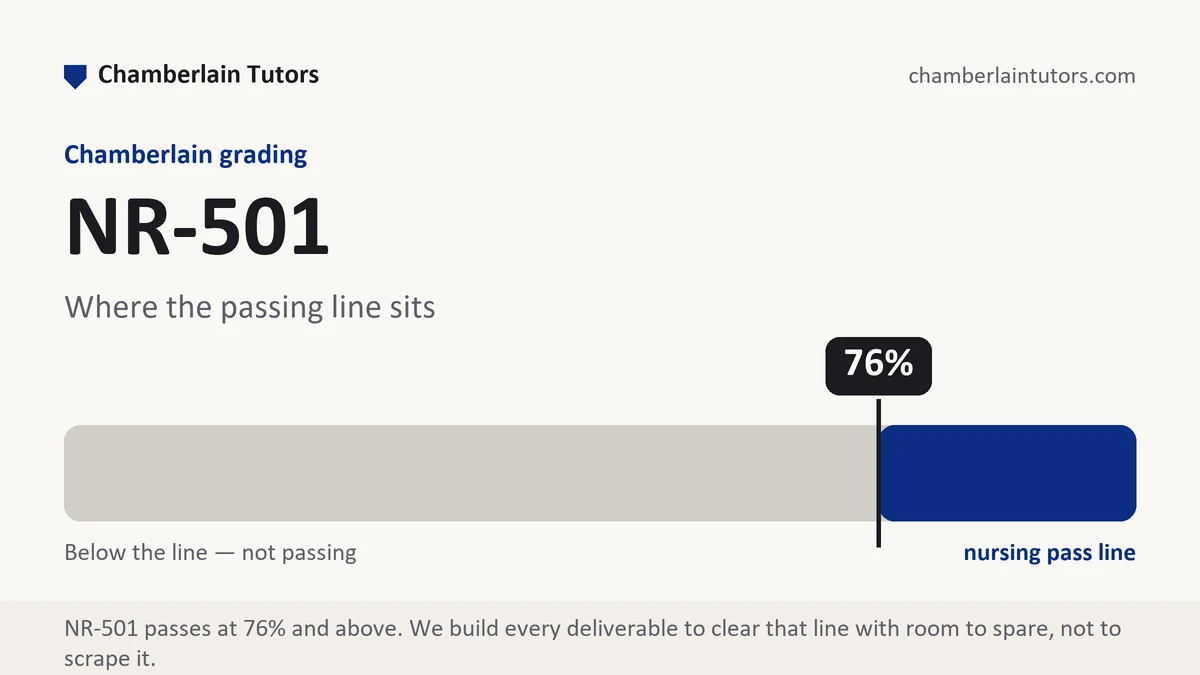
Theory courses tend to be graded with unusual precision, because a grader can check whether you attributed a concept correctly in a way they cannot check whether your reflection was sincere. The 76 percent floor applies as in any core nursing course, core assignments are averaged apart from supplemental ones, and supplementary work cannot lift a weak weighted average once the main pieces are in. In an eight week session with something due every week, there is no quiet stretch in which to fix a poor start.
One rule catches theory students specifically. Discussion boards do not reopen after submission, and theory boards are where misattributions happen most. Draft the post elsewhere, check the attribution against the source you actually read, then paste.
Read the scoring guide first, then spend the words
A prompt in this course usually says something like select a theory and discuss its application to advanced practice. That sentence is not a plan. The scoring guide is, because it tells you how much of the paper each part is worth, and in a theory paper the weights are almost never distributed the way instinct suggests. Copy the rows into a blank document as headings in the guide's order, strip each to its verb, and treat a row that says analyze or evaluate as a demand for a judgment with reasons, not a longer description.
Then convert weight into words. Take a paper capped at 1,750 words with four rows: theory analysis at 40 percent, application to advanced practice at 30, evaluation of the theory's usefulness at 20, and scholarly writing with APA at 10. Multiply the three content rows against the cap and you get 700 words, 525 words and 350 words. The writing row has no section of its own, so give its 175 words to the opening and closing, which is a generous frame and should be spent on stating the problem and naming the theory rather than on the history of nursing science.
Now look at the 700. Few students would write 700 words of analysis unless the arithmetic told them to, which is exactly why the row is worth 40 percent. If your guide uses points rather than percentages, divide the words available by the points available and work from that rate.
The parts of a theory analysis
Whatever the deliverable is called, a graduate theory analysis moves through this ground. Each part carries a job, and each has a familiar weak version.
| Part | What it has to establish | The weak version graders see |
|---|---|---|
| The theory identified and placed | Whose theory, from what tradition, and at what level of abstraction it operates | A theorist's name and a publication year with no orientation |
| Origins and assumptions | What the theorist took as given, and what problem in nursing the theory was built to answer | A biography paragraph about the theorist's career |
| Major concepts defined | The theory's own terms, defined as the theorist defined them, not as ordinary English | Dictionary definitions of words the theory uses technically |
| Propositions and relationships | What the theory claims connects to what, and in which direction | Concepts listed as a vocabulary set with no relationships stated |
| Evaluation on named criteria | Criteria stated first, then the theory judged against each one, with a verdict | Adjectives such as comprehensive and useful, offered without a standard behind them |
| Application to a practice problem | A specific problem examined through the theory's concepts, so the theory does the analytical work | A practice story followed by a sentence saying the theory applies to it |
| Limits of fit | Where the theory explains less well, and what that costs a nurse who relies on it | No limits section, or one sentence conceding the theory is not perfect |
Sourcing theory without losing the trail
Theoretical writing has its own citation traps, and four habits handle most of them.
Read the theorist, or say that you did not. Textbook chapters summarize theories well, and summaries flatten them. If your account of a theory comes from a chapter rather than from the theorist's own work, attribute the chapter honestly rather than citing the theory as though you read it firsthand. Graders in a theory course notice when a definition matches a well known secondary summary word for word.
Keep two clocks running. A theory has an origin date and a literature has a current date. The theory can be forty years old and still current as a framework; the studies you use to show it working should be recent unless you say why an older one earns its place. Where your guide sets no recency rule, treat five years as the default boundary for empirical sources and justify exceptions in the sentence.
Match the verb to the kind of claim. A theory proposes, posits, frames and explains. A study finds, reports and observes. Writing that a theory proved something is a category error, and it is one graders in this course mark every time. When you move to the evidence supporting an application, keep the same discipline: observational work supports was associated with and occurred more often among, while caused and reduced belong only where an intervention was applied deliberately and measured.
Give any figure its base and its stretch of time. Application sections often reach for a statistic to prove the problem is real, and the statistic arrives naked. Say what was counted, out of how many, and over what period, before the proportion appears. Nineteen of the 240 patients readmitted within thirty days carries weight. Eight percent of patients does not, because the reader cannot tell whether the denominator was a unit, a system or a year.
Passing analysis, strong analysis, in NR-501
A passing NR-501 paper describes a theory accurately, lists its concepts, and closes with a plausible application. Nothing in it is wrong. It also never reaches a judgment, and the scoring rows that pay best are the judging rows.
A strong paper differs in three ways that are visible within a page. It states its evaluation criteria before it evaluates, so the reader knows what standard is being applied and can disagree with it, which is what makes it a critique rather than an opinion. It keeps the theory's vocabulary alive in the application section, so the analysis could not be transplanted to a different theory by find and replace. And it names a limit and follows it somewhere, saying what a nurse relying on this theory would miss and what would have to be added. A paper that concedes nothing reads as unexamined enthusiasm, and enthusiasm is not a scoring row.
Six mistakes that cost points here
- Biography instead of analysis. Where the theorist trained and worked is background. The scoring row wants the theory's structure.
- Concepts without propositions. Listing a theory's terms is half the work. What the theory says connects to what is the other half, and it is the graded half.
- Evaluating with adjectives. Useful, comprehensive and holistic are verdicts with no criteria attached, and they score as description.
- Application that could be any theory. If the practice section survives swapping the theory out, the theory was decoration.
- Citing the summary as the source. Attribute the chapter you read, or read the original. Reference lists get checked against the text mechanically.
- Skipping the limits. A critique with no limits section has answered a different assignment, and it is usually the cheapest row to recover.
Questions NR-501 students ask
Can I use a theory from outside nursing?
How do I evaluate a theory without sounding like I am attacking a respected scholar?
My application section keeps being marked as superficial. What is missing?
The weeks, one by one
Week 1
NR-501 Week 1 sets the map before any single theory is examined: the four concepts nursing theories all address, and the tiers of abstraction that separate a philosophy from a bedside protocol. Read the full Week 1 manual.
Week 2
NR-501 Week 2 moves from the map of theory down to its bricks: concepts, the way they are defined, and the disciplined procedure for taking one apart. Read the full Week 2 manual.
Week 3
NR-501 Week 3 works the top of the ladder, where conceptual models and grand theories describe nursing as a whole rather than one problem inside it. Read the full Week 3 manual.
Week 4
NR-501 Week 4 drops a rung on the ladder to the level where theory becomes usable: middle range accounts narrow enough to be tested and specific enough to shape a plan of care. Read the full Week 4 manual.
Week 5
NR-501 Week 5 takes up the theories nursing did not build: accounts from psychology, sociology, education, management and systems thinking that the discipline uses anyway, and the argument required to use them well. Read the full Week 5 manual.
Week 6
NR-501 Week 6 is the critique stage, where a theory stops being reported and starts being judged against standards you state out loud before you apply them. Read the full Week 6 manual.
Week 7
NR-501 Week 7 joins the two halves the course has been holding apart: how a theory generates a study, and how the findings return to change what the theory claims. Read the full Week 7 manual.
Week 8
NR-501 Week 8 asks for the payoff: a proposed change in advanced practice where a theory does real work in the design, not a change with a theory attached at the end. Read the full Week 8 manual.