NR-449 Week 1 sits at the point where a clinical irritation becomes a researchable question, and the opening written work in an evidence course almost always asks you to perform that conversion on paper: name a problem you have actually seen, define who it touches, and shape it into a question that published research could answer. Your section may print this as NR 449 or NR449; it is the same course. Chamberlain publishes no syllabi outside Canvas. The placement here is our teaching judgment from the course's catalog arc; your section's rubric decides what your week actually asks.
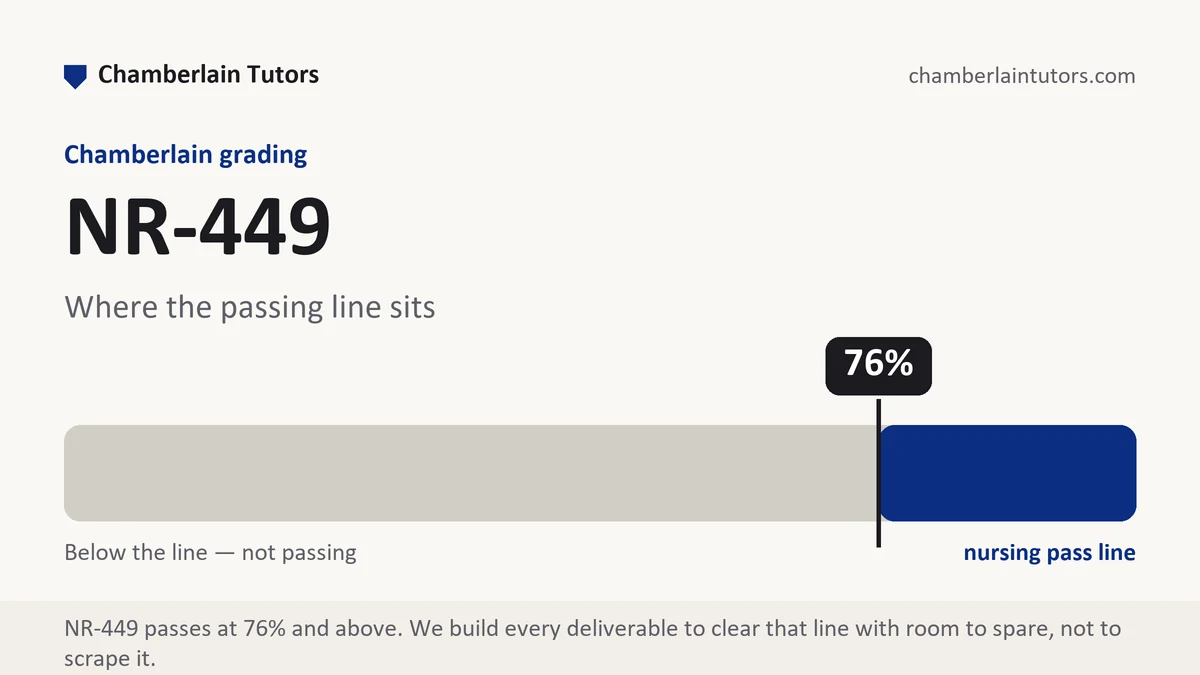
What NR-449 Week 1 asks for
Picture the scene that starts most good evidence questions. A skilled nursing facility takes an admission from the hospital on a Friday evening, the resident is oriented on arrival, and within forty-eight hours she has fallen twice in the corridor outside her new room. Nobody on the unit did anything wrong in the chargeable sense, and yet everyone who was there can feel that something in the transition failed her. An evidence based practice course exists to teach you what to do with that feeling: not to write an incident report about it, which is the facility's business, but to turn it into a question that the published literature can be made to answer.
Because NR-449 is a lecture course rather than a clinical one, the graded work is entirely written, and the opening stage usually carries a short piece in which you present a clinical problem and begin structuring it. Some sections run this as a discussion post, some as a brief paper, some as both. Whatever the container, the intellectual task is the same: move from a story to a problem statement, and from a problem statement to a question with parts a librarian could search. The story about the Friday admission is where you start, not where you finish.
The skill being installed this week is precision about populations and outcomes, and it pays off for the rest of the session. A student who writes that falls are a problem in older adults has said something true and unsearchable. A student who writes that newly admitted long-term-care residents in their first week after hospital transfer fall more often than established residents, and asks what admission-period interventions reduce that difference, has built the spine of every assignment that follows. Faculty read opening submissions partly for writing quality and partly for whether the question you pick can survive seven more weeks of work, so choose one with published evidence behind it rather than the rarest thing you ever witnessed.
The NR-449 Week 1 method, step by step
Six moves that turn a bedside observation into a question a database can answer.
-
Problem observation
Write the clinical situation as one concrete paragraph before you generalize anything: the setting, the people, what happened, and what it cost. Specificity here is raw material. A vague problem produces a vague question, and a vague question produces an unmarkable search next week.
-
Population definition
Name who the problem belongs to in terms a study could recruit: age range, care setting, condition or circumstance. Residents within thirty days of facility admission is a population. The elderly is a demographic mood. The narrower phrase will find you better articles and a better grade.
-
Intervention and comparison naming
Say what you suspect might help and what it would be measured against, even provisionally. The comparison is usually current practice, and stating that explicitly matters, because a question with no comparator reads as a topic rather than an inquiry.
-
Outcome selection
Choose an outcome that is countable and already counted somewhere: fall rates, readmission within a window, pressure injury incidence, medication discrepancies at transfer. Feelings of safety are real but hard to search as a first outcome; pick the measurable one and mention the human one alongside it.
-
Question assembly
Put the parts into whichever structured question format your section teaches, and label the parts so the grader can see each one. Structured formats exist to prove completeness at a glance; using one loosely defeats its purpose, and the writing row usually notices.
-
Significance drafting
Close with why the question deserves eight weeks of attention, supported by at least one published source about the scale or cost of the problem. Your own unit story illustrates significance; a national statistic from a named organization establishes it.
A layout and word budget for a question formation paper
This is the frame our tutors keep beside an opening evidence submission, sized for roughly 700 to 1,000 words, which is the range these early pieces commonly occupy. It is our own outline rather than anything the university issues, and your section's instructions outrank it wherever the two disagree. Scale proportionally if your assigned length differs.
| Section | What belongs in it | Word target |
|---|---|---|
| The clinical problem | One concrete scene from practice or clinical rotation, told in specifics: setting, population, event, cost. | 120 to 150 |
| Problem statement | The scene generalized into a single declarative sentence about who experiences what, where, and how often. | 60 to 90 |
| Significance | Published support for the problem's scale, with the issuing organization and year named in the sentence. | 150 to 190 |
| The structured question | Each component labeled and phrased in searchable terms, then the assembled question written out in full. | 120 to 160 |
| Search preview | What kind of evidence you expect to find and where you would look first, in two or three sentences. | 80 to 110 |
| Closing rationale | Why this question, this population, this term; what answering it could change at unit level. | 80 to 110 |
Evidence craft for question formation
The problem must be documented, not just witnessed. Your scene from a rotation or a shift gives the paper life, but the claim that the problem is widespread needs a published source behind it. Professional organizations and federal agencies publish figures on falls, readmissions, and care-transition failures; naming one, with its year, converts your observation into a supported problem.
Keep the anecdote in its lane. The scoring pattern in evidence courses rewards the sequence of claim, source, illustration. When the story about the new admission who fell twice comes before any evidence, the paper reads as personal grievance; when it comes after a cited statistic, it reads as the statistic made visible. Same material, different order, different grade.
Search-test your terms before you commit to them. Ten minutes in a database this week saves a rebuild next week. If the population phrase you chose returns almost nothing, the flaw is usually in your wording rather than in the literature, and the time to discover that is before the question is graded.
Numbers arrive with a base and a window. If you cite that falls occur at some rate, keep the denominator and the period attached: per thousand resident-days, per hundred admissions, over a year. A bare percentage in a significance paragraph invites the one question you cannot answer, which is: of what?
Five mistakes that cost points in this week's territory
- Choosing a problem for its drama instead of its literature. A rare, shocking event makes a gripping paragraph and an unanswerable question. Pick the common problem; it has the evidence base.
- A population defined by adjectives. Vulnerable elderly patients cannot be searched. Adults over sixty-five within thirty days of transfer to long-term care can.
- Outcomes nobody measures. Dignity and comfort matter, but a first evidence question needs an outcome that appears in study results tables, or the whole session runs uphill.
- Skipping the comparator. Without an against-what, your question is a topic sentence. Current practice is a perfectly good comparison; say it.
- An unsourced significance paragraph. Claiming a problem is common on your own authority forfeits the support row before the grader reaches your question.
Before you submit
- The clinical scene names a setting, a population, and a cost
- The problem statement is one sentence a stranger could act on
- At least one published source with a named organization and year supports significance
- Every component of the structured question is labeled and searchable
- The outcome you chose is one that studies actually count
- Every reference appears in the text and every citation appears in the list
Starting NR-449 this week?
Send the instructions and the rubric out of Canvas. A premium original draft comes back in 24 to 48 hours with a searchable question built from your own clinical scene, and revisions run until the grade lands.