NR-444 Week 5 sits in the stretch of the session where plans meet rooms, and the written work usually turns on the implementation account: a disciplined record of what your community intervention actually did when it ran, told against the plan rather than instead of it. This is the assignment the 144 clinical hours exist for. The 96-hour version of the community course can stop at a proposal; this one buys enough site time for delivery, and delivery invites the question no proposal ever faces: what happened, and how do you know. Your section may print this as NR 444 or NR444; it is the same course. Chamberlain publishes no syllabi outside Canvas. The placement here is our teaching judgment from the course's catalog arc; your section's rubric decides what your week actually asks.
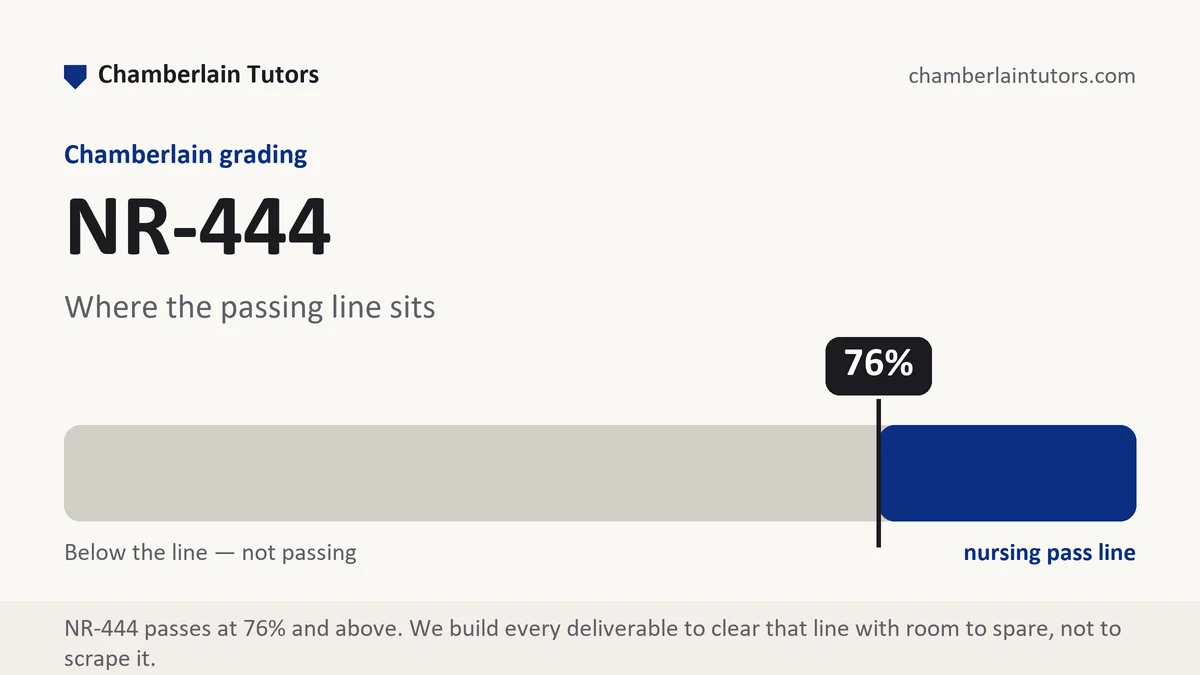
What NR-444 Week 5 asks for
What does an honest delivery account sound like? Start where the plan bent. The senior center's activity room was booked for ten, the flyer said ten, and at ten past the hour there were six people at tables set for twenty, one of them mostly there for the coffee. The student delivering a fall-prevention teach-back had planned for stations and ran a single circle instead, and by the end the six had each demonstrated a sit-to-stand and named one hazard in their own homes. A weaker writer would report a successful session. A stronger one reports exactly the scene above: planned twenty, drew six, adapted the format, met the demonstration objective with all six, and knows why the flyer failed. The second version scores higher in every rubric territory this stage touches, because implementation rows grade fidelity, adaptation and honesty, not attendance.
Why is the plan the spine of the account? Because implementation only means anything against intention. The write-up walks the reader through what was planned, what occurred, where the two diverged and why, using the process objectives you set earlier as the checkpoints. Counts belong everywhere counts exist: who came, what was distributed, what was completed. This is also the stage where your evaluation instrument, named weeks ago, gets administered, and the account should record that it was, with the results held for the fuller evaluation write-up to come.
Whose work is the delivery itself? Yours, entirely, and the writing must reflect that. The session, the site relationship, the hours and every signature and log entry are your own clinical activity; no tutor delivers, attends, documents or reconstructs any of it. What writing support can do is help you shape the record you bring back from the floor: your notes, your counts, your adaptations, turned into an account with the plan as its measuring stick. If it did not happen, it does not go in the draft, and a draft built from your real notes will always out-score one built from wishful memory, because faculty read these against your clinical paperwork.
The NR-444 Week 5 method, step by step
Six moves that turn a delivery day into a scoreable account.
-
Write your field notes within a day of delivery
Times, counts, what you changed, what people said in de-identified form, what broke. Memory smooths events within a week, and the smoothed version is precisely the one that cannot survive a grader's questions.
-
Structure the account as planned versus occurred
Take each element of the plan in order: venue, timing, audience, method, materials, instrument. For each, one or two sentences of what the plan said and what the day did. The structure itself demonstrates fidelity thinking.
-
Report every divergence with its reason and its response
The projector failed, so the demonstration ran from the printed cards; attendance halved, so stations became a circle. Divergence handled in the moment is competence, and it earns points only if the account records it.
-
Anchor the account in counts
Attendees against expected, materials distributed against printed, teach-backs completed against attempted. Small numbers are fine; the six who came are your denominator now, and honest small numbers read better than round large ones.
-
Record the instrument's administration, not yet its verdict
Say that the exit cards went out and came back, how many, and under what conditions. The analysis belongs to the evaluation stage; this account establishes that the measurement actually happened as designed.
-
Close with the partner's and audience's voice, de-identified
One or two paraphrased reactions, no names and no identifying details: what the center director asked for next time, what a participant said the session changed. Community rows reward evidence that the partnership was real.
A layout and word budget for an implementation account
Our frame for this stage, sized for roughly 1,000 to 1,300 words. It is our own outline rather than anything the university issues, and your week's rubric outranks it wherever the two disagree.
| Section | What belongs in it | Word target |
|---|---|---|
| Plan in one paragraph | The intervention as designed: audience, objectives, method, instrument, so the reader can measure the day against it. | 110 to 140 |
| The delivery narrative | The session as it ran, in sequence, with times and counts, told plainly and without varnish. | 280 to 330 |
| Divergence analysis | Each departure from plan with its cause, your in-the-moment response, and the effect on the objectives. | 220 to 260 |
| Process objective scorecard | Each process objective marked met, partly met or missed, with the count that decides it. | 120 to 150 |
| Measurement record | Confirmation the instrument ran as designed: response counts, conditions, anything that could color the results. | 100 to 130 |
| Partner and participant response | De-identified reactions and the partner's read on the session, as evidence of the collaboration's reality. | 110 to 140 |
Evidence craft for implementation writing
Your field notes are the primary source; treat them like one. Quote your own counts and times from notes made near the event, and keep the notes, because an account is strongest when its author can show where every number came from if asked.
De-identify people and, where required, places. Participants appear as roles and numbers, never as names or describable individuals. Follow your section's rule on naming the site; when in doubt, a generic descriptor loses nothing and risks nothing.
Let shortfalls stand without cushioning. Six of twenty expected attendees is a result, and the account should state it in exactly those terms before analyzing why. Softening language around a count signals discomfort with data, and community faculty read the softening as clearly as the number.
Distinguish what you observed from what you infer. You observed that three participants left before the demonstration; you infer the timing conflicted with the center's lunch service. Both belong in the account, in that order, with the inference labeled as your reading of the observation.
Five mistakes that cost points in this week's territory
- The triumphal account. A session reported as flawless reads as unexamined, and graders trust it less than an account with two named problems.
- Divergences hidden rather than analyzed. Adaptation is where implementation competence lives; deleting it from the record deletes the evidence of skill.
- Counts replaced by adjectives. Good turnout and most participants are not data, and the rows scoring process objectives need numbers to work with.
- Results smuggled in early. Analyzing instrument findings in the delivery account duplicates the evaluation stage badly and usually contradicts it later.
- Reconstructed detail. Precise-sounding specifics that your notes and log cannot support; cross-reading exposes them, and the cost lands on the whole account's credibility.
Before you submit
- The plan is restated first so divergence is measurable
- Every count is real, sourced from notes made near the event
- Each divergence carries cause, response and effect on objectives
- Process objectives are individually marked with their deciding numbers
- The instrument's administration is recorded without previewing its verdict
- All people are de-identified and the account matches your clinical paperwork
Writing up your NR-444 delivery?
Send the rubric and your field notes out of Canvas, shortfalls included. A premium original draft comes back in 24 to 48 hours shaped as a plan-versus-occurred account that holds up against your paperwork, and revisions run until the grade lands. The delivery itself, the hours and the logs were and remain yours.