NR-444, Community Health Nursing, is the higher-clinical version of the community course: two theory credits, three clinical credits, 144 clinical hours. That extra clinical weight changes what the writing has to prove. With half again as much time in the setting, the scoring guides expect deliverables that describe something planned, delivered and then evaluated, not just proposed. This page is the manual for writing work that survives the evaluation question.
What NR-444 actually grades
Community health nursing content and community partnership sit behind the course, but the grading pressure comes from the size of the clinical block. Ninety six hours buys assessment and a proposal. A hundred and forty four buys delivery, and a paper describing delivery invites a question a proposal never faces: what happened, and how do you know. That is where most points move in NR-444. The rows reward objectives written so they could fail, a method matched to the people in the room, an evaluation instrument named before the session rather than invented afterwards, and an honest account of what the session actually produced.
How we help in this course
We draft the written layer: teaching plans, project documents, evaluation write-ups, the reflective pieces. The clinical side stays with you completely. Clinical hours, contact with a site or preceptor, placement paperwork and hour logs are never ours to touch, and no draft will describe an outcome you did not produce. Send what actually happened, including the parts that went badly, and the draft is built on that.
Orders run the full pipeline: your guide decoded row by row, core work tagged apart from supplemental, a writer matched to community and patient education work, a rubric pass and an independent APA and originality pass, the scale check, delivery inside 24 to 48 hours.
How to write this course's deliverables
Week numbers mean nothing without your own Canvas shell in front of you, and Chamberlain publishes no syllabi to fill the gap. So this manual runs on the parts that do not change between sections: how to price a scoring guide in words, what a teaching plan has to carry, and how to report a small evaluation without either inflating it or shrinking from it.
In NR-444 right now?
Send the week and the rubric from Canvas. First premium sample free, floor-checked, back in 24 to 48 hours.
What the longer clinical block changes
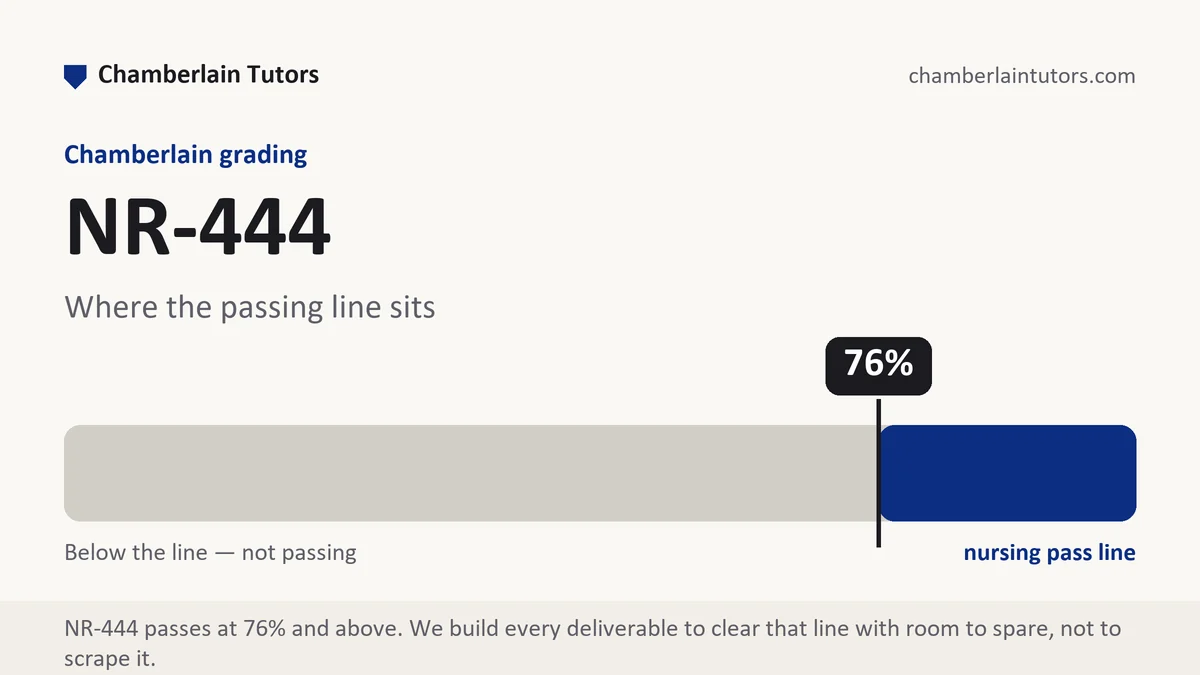
NR-444 asks for 144 clinical hours against 96 in the lower-clinical version, and the difference lands on your calendar rather than on the syllabus. Sixteen week semesters run as two eight week sessions, so a session carrying this much clinical time is also carrying weekly written deliverables, and the written half is usually what gets compressed. The 76 percent floor does not move to accommodate that: the core average is computed by itself and has to reach 76 before supplemental points enter the calculation at all. No later submission repairs a weighted average that has already fallen. Discussion boards stay uneditable after posting. The practical defense is to write field notes on the day rather than the weekend, because evaluation detail is the first thing memory loses and the first thing the rubric asks for.
Read the rubric before the prompt, then divide what is left
Read the scoring guide first and the prompt second, because the guide is the document being scored against. Copy each criterion row into an empty file as a heading in the guide's order, then set a word figure against each one before drafting.
Teaching plan guides usually carry two kinds of row, and they have to be handled differently. Say your section caps the write-up at 1,600 words with six rows: learner assessment 20 points, objectives 15, content and method 20, implementation 15, evaluation 20, and APA with scholarly writing 10. Two of those are cross-cutting, judged across the whole document rather than in a place of their own, so lift out the writing row first. Hold back 150 words for opening and closing material, leaving 1,450 words against the 90 remaining points, which is roughly 16 words per point. That produces 320 words for learner assessment, 240 for objectives, 320 for content and method, 240 for implementation, 320 for evaluation.
Run your own guide's numbers rather than these. What matters is the shape the arithmetic reveals: evaluation has earned as much room as content, and in most drafts evaluation gets a closing paragraph while content gets three pages. That single inversion accounts for more lost points in this course than any other habit, because content is the part students enjoy writing and evaluation is the part the extra clinical hours were supposed to make possible.
The parts of a teaching plan and its evaluation
Whatever your section calls it, this deliverable holds one shape. Each part proves something specific, and the weak version of each is what graders see over and over.
| Part | What it has to prove | The weak version |
|---|---|---|
| The learners, named | Who was actually in the room: how many, their age range, why they were there, what they already knew | Community members, a phrase that shapes no teaching decision |
| The learning need, evidenced | How you established the gap, whether by observation, a conversation with staff, or published data on the group | A topic chosen because it seemed useful, with nothing behind the choice |
| Objectives that can fail | An observable behavior, the conditions it happens under, and the standard that counts as achieved | Participants will understand, which nobody can see and nothing can disprove |
| Content matched to the learners | Material pitched at a reading and health literacy level you can defend, with jargon converted rather than glossed | A clinical handout reprinted for the public with the terms left in |
| Method and setting | A teaching approach fitted to the room, the time available and what people came for | A slide deck delivered at a food pantry queue |
| Implementation record | What actually occurred: attendance, timing, what you cut when the session overran, what interrupted it | The plan restated in the past tense as though nothing deviated |
| Evaluation, chosen in advance | A named instrument, a baseline, when it was applied and what it returned | Satisfaction faces collected at the door, measuring enjoyment rather than learning |
| What you would change | One specific revision tied to something that happened, not a general resolution to prepare more | The session went well and I would do it again |
Reporting a small evaluation honestly
The evaluation row is where careful writing shows and where overclaiming is most easily caught. Four habits carry it.
Measure learning, not mood. Choose the instrument before the session and match it to the objective. If the objective is a behavior, use return demonstration and record how many performed it correctly. If it is knowledge, use the same short question set before and after. If it is understanding of instructions, use teach-back and record what came back. Enjoyment ratings are worth collecting and are not evidence that anything was learned, so report them separately and say what they are.
Report the denominator every time. Six of the nine people who stayed to the end is a finding. Two thirds improved is not, because it hides that the whole evaluation rested on nine people. Give the count, the base and the window in the same sentence, and note anyone who left partway through rather than dropping them silently from the total.
Let the sample size set the verb. A single session with nine attendees supports description, not inference. Write that six of nine demonstrated the technique correctly after the session, and stop there. Do not write that the intervention improved technique, because that verb belongs to designs with comparison groups. The same rule governs your published sources. Observational work earns was associated with and occurred more often among; the stronger verbs are reserved for research that altered a condition on purpose and then measured what followed.
Source teaching decisions as well as health facts. Two different evidence needs sit inside one teaching plan. The health content needs current clinical sources, and for those, name the design and the sample before the finding. The teaching method needs its own support, and citing why teach-back or return demonstration suits this group is an easy set of points that most write-ups leave on the table entirely.
What lifts a teaching plan above passing
A passing NR-444 teaching plan names a topic, lists objectives, describes a session and reports that participants responded well. It clears the floor and tells the reader nothing about whether anything changed.
Three habits separate that from a write-up in the top band. Its objectives are falsifiable, so at the end of the session there is a fact of the matter about whether each one was met, and the write-up states it either way. It reports what went wrong, because sessions that overran, rooms that were noisy, and the two people who left after ten minutes are the details that prove you were present and they set up the revision section. And it holds its claim to the size of its evidence, describing what nine people did on one afternoon rather than what the intervention achieved. Falsifiable, honest about the room, claim sized to the sample.
Six mistakes that cost points here
- Objectives nobody could fail. Understand, appreciate and be aware of cannot be observed, so the objective row has nothing to score against.
- Materials written above the learners. A handout carrying clinical terms is a handout the group cannot use, and the content row is judged on fit rather than accuracy alone.
- Satisfaction reported as learning. People enjoying a session is a different claim from people learning something, and merging them costs the evaluation row.
- A percentage hiding a tiny sample. Sixty seven percent improved, from a group of six, reads as concealment the moment the reader finds the base.
- The plan retold as though it went perfectly. Implementation rows want deviation, because deviation is what proves the session happened at all.
- Writing beyond what your hours support. A document describing work the clinical record does not show puts two graded halves of the course in contradiction.
Questions NR-444 students ask
Only four people came to my teaching session. How do I write the evaluation?
Do the extra clinical hours change what the written work has to say?
Can you write my clinical journal or fill in my hour log?
The weeks, one by one
Week 1
NR-444 Week 1 is where the client stops being a person in a bed and becomes a place with a boundary around it, and the opening written work in a community course almost always turns on assessment: observing a defined community systematically, describing it in the language of community health, and. Read the full Week 1 manual.
Week 2
NR-444 Week 2 is the stage where impressions from the windshield meet the numbers, and the written work usually turns on epidemiologic reading: pulling indicators for your bounded community from public sources, comparing them against county, state or national figures, and converting the gap into a. Read the full Week 2 manual.
Week 3
NR-444 Week 3 typically narrows the lens from the whole community to the people carrying the problem, and the written work turns on vulnerability and access: describing a priority population within your community, analyzing the barriers standing between them and better health, and doing it in. Read the full Week 3 manual.
Week 4
NR-444 Week 4 is where the session pivots from knowing to doing, and the written work usually turns on a plan: measurable objectives for a community intervention, a teaching or screening design matched to the priority population, and a partnership arrangement that makes the whole thing deliverable. Read the full Week 4 manual.
Week 5
NR-444 Week 5 sits in the stretch of the session where plans meet rooms, and the written work usually turns on the implementation account: a disciplined record of what your community intervention actually did when it ran, told against the plan rather than instead of it. Read the full Week 5 manual.
Week 6
NR-444 Week 6 usually belongs to evaluation: taking the instrument you named in planning and administered at delivery, reading its results against your outcome objectives one by one, and saying what the intervention achieved in terms someone else could verify. Read the full Week 6 manual.
Week 7
NR-444 Week 7 tends to widen the frame from your single project to the community's larger protective systems, and the written work usually turns on preparedness and continuity: how a community absorbs a disaster or outbreak, how its referral networks and safety-net services catch the people your. Read the full Week 7 manual.
Week 8
NR-444 Week 8 closes the session, and the written work usually turns on two questions: what happens to the project when you leave, and what happened to you while it ran. Read the full Week 8 manual.