NR-306 Week 7 is where the course assembles itself: the complete head-to-toe assessment, performed as one continuous exam and documented as one coherent record. The written work grades integration, whether the regional skills from earlier weeks appear in a sensible sequence, in consistent language, at the right level of detail, with nothing examined twice and nothing skipped. Your section may print this as NR 306 or NR306; it is the same course. Chamberlain publishes no syllabi outside Canvas. The placement here is our teaching judgment from the course's catalog arc; your section's rubric decides what your week actually asks.
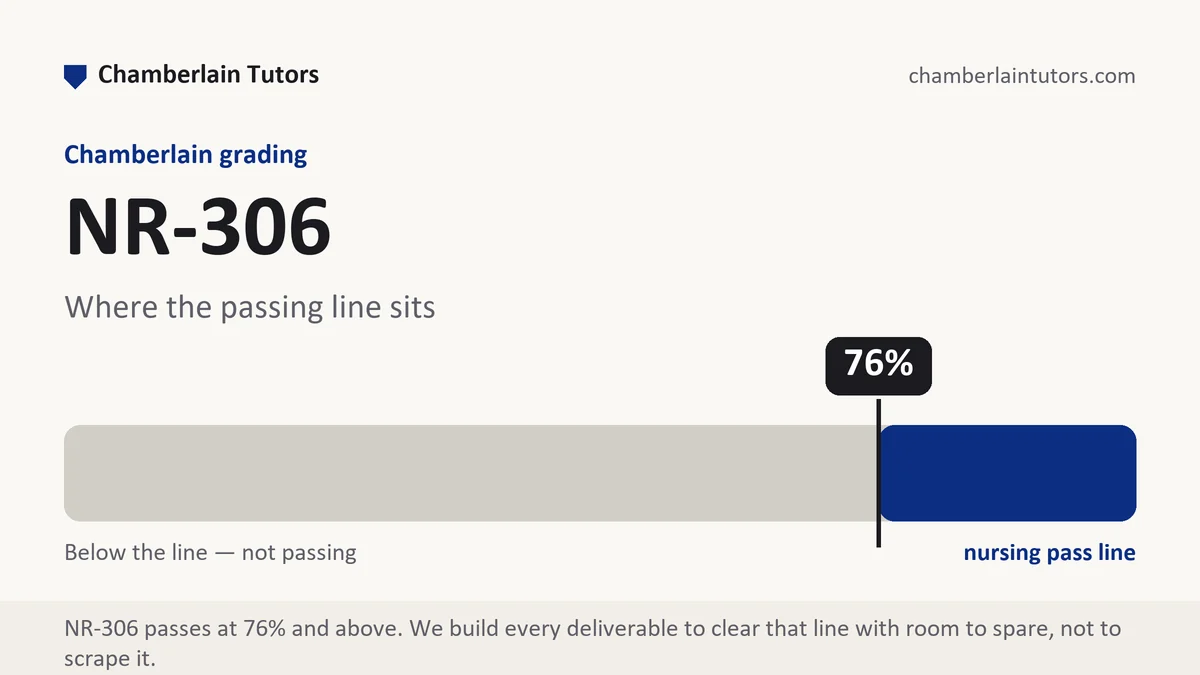
What NR-306 Week 7 asks for
What changes when the exam stops being a set of stations? At a school-based clinic on the last morning of sports-physical season, a nurse moves a fidgeting fifteen-year-old through an entire assessment in under twenty minutes, and nothing about it looks like the regional drills a student practices: regions flow into each other, the patient changes position three times instead of ten, and the conversation never stops. Week 7 of NR-306 asks you to produce the written version of that fluency, a head-to-toe record where the seams between systems disappear.
Integration is a different graded skill from regional competence, and it fails in different ways. A head-to-toe write-up can contain eight adequate sections and still read as eight separate assignments stapled together: general survey vocabulary in one register, chest findings in another, an abdominal section that repeats vital signs the first page already gave. The grader of an integrated write-up is checking sequence, consistency, and economy. Does the documentation follow one announced order, head downward, without doubling back? Does the same scale vocabulary appear wherever the same kind of finding does? Does each fact appear exactly once, in its home section?
Most sections stage the course's heaviest written assignment here, usually a full documented head-to-toe on a volunteer or lab partner, sometimes with a reflection on what the integrated exam changed. Many also point toward a lab practical around this stage, and the two support each other: writing a tight record teaches you the sequence your hands need, and rehearsing the sequence gives your record its spine. The performed exam, and any check-off attached to it, is your own work with your own patient in front of you. The written record is what this manual supports, and at this stage the record is the course in miniature.
Plan the session itself before you plan the document. A complete head-to-toe on a live volunteer runs long the first time, most students need well over an hour, and fatigue on both sides degrades the later systems, which is why so many first records go thin exactly where the neuro section needs them thick. Schedule generously, warn your volunteer, and take structured field notes during the exam rather than trusting recall: a folded sheet with one line per region, filled in as you go, is the difference between documenting what happened and reconstructing what probably happened. The write-up you produce from real-time notes will also be faster to draft, because the hardest part of integrated documentation is not the prose; it is trusting your own data.
The NR-306 Week 7 method, step by step
Six moves for assembling regional skills into one integrated record.
-
Announce your sequence once, then never violate it
One sentence stating the order, general survey and vitals, then head downward system by system, becomes the contract your documentation signs. Every finding filed out of order breaks it visibly.
-
Give every fact exactly one home
Vital signs live in their block and are referenced, not repeated, elsewhere. Skin findings observed during the chest exam file under skin or chest, by your section's convention, but never under both.
-
Flatten your vocabulary to one register
Earlier weeks were drafted at different points in your learning, and it shows when they are pasted together. Rewrite so pulse grades, strength scores, and descriptive terms use the same scales and the same phrasing top to bottom.
-
Compress the normal, expand the exceptional
An integrated record earns its length: described normals in one or two checkable lines per region, with full attribute detail reserved for anything that departs from expected. Uniform depth everywhere reads as a checklist, not judgment.
-
Thread the subjective spine through
The history's active threads should surface where their systems are examined, labeled as report beside observation, so the record reads as one person assessed rather than systems inventoried.
-
Close with a findings summary that adds order, not diagnosis
Two or three sentences gathering the deviations from expected into one place, each already documented above, each with its recheck or reporting step. Summary is the integrated exam's version of judgment, and it still names no diseases.
A layout and word budget for a head-to-toe record
How long should the whole thing run? The frame below fits a complete head-to-toe of roughly 1,200 to 1,500 words, the longest write-up of the course. It is our own outline rather than anything the university issues, and your week's rubric outranks it wherever the two disagree.
| Section | What belongs in it | Word target |
|---|---|---|
| Opening block | Identifying context, reliability, the active subjective threads in brief, general survey, and vital signs with conditions. | 180 to 220 |
| Head, neck, and skin | HEENT and integumentary findings in compressed described-normal form, exceptions expanded with full attributes. | 180 to 220 |
| Chest | Lungs and heart in sequence with landmarks, sides compared, one register of sound vocabulary throughout. | 200 to 240 |
| Abdomen | The reordered technique sequence shown, findings filed by quadrant, tender areas last. | 150 to 190 |
| Limbs and movement | Peripheral vascular pairs, musculoskeletal range and strength on named scales, gait observed. | 200 to 240 |
| Neuro, mental status, and summary | Consciousness, orientation with probes, focused neuro checks, then the deviations gathered with next steps. | 230 to 280 |
Evidence craft for integrated documentation
Consistency is now a form of evidence. When the same scales, units, and phrasing hold from scalp to soles, the record testifies that one trained examiner produced it. Vocabulary that shifts register mid-document testifies to patchwork, and graders read it that way even when every individual finding is sound.
Sequence proves the exam. In a full record, the order of documentation is the primary witness that a systematic exam occurred. Guard it during revision especially, when moving a paragraph for flow can silently break the anatomical logic a grader is tracing.
Economy signals mastery. The strongest head-to-toe records are shorter than beginners expect, because every sentence carries a finding and no finding appears twice. If a sentence neither documents nor flags, it is drag; the length this assignment needs comes from coverage, not elaboration.
Keep the single-source rule for interpretation. Wherever the record interprets, against expected ranges or scales, it should lean on the one assigned text, cited once and used uniformly, so the whole document answers to the same authority.
Five mistakes that cost points in this week's territory
- Stapled regionals. Eight sections in eight voices, with repeated vitals and colliding conventions, is the signature failure of this week and the first thing an integration rubric checks.
- Uniform depth. Giving a clear lung field and an unexpected finding the same word count buries the finding and tells the grader you cannot rank importance.
- Sequence breaks. An abdominal detail surfacing in the neuro section, or vitals repeated at the summary, reads as an exam that wandered.
- The vanished patient. A record with no subjective thread anywhere between the opening and the summary has inventoried systems, not assessed a person.
- A summary that diagnoses. After seven weeks of holding the line, the final paragraph is where students most often name a disease; it is still the wrong document for that sentence.
Before you submit
- The announced sequence holds from first section to last
- No finding, vital sign, or measurement appears in two places
- Scales, units, and descriptive vocabulary are consistent throughout
- Normals are compressed and checkable; exceptions carry full attributes
- Subjective threads surface, labeled, in the systems they belong to
- The summary gathers documented deviations with next steps and no diagnoses
Head-to-toe record due in NR-306?
Send the instructions and the rubric out of Canvas. A premium original draft of the written record comes back in 24 to 48 hours, integrated in one register from survey to summary, and revisions run until the grade lands.