NR-306 Week 4 tends to carry the cardiopulmonary exam: the thorax and lungs, then the heart and neck vessels, with auscultation finally earning its place as the technique that defines the region. The written work asks you to map sounds to named landmarks and describe what you heard in the standard vocabulary, so a reader could stand where you stood and check. Your section may print this as NR 306 or NR306; it is the same course. Chamberlain publishes no syllabi outside Canvas. The placement here is our teaching judgment from the course's catalog arc; your section's rubric decides what your week actually asks.
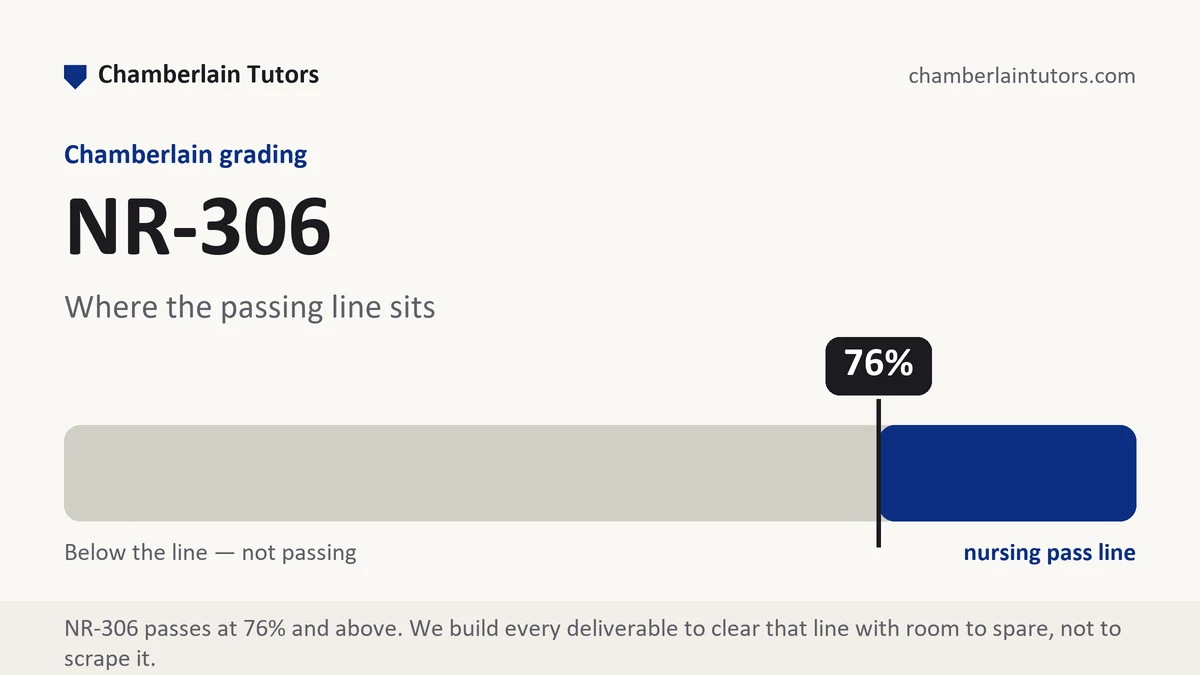
What NR-306 Week 4 asks for
Where exactly were you standing when you heard it? In the back room of a mobile clinic parked outside a food pantry, a volunteer nurse listens to the chest of a woman who has been short of breath climbing the hill to the bus stop. When she documents later, nothing she writes matters unless it says where: which interspace, which line, anterior or posterior, and what the sound did between inspiration and expiration. Week 4 of NR-306 is where location becomes half of every finding.
The territory is the chest, front and back. For the lungs: respiratory pattern and effort, chest shape and symmetry, expansion, tactile fremitus, percussion notes, and breath sounds by field, with adventitious sounds named from the standard set rather than improvised. For the heart: the inspection and palpation of the precordium, the auscultatory landmarks, rate and rhythm, the first and second heart sounds, and the discipline of describing anything extra by timing and location instead of guessing at its cause. Written deliverables here are usually documentation exercises from lab, a focused write-up of a respiratory or cardiac assessment, or a discussion post comparing expected and unexpected sounds.
This is also the week the course's word "systematic" stops being abstract. Chest assessment has an order: side-to-side comparison, apex to base, one interspace at a time. Your write-up is graded on whether the documented sequence shows that order happened. As always in a lab course, the listening itself, and any check-off your section runs on it, is your own work with your own ears; the written layer this manual supports is where the findings either become communicable data or dissolve into "lungs clear" with nothing behind it.
A word about practice logistics, because they shape the writing. Chest findings are the first in this course that genuinely require repetition to recognize, and the written vocabulary only settles once the ear has met the sounds it names. Most texts ship with audio libraries, and lab time gives you living chests; use both in the same week the write-up is due, not after. Listen to a recorded sound, write its name, location convention, and phase from memory, then check yourself against the book. Ten minutes of that loop, three or four times across the week, is what separates a write-up that deploys the standard vocabulary confidently from one that hedges every finding because the writer is not sure what the words commit them to.
The NR-306 Week 4 method, step by step
Six moves for documenting a chest exam that reads like it happened.
-
Write the sequence you followed, then let the findings inherit it
State that auscultation ran apex to base, comparing sides, anterior then posterior. Findings listed in that same order prove the method without another word of explanation.
-
Locate every sound by interspace and line
Second intercostal space at the right sternal border; posterior fields at the bases bilaterally. The named landmark system exists so that a finding can be relocated by the next examiner, and rubrics treat missing landmarks as missing data.
-
Describe breath sounds by type, location, and phase
Which expected sound belongs in that field, what you actually heard, and where it sat in the respiratory cycle. An adventitious sound gets its standard name, its timing, and whether it cleared with a cough.
-
Give the heart its two questions: rate and rhythm first, sounds second
Rate counted for a full minute when rhythm is irregular, described as regular or irregular, then the first and second sounds characterized at each landmark. Anything extra is described by timing and location only.
-
Tie subjective breathlessness to observed effort
The patient's report of when breathing gets hard belongs beside your observations of rate, effort, accessory muscle use, and position preference, each labeled as report or observation so the pairing argues without blending.
-
Flag, do not diagnose
An unexpected sound ends with a flag and a next step: recheck after a cough, compare the other side, note what you would report. Naming a disease from one auscultation finding is the overreach this course trains out.
A layout and word budget for a cardiopulmonary write-up
What does a complete chest documentation piece look like at this stage? The frame below fits a write-up of roughly 850 to 1,050 words covering both lungs and heart. It is our own outline rather than anything the university issues, and your week's rubric outranks it wherever the two disagree.
| Section | What belongs in it | Word target |
|---|---|---|
| Subjective chest thread | Breathlessness, cough, chest sensations, and tolerance for activity as the person reports them, with duration. | 110 to 140 |
| Inspection of the thorax | Respiratory rate and pattern, effort, chest shape, symmetry of movement, skin over the chest. | 120 to 150 |
| Palpation and percussion | Expansion, fremitus compared side to side, percussion notes by region. | 130 to 160 |
| Lung auscultation | Breath sounds field by field in sequence, expected type per field, any adventitious sound named with timing and location. | 180 to 220 |
| Heart assessment | Precordium inspection and palpation, rate, rhythm, sounds at each landmark, neck vessel observations if assigned. | 170 to 210 |
| Flags and next steps | Findings outside expected, restated as observations, each with a recheck or reporting step. | 100 to 130 |
Evidence craft for chest documentation
The landmark is part of the finding. A crackle is not a finding; a crackle at the right posterior base on late inspiration is. Train yourself to refuse to write a sound without its address, and the habit will hold when charts are real.
Use the standard sound vocabulary and no other. Your assigned text defines the accepted names for breath sounds and their departures. Invented descriptors read as unfamiliarity, while a correctly used standard term is checkable against the book, which is what makes it evidence.
Count honestly and say how. A rate counted for thirty seconds and doubled is a different measurement from a full-minute count on an irregular rhythm, and the difference matters. Write the method beside the number when the number is doing serious work.
Comparisons carry the chest exam. Side against side, apex against base, this visit against the patient's report of their usual state. Explicit comparison sentences are the strongest evidence a beginner's chest write-up can offer, and they cost nothing but attention.
Five mistakes that cost points in this week's territory
- "Lungs clear bilaterally" as the entire respiratory section. One phrase cannot carry fields, sequence, and comparison; the grader reads it as an exam that may not have happened in full.
- Sounds without addresses. An adventitious sound with no interspace, line, or phase attached is unverifiable and marked accordingly.
- Skipping percussion and fremitus. The middle techniques disappear from weak write-ups, and their absence is visible to any grader scanning for the four-technique structure.
- Cardiology vocabulary beyond the data. Naming a murmur's cause or grading beyond what your course has taught claims expertise the write-up cannot support; timing and location are the honest limits.
- Losing the subjective thread. A chest exam documented with no mention of what the person reported reads as technique practice, not assessment.
Before you submit
- The documented sequence shows side-to-side, apex-to-base comparison
- Every auscultation finding carries interspace, line, and respiratory phase
- Expected sounds are named per field, not summarized in one phrase
- Heart findings include rate, rhythm, and sounds at named landmarks
- Subjective reports appear, labeled, beside the observations they inform
- Unexpected findings end in flags and next steps, never in diagnoses
Writing up chest assessments for NR-306?
Send the instructions and the rubric out of Canvas. A premium original draft of the written work comes back in 24 to 48 hours with every finding located and phrased in standard vocabulary, and revisions run until the grade lands.