NR-306 Health Assessment is the single-course version of the assessment sequence: three theory credits, one lab credit, 32 lab hours, and everything the two-course path spreads across two terms compressed into one. History taking, interview and communication, the four examination techniques, and applying findings to clinical decision making all arrive together. The written consequence is that the documentation record and the reasoning about it are usually graded in the same submission, and students who write one well and the other poorly average out at a number they do not like.
What NR-306 actually grades
Two competing standards at once. The documentation standard says report what was found, in clinical language, without interpretation leaking in. The reasoning standard says tell me what it means and what you would do. A record that only documents scores as incomplete; a record that interprets everywhere reads as a student who cannot keep subjective, objective and assessment apart. The scoring guides students send us almost always contain a row for each, and the top band of both is reachable in the same paper only if the sections are kept physically separate.
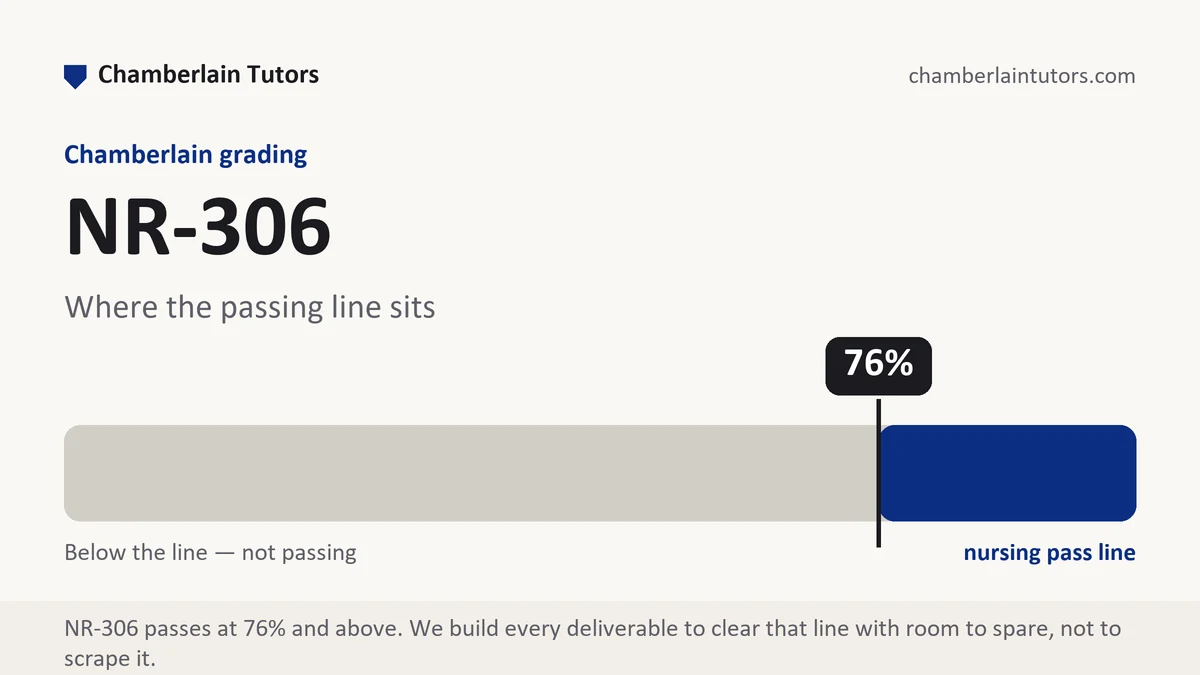
Because the course carries four credits and a 76 percent floor applies across core nursing courses, the weekly written pieces matter more here than in the two-credit halves. There are simply more of them, arriving faster, with lab work running alongside.
How we help in this course
The written half is ours: system documentation records, focused write-ups, interview analyses, decision-making papers, discussion responses and any reflection tied to lab. Every draft comes back with the objective and interpretive layers separated on purpose, so you can see the boundary the guide is grading.
The 32 lab hours, the practice sessions and every hands-on check are yours. We do not perform them, appear in them, or produce anything meant to represent them. What we can shorten is the hours you spend staring at a blank documentation template at eleven at night.
In NR-306 right now?
Send the week and the rubric from Canvas. First premium sample free, floor-checked, back in 24 to 48 hours.
Read the rubric before the prompt
In a compressed course the temptation is to start writing immediately, which is precisely why the guide has to come first. Paste the criterion rows into an empty file, one per line, and strip each to its verb: obtain, examine, document, interpret, communicate. Build your headings from those verbs in the guide's order so that a grader moving down the rows never has to search.
Then turn the weights into words. Take a 1,200 word record with four rows weighted 45, 25, 20 and 10 percent. That is roughly 540 words for the first row, 300 for the second, 240 for the third and 120 for the last. A 45 percent row is unusual and worth pausing on, because when one row is that heavy the assignment is telling you it will be graded almost entirely on that one thing. Most students still distribute their effort evenly, which converts a heavy row into a mediocre score no matter how polished the rest is.
Bracket each target beside its heading. When a section refuses to reach its number, the problem is usually that you are describing a system in general terms instead of reporting what you found on one person.
Build a documentation template in the first two weeks and reuse it all term. Set up the subjective and objective headings, a line for technique under each system, a place for relevant negatives and a separate block for interpretation, then fill a fresh copy for every assignment. In a compressed course the time saved is real, but the bigger gain is structural: the template keeps interpretation out of the objective section automatically, which is the boundary this course grades hardest and the one that erodes fastest when you are writing quickly after a lab session.
The shape of a system by system record
The dominant deliverable in this course is a documentation record organized by body system, with a reasoning section attached. These rows are what a grader is checking as they read down it.
| Section | What belongs in it | What quietly loses points |
|---|---|---|
| Subjective, by system | What the patient reports about that system, in their words where the phrasing matters. | Your inference recorded as their report. |
| Objective, by technique | What inspection, palpation, percussion and auscultation produced, with location and quality. | Findings written with no technique attached, so nothing can be checked. |
| Relevant negatives | The absences that matter, stated deliberately, showing you looked and found nothing. | Silence, which reads identically to not having assessed. |
| Measurements and units | Values with units, sides, and positions, recorded exactly as taken. | Numbers without units or a note of which arm, side or position. |
| Interpretation, kept separate | What the findings suggest, in a section of its own, after the data ends. | Interpretation sprinkled through the objective section. |
| Next steps at student scope | What you would assess next, what you would report, and what would raise concern. | A diagnosis and a treatment plan neither of which is yours to write. |
Evidence and citation craft at this level
Documentation courses cite sparingly, but every citation is load bearing, and four habits decide whether yours hold.
Age of source, argued not assumed. Anything older than five years needs a stated reason. Reference ranges and screening guidance move; the description of how to percuss a border does not. Say which kind of claim you are making and the age of the source stops being a liability.
Design and sample in front of the finding. Give the reader the shape before the result: "in a validation study of 340 adults" tells them how far the number travels. Assessment courses often cite validation and diagnostic accuracy work, where sample size and setting matter more than in most literature.
Association verbs unless the design earns more. A finding that occurs alongside a condition is not a finding that produces it. Write "was present more often among", "was associated with", "predicted". Reserve "causes" for controlled work, and be especially careful in the sentence where you explain why an examination technique detects something.
Denominator and window before any rate. Sensitivity and prevalence claims are meaningless without a base. "Of the 512 patients examined, roughly one in four had the finding at first visit" can be evaluated; "25 percent had the finding" cannot. If the source gives a time window, carry it into your sentence rather than dropping it.
What separates a passing record from a strong one
A passing record in NR-306 is complete and neutral. Every system appears, nothing contradicts itself, the language is clinical. It sits in the seventies and low eighties because it could have been produced without a patient in the room. Nothing in it is specific enough to be wrong, which means nothing in it is specific enough to be right.
Strong records differ in three ways that cost nothing to install. They report values with their conditions attached, which side, which position, how long after activity, so the reader can picture the encounter. They include relevant negatives rather than leaving silence, because a documented absence is evidence and a gap is not. And they keep interpretation quarantined in its own section, which makes both the data and the reasoning easier to score at the top of their rows. Conditions, deliberate negatives, a clean boundary.
Mistakes that cost points here
- Blanket normals. Writing normal across systems you did not examine is the fastest way to lose credibility in a documentation course, and graders check for it deliberately.
- Interpretation inside the data. The moment a conclusion appears in the objective section, the row that grades documentation drops a band even if the conclusion is right.
- Values with no conditions. A measurement without its units, side or position is not reportable, and a record full of them reads as invented.
- Even effort against uneven weights. When the guide puts 45 percent on one row, everything else in the paper is worth less than that row. Spend accordingly.
- Discussion posts written live. Once a response is submitted at Chamberlain there is no way back into it. Draft in a document, check it against the guide, then paste once.
- Falling behind in a compressed course. This course delivers two terms of material in one, so a week missed is two weeks of content to recover while the next week arrives on schedule.
Questions NR-306 students ask
Is NR-306 harder than taking the two-course assessment sequence?
How do I write relevant negatives without padding the record?
Can you write my documentation record for me while I do the lab?
The weeks, one by one
Week 1
NR-306 Week 1 opens the assessment course where every later skill lives or dies: the health history. Read the full Week 1 manual.
Week 2
NR-306 Week 2 typically moves from listening to looking: the general survey, vital signs, pain as the subjective vital sign, and the discipline of recording a first objective baseline. Read the full Week 2 manual.
Week 3
NR-306 Week 3 usually brings the four physical examination techniques into the course as a working vocabulary: inspection, palpation, percussion, and auscultation, practiced in lab and then proven on paper, most often against skin, hair, nails, and the head and neck regions. Read the full Week 3 manual.
Week 4
NR-306 Week 4 tends to carry the cardiopulmonary exam: the thorax and lungs, then the heart and neck vessels, with auscultation finally earning its place as the technique that defines the region. Read the full Week 4 manual.
Week 5
NR-306 Week 5 usually gathers the regions where technique order changes and comparison rules: the abdomen, where auscultation jumps ahead of palpation; the peripheral vascular system, where pulses and skin are graded in pairs; and the musculoskeletal exam, where range and strength are recorded against named scales. Read the full Week 5 manual.
Week 6
NR-306 Week 6 typically takes on the system where documentation is hardest to fake: the neurological exam and the mental status assessment. Read the full Week 6 manual.
Week 7
NR-306 Week 7 is where the course assembles itself: the complete head-to-toe assessment, performed as one continuous exam and documented as one coherent record. Read the full Week 7 manual.
Week 8
NR-306 Week 8 closes the course by asking what the data is for: taking documented findings and reasoning from them toward priorities, recognizing which deviations matter most, what gets rechecked, what gets reported, and what gets watched. Read the full Week 8 manual.