NR-711 Fiscal Analysis and Project Management is a three-credit doctoral course covering financial planning, business management, needs-based organizational assessment and project management for nursing leaders. The graded writing is a business case with a project plan attached. Two things decide the score: whether your numbers are built from stated assumptions a reader can challenge, and whether your plan assigns work to named roles on dated milestones. Prose quality matters far less here than arithmetic that survives inspection.
What NR-711 actually grades
The heaviest rows in this course reward a cost build that can be traced. Not a total, but the components: how many hours, at what loaded rate, how many times a year, plus what is bought once and what recurs. A grader reading a figure of 84,000 dollars wants to see the four numbers it came from and the source of each. A figure with no build behind it cannot be scored as analysis, only as a claim.
The second demand is the benefit side, which most students handle worse than the cost side. Benefit in a healthcare business case is usually avoided cost, and avoided cost requires a baseline event rate, a unit cost per event, and an assumed reduction with a source. Writing that the project will improve quality and reduce length of stay is not a benefit; it is an intention. Turning it into a number, and then saying openly how uncertain that number is, is the doctoral move this course exists to teach.
How we help in NR-711
Our doctoral writers build fiscal work as a model rather than as prose: assumptions listed, costs itemized, benefits derived from a stated baseline, and sensitivity shown at the values a skeptical reader would push on. The project plan arrives with owners and dependencies, not a decorative timeline.
Deliverables run the standard promise: a premium original draft in 24 to 48 hours, targeted at the A band of your course's actual scale, through the eight-person pipeline with both QA passes and the floor check, revised free until it lands.
In NR-711 right now?
Send the week and the rubric from Canvas. First premium sample free, floor-checked, back in 24 to 48 hours.
Read the rubric before the prompt
Fiscal rubrics tend to be more literal than the rest of the doctoral sequence. Rows often name an artifact: a budget, a timeline, a risk register, an assumptions list. Copy the rows into a blank file and mark which ones demand a table or exhibit rather than paragraphs, because losing points for a missing exhibit is the most avoidable failure in this course.
Then price the narrative. Suppose the week caps the written portion at 1,500 words with four rows at 36, 28, 22 and 14 percent, exhibits excluded from the count. That is 540, 420, 330 and 210 words. The 540-word row is normally the financial analysis, and the useful discipline is that those 540 words should explain the exhibit rather than repeat it. A table gives the numbers; the paragraph says which assumption the answer is most sensitive to and why a reader should believe it.
Add one column to your outline labelled source. Every number in a business case has one: a payroll rate, a published unit cost, a supply quote, an internal volume report, a study estimating effect size. Filling that column while you draft prevents the most common late-week discovery, which is that the model rests on a figure you cannot attribute.
The shape of a business case
Whether your week calls it a business case, a budget proposal or a project charter with a financial section, the structure below is what a reader is scanning for. Each part answers a question a finance reader will ask, in roughly the order they ask it.
| Part | What it has to prove | How a thin version looks |
|---|---|---|
| The need, in money | The current problem sized with volume and unit cost, so the reader sees what is being spent today. | A quality problem described with no financial consequence. |
| The proposal in one paragraph | What is bought or changed, for whom, starting when, in plain terms a finance reader can repeat. | Three pages before the ask appears. |
| Cost build | Line items separated into one-time and recurring, with quantity, rate and frequency shown for each. | A single total with no components. |
| Benefit build | Avoided events multiplied by unit cost, plus any revenue or productivity effect, each traceable to a source. | Improved outcomes asserted as the return. |
| Assumptions listed openly | Every number that was estimated rather than measured, gathered in one place with its basis. | Estimates scattered through the prose and never labelled. |
| Payback and sensitivity | When the investment is recovered, and what happens if the key assumption is half as good. | A best-case result presented as the expected one. |
| Project plan with owners | Phases, milestone dates, dependencies, and a named role accountable for each. | A timeline of activities with no one attached. |
Evidence and citation craft with financial data
Financial writing has its own citation discipline, and four habits cover most of the marks.
Never quote a charge as a cost. Charges are what appears on a bill, payment is what an insurer sends, and cost is what the organization spends to produce the service. They differ by large multiples. Say which one your figure is, and if you are using a published charge because cost is unavailable, say that too and show what it does to the model.
Give every dollar a year and a source. A unit cost from a 2019 study is not a 2026 figure. State the dollar year, say whether you adjusted it and how, and cite the source in the same sentence. Where your guide sets no recency rule, cost evidence older than five years needs its justification written in, because prices, staffing markets and payment rules all move.
Load your labor rates and say so. An hourly wage is not the cost of an hour of nursing time. Benefits, taxes and paid time off raise it, and the multiplier you use is an assumption a reader will test. Write that a loaded rate of a stated multiple of base wage was applied, and put the multiple in the assumptions list rather than burying it in a calculation.
Every rate carries a denominator and a window. A projected reduction means nothing without the base it applies to. Write that 62 events occurred across 9,400 patient days in the prior twelve months, then apply the reduction you are claiming. When you cite a study for that reduction, match the verb to its design: a controlled trial buys reduced, a single-site before-and-after report buys was followed by.
What separates a pass from a strong pass here
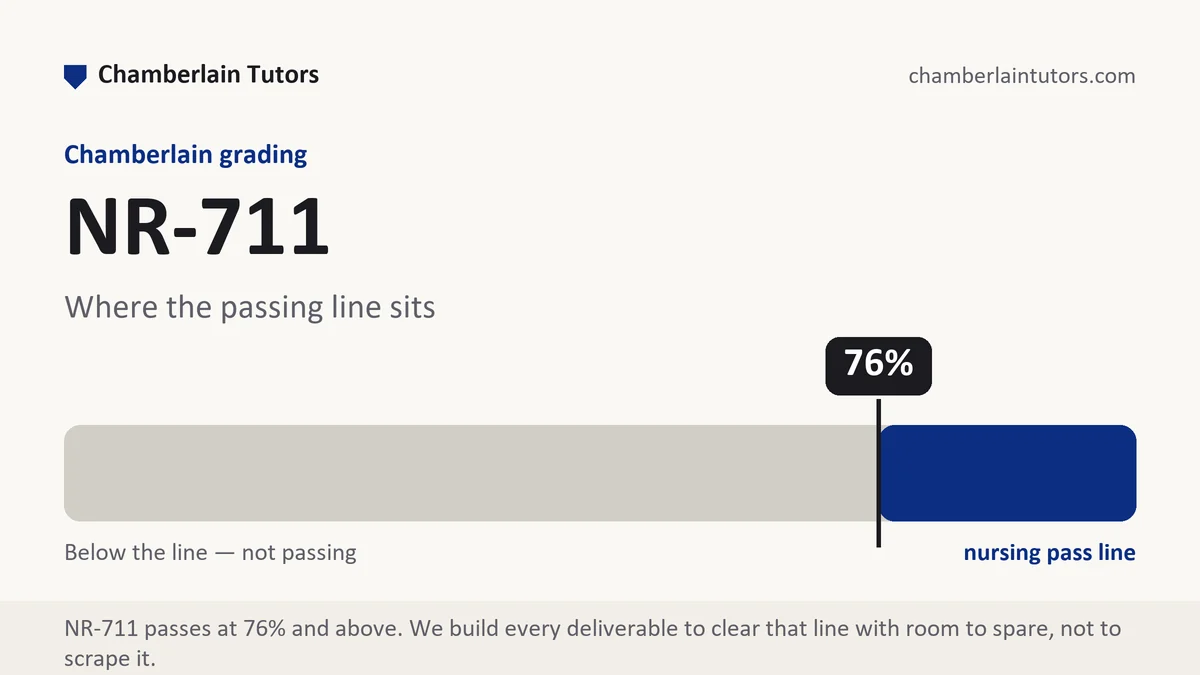
A passing NR-711 submission produces a tidy budget and a plausible timeline. The numbers add up, the sources exist, and nothing in it invites a hard question. Chamberlain's core nursing courses hold a 76 percent floor with no supplementary path back from an average that has weakened, tidy but unpressured work is how strong students end sessions with less margin than they expected.
Strong business cases anticipate the hostile reader. They state which single assumption the whole return depends on, then show the result at a pessimistic value of it, because a case that only works at the optimistic value is not a case. They separate hard savings, meaning money that leaves the budget, from soft savings such as recovered staff time, and they do not pretend the second kind is the first. And they close the loop between the money and the plan: the milestone at which the first benefit should appear, the report that would show it, and the person who owns the answer. A financial section with no owner attached to the benefit is a forecast nobody is accountable for.
Six mistakes that cost points in NR-711
- Presenting a total with no build. Reviewers score the components. A number without its parts cannot be checked or defended.
- Leaving assumptions unlabelled. Estimates are legitimate. Estimates presented as measurements are not, and one exposed guess undermines the rest of the model.
- Claiming savings against no baseline. A reduction needs a starting rate, a volume and a period, otherwise the benefit column is invented.
- Ignoring the arithmetic of staffing. Coverage math, replacement time and the difference between hours and positions decide whether a proposal is deliverable at all.
- Building a timeline with no dependencies. If nothing in the plan waits for anything else, the plan has not been thought through.
- Skipping sensitivity. One alternative scenario is often the difference between a case a reader trusts and one they discount entirely.
Questions NR-711 students ask
Where do I get real cost figures if my employer will not share the budget?
How precise does the project plan need to be?
Can I write the business case for the same project I am using elsewhere in the program?
Where NR-711 sits in Chamberlain's programs
Open the exact program map for sequence, credit, and option context. The current student schedule and syllabus remain authoritative after transfer evaluation, electives, state rules, and approved plan changes.
The weeks, one by one
Week 1
A fiscal and project management course opens by making an organization legible. Read the full Week 1 manual.
Week 2
Once a gap has been described it has to be priced. Read the full Week 2 manual.
Week 3
Budget construction is where a proposal stops being an idea and becomes a set of numbers somebody has to approve. Read the full Week 3 manual.
Week 4
Halfway through a fiscal course the direction reverses. Read the full Week 4 manual.
Week 5
This is the stage where the cost of the problem and the cost of the fix are put on the same page and compared. Read the full Week 5 manual.
Week 6
The second half of a fiscal and project management course turns from money to method. Read the full Week 6 manual.
Week 7
A schedule is an argument about time, and this stage asks you to make it in writing. Read the full Week 7 manual.
Week 8
The closing stage assembles everything the session built into one document addressed to people who can say yes. Read the full Week 8 manual.