The closing stage assembles everything the session built into one document addressed to people who can say yes. A business proposal opens with an executive summary that could be read alone, carries the problem with its cost, the evidence-based intervention, the budget, the return, the plan and the evaluation, and ends with the question most student proposals never answer: what keeps this alive after the person who championed it moves on. Sustainability is the doctoral test here, because a practice change that depends on one nurse's persistence has not been translated into the organization at all. Your section may print this as NR 711 or NR711; it is the same course. Chamberlain publishes no syllabi outside Canvas. The placement here is our teaching judgment from the course's catalog arc; your section's rubric decides what your week actually asks.
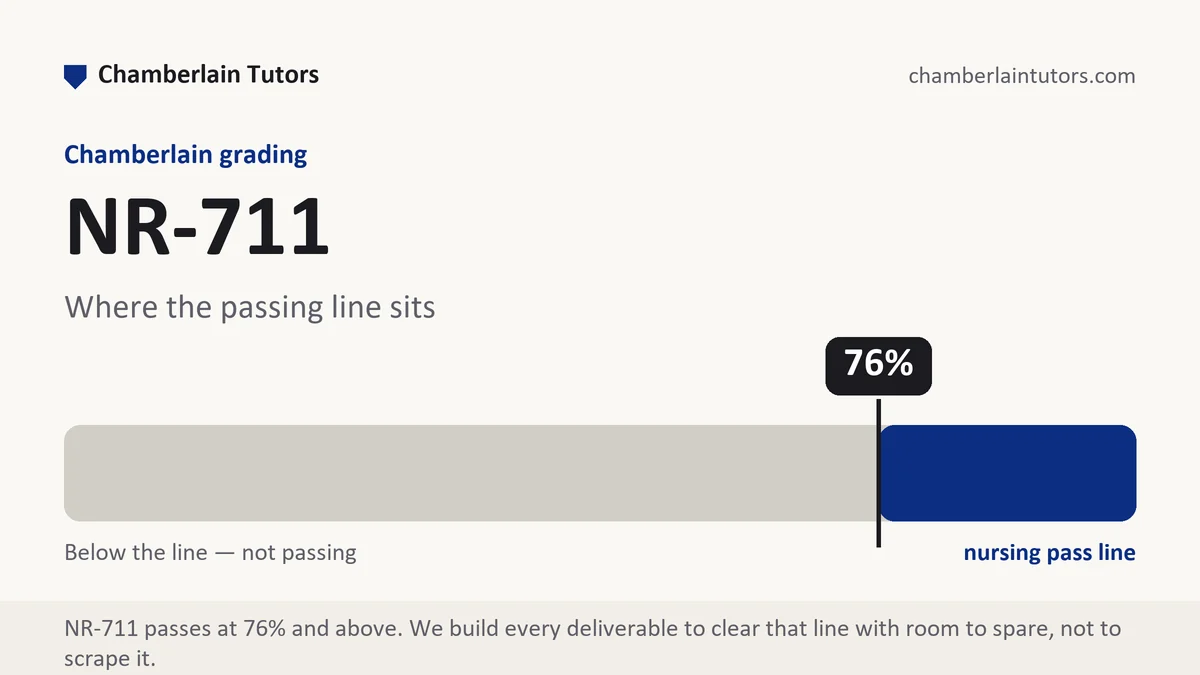
What NR-711 Week 8 asks for
A doctoral student presents a transitional care proposal to the operating committee of a post-acute network. She has the analysis right and she loses the room in the first ninety seconds, because she opens with a literature review. The committee has twenty minutes and four proposals, and the only question in their heads is what they are being asked to approve, what it costs, what it returns and what happens if they decline. Everything she prepared answers those questions. None of it was placed where the answers would be found. Proposal writing is largely the discipline of ordering material by the reader's need rather than by the order in which you did the work.
The executive summary is the whole document in miniature and it is written last. In a single page it names the problem with its magnitude and cost, states the recommendation, gives the investment required and the expected return with its time frame, names the sponsor and the decision requested, and flags the principal risk. An executive who reads nothing else should be able to vote. Everything after that page exists to support a reader who wants to check a claim, which is why the body carries the analysis, the evidence and the tables in an order a skeptic could follow.
The evaluation section is where a practice doctorate distinguishes itself from a business school assignment. You are proposing to translate existing evidence into a change at one site, and the way that change is judged is by improvement methodology rather than by research design. That means outcome measures, process measures that show whether the intervention is actually being delivered, and balancing measures that would catch harm somewhere else; a plan for data collection using systems that already exist; and repeated measurement over time rather than a single comparison of before and after. Say plainly that this is quality improvement evaluation, not a trial, and that no claim of generalizable knowledge is being made.
Sustainability is the closing argument. It has four components worth naming: financial, meaning where the recurring cost sits in next year's budget and who owns that line; operational, meaning how the change is embedded in orientation, standard work, competency checks and the electronic record so that it survives turnover; governance, meaning which existing committee assumes ongoing oversight of the measure; and cultural, meaning who locally owns the change and how results stay visible. Expect a full written proposal, often with an executive summary and appendices, and sometimes a presentation deck or a recorded briefing. Where a discussion post closes the session, treat it as final copy; posts do not reopen once submitted in Canvas.
The NR-711 Week 8 method, step by step
Six moves that turn eight weeks of analysis into a document that gets a decision.
-
Determination of the reader and the decision
Name who is being asked and exactly what they must approve: a dollar amount, a position, a change in standard work, a partnership agreement. A proposal without a stated ask is a report, and reports do not get funded.
-
Reordering of the material by the reader's questions
Problem, cost, recommendation, investment, return, plan, evaluation, sustainability, risks. Your research order and your reader's order are different, and the second one wins in every professional document.
-
Reconciliation of the numbers across sections
The cost of the problem, the budget, the return figure and the executive summary must agree exactly. One inconsistent number in a finance-facing document costs more credibility than any weakness of argument.
-
Construction of the evaluation plan in improvement terms
Outcome, process and balancing measures, each with a data source, a collection method, a frequency and an owner, tracked over time rather than compared once. Name the improvement framework you are working within.
-
Specification of the sustainability handoff
Say who owns the recurring budget line, which committee receives the measure, what is embedded in orientation and standard work, and what happens the week after the project formally ends.
-
Composition of the executive summary last
Write the one page only after the body is final, holding the problem, the ask, the money, the return, the risk and the decision. Then read it aloud alone and ask whether a vote could be taken on it.
A layout and word budget for a business proposal
Our frame for a closing proposal, sized for roughly 2,000 to 2,600 words plus tables and appendices. It is our own outline rather than anything the university issues, and your week's rubric outranks it wherever the two disagree.
| Section | What belongs in it | Word target |
|---|---|---|
| Executive summary | Problem with magnitude, recommendation, investment, return, principal risk and the decision requested. | 300 to 400 |
| Problem and current cost | The gap with its count, denominator and period, and the current-state cost carried forward from your analysis. | 300 to 380 |
| Recommended change and its evidence | What is being proposed, drawn from appraised literature, with the expected effect and its transferability. | 340 to 420 |
| Investment and return | The budget in summary, the return or cost-effectiveness figure, break-even, and the sensitivity case. | 300 to 380 |
| Implementation and evaluation | Phases, milestones, responsibility, and the outcome, process and balancing measures with sources and owners. | 340 to 420 |
| Sustainability and risk | Financial, operational, governance and cultural sustainability, plus the residual risks and their responses. | 300 to 380 |
Evidence craft for proposal writing
Make every number in the summary traceable. Each figure on the first page should appear again in the body with its derivation. Executives check one number at random, and a summary figure that appears nowhere else reads as invented even when it is not.
Keep the evidence base explicit but compressed. Name the strongest sources, their populations and their effect magnitudes in a short paragraph rather than a review. The full appraisal belongs in an appendix if your section wants it.
Write the evaluation as improvement, never as research. Use the language of measures, run charts and repeated observation. Do not describe the work as a study, do not promise a determination from any review body, and do not claim the finding will generalize beyond the site.
Give sustainability an owner and a date. The strongest closing sentence in a proposal names the committee that will receive the measure quarterly and the role that holds the budget line after the project ends. Everything else in that section supports those two facts.
Keep clinical work and program hours out of the written help boundary. A proposal can describe what staff will do and how it will be measured. Actual patient care, practicum hours, preceptor evaluations and site documentation are the student's own record, performed and documented by the people who did them, and any resident detail appearing anywhere in the writing is de-identified.
Five mistakes that cost points in this week's territory
- An executive summary that summarizes the paper instead of the decision. A paragraph describing what each section contains gives an executive nothing to approve.
- Numbers that disagree between sections. A budget total that differs from the summary figure by even a small amount undermines every other calculation in the document.
- Evaluation described as a study. Calling a site improvement evaluation a trial, or promising a research determination, misreads the practice doctorate at the last possible moment.
- Sustainability as a paragraph of intent. Continued monitoring and ongoing commitment name nobody, fund nothing and survive no turnover.
- Risks omitted to look confident. Every reviewer knows the risks exist, and a proposal that names and answers them is more persuasive than one that pretends there are none.
Before you submit
- The executive summary states the ask, the money and the decision requested
- Every figure in the summary reappears in the body with its derivation
- The recommended change is tied to cited evidence with an effect magnitude
- Outcome, process and balancing measures each carry a source, a frequency and an owner
- The evaluation is written in improvement language, not research language
- Sustainability names a budget owner and a governing committee
- Every reference appears in the text and every in-text citation appears in the list
Finishing NR-711 this week?
Send the rubric and your prior submissions out of Canvas. A premium original draft comes back in 24 to 48 hours with a decision-ready summary, reconciled numbers and a sustainability plan that names owners, and revisions run until the grade lands.