NR-706 Healthcare Informatics and Information Systems is a three-credit doctoral course covering the assessment, design and analysis of information systems that support data-driven decisions. The writing it grades is not a review of software. It is an argument that runs decision, data, workflow, system: name the clinical or operational decision that is being made badly, show what data would make it better, show where the current workflow loses that data, then design the system change that closes the loop.
What NR-706 actually grades
The rows that carry weight in this course ask for analysis of an information system in use, not a description of its features. A grader is looking for the point where data is created, the point where it is needed, and everything that happens in between: who enters it, in what field, under what time pressure, and how it gets from that field into the report someone reads. Students who have worked with a record system for years find this hard to write because the steps are invisible from the inside, and papers that skip them read as vendor brochures.
The second thing this course rewards is honesty about data quality. Completeness, accuracy, timeliness and consistency are the properties that decide whether a dashboard means anything, and each one has a failure mode you can name from your own setting. A paper that proposes a new report without saying whether the underlying field is reliably populated has proposed a prettier version of the same uncertainty.
How we help in NR-706
Our doctoral writers build informatics work from the decision backwards, mapping current-state workflow before proposing anything, so the recommendation is anchored to a real gap rather than to a feature list. Every draft comes back with the data path written out, which is what makes the proposal defensible when a faculty reader asks where a number would come from.
Deliverables run the standard promise: a premium original draft in 24 to 48 hours, targeted at the A band of your course's actual scale, through the eight-person pipeline with both QA passes and the floor check, revised free until it lands.
In NR-706 right now?
Send the week and the rubric from Canvas. First premium sample free, floor-checked, back in 24 to 48 hours.
Read the rubric before the prompt
Informatics prompts often read as invitations to describe technology, and the rubric almost never asks for that. Copy the criterion rows out of Canvas and mark each with the layer it interrogates: decision, data, workflow, system, adoption, evaluation. Sorting the rows this way exposes how little of the guide is about the technology itself, which is the single most useful thing to learn before drafting.
Then price the rows. Take a 2,000-word paper with four scored rows at 35, 25, 25 and 15 percent. That is 700, 500, 500 and 300 words. In NR-706 the 700-word row is usually current-state analysis, which means the section describing how work is done today deserves more space than the section describing what you would buy. Put the four numbers beside your headings and check them as each section closes.
A practical habit while drafting: for every element of data you mention, write three things in your notes even if only one reaches the page. Where it is captured, who captures it, and what else that person is doing at that moment. The third item is where most informatics failures live, and a paper that mentions it once reads as written by someone who has stood at the workstation.
The shape of an informatics analysis
Whether your week asks for a system assessment, a workflow analysis or a proposal, the same skeleton carries it. Each part carries a distinct task, and a grader sees quickly whether it was completed.
| Part | What it has to prove | How a thin version looks |
|---|---|---|
| The decision that needs data | A specific choice someone makes on a schedule, named with the role that makes it and the interval. | A general claim that better information improves care. |
| Current-state workflow | The steps as they happen, including workarounds, with the moment each data element is created. | The intended process copied from a policy document. |
| Data sources and their quality | Which field holds each element, whether it is structured, and how complete and timely it actually is. | An assumption that anything in the record can be reported on. |
| The proposed change | A designed intervention at a named point in the workflow, described so someone could build it. | A recommendation to implement a dashboard. |
| Standards and interoperability | How the data will move between systems and what terminology or exchange standard makes that possible. | An assurance that the systems will be integrated. |
| Adoption plan | Training, super-user support, and what happens in the first two weeks when it is slower than the old way. | Education listed as a single line item. |
| Evaluation tied to the decision | Measures that show the decision improved, not only that the tool was used. | Log-in counts reported as evidence of benefit. |
Evidence and citation craft in informatics writing
Informatics papers fail evidence rows in predictable ways. Four habits fix most of them.
Keep vendor material out of the evidence position. Product documentation is a legitimate source for what a system does and a poor source for whether it works. Cite it for capability, cite peer-reviewed evaluations for effect, and say which you are doing. Where your guide sets no recency rule, technology evidence past five years old needs its justification written into the sentence, because the systems it studied may no longer exist in that form.
Describe the data before the finding it produced. A number extracted from a record system carries the properties of the field it came from. Write that the value was pulled from a structured discrete field completed at triage in 91 percent of encounters, then report it. Free-text extraction, manual chart review and structured query are three different provenances and they buy different levels of confidence.
Match the verb to the design. Most published informatics evidence is before-and-after work in single organizations, which buys was followed by and was associated with. Randomized or stepped-wedge evaluations buy reduced and increased. Alerts, order sets and dashboards are especially prone to overclaiming because the systems are implemented alongside other changes, and separating them is exactly what a doctoral reader will ask about.
Every rate carries a denominator and a window, including usage rates. Adoption reported as high tells a grader nothing. Write that 63 of 88 eligible clinicians used the tool at least once during the first four weeks, then convert to a percentage. Do the same for alert override rates, where the denominator is the number of alerts fired rather than the number of patients.
What separates a pass from a strong pass here
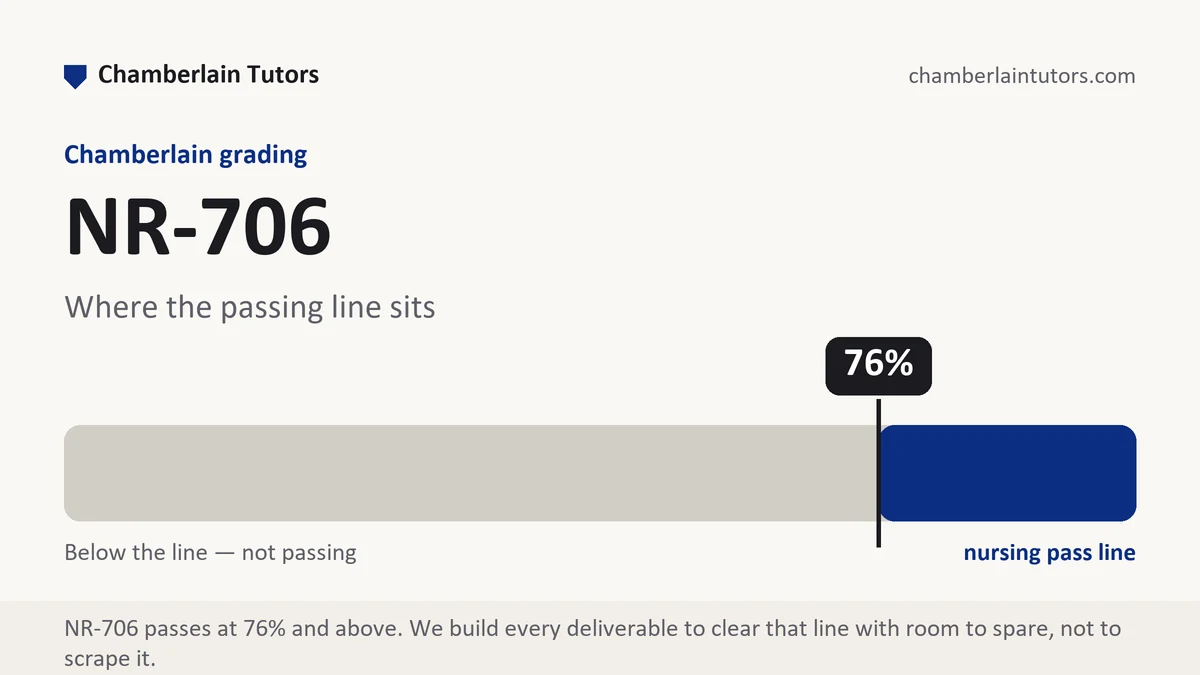
A passing NR-706 paper identifies a genuine problem and proposes a plausible technology response. It is usually accurate, and it is usually interchangeable with any other student's paper on the same topic. Chamberlain treats 76 percent as the last passing number in its core nursing courses, and a weak weighted average cannot be repaired after the fact, so accuracy without distinctness is a slow way to lose the margin you will want later in the session.
Strong papers do three things. They locate the change at a specific point in a specific workflow, so a reader can see the screen and the moment. They treat unintended consequences as part of the design rather than as a limitation paragraph, naming what the change adds to someone's click count and how that time is bought back. And they close the loop on the decision they opened with: the same role, the same interval, now making the choice with information it did not have. A paper that ends on implementation rather than on the decision has left the highest-weighted row half answered.
Six mistakes that cost points in NR-706
- Reviewing software instead of analyzing a system. Feature lists are marketing. The analysis rows want workflow, data and decisions.
- Treating a dashboard as an outcome. A report being available is not a result. Name what changed for a patient or a process because it existed.
- Ignoring where the data is entered. Every reporting proposal depends on someone typing something during a shift. If you cannot say who and when, the proposal is not designed yet.
- Handling privacy in one sentence. Access control, minimum necessary and audit are design decisions in this course, not a compliance footnote.
- Posting an unrehearsed board response. Chamberlain discussion posts cannot be edited after submission, so write and check the workflow claims elsewhere first.
- Making claims about automated decision support you cannot source. Any assertion about performance needs an evaluation behind it, in a setting you can compare to yours.
Questions NR-706 students ask
I am not technical. Can I still write a strong systems analysis?
How do I diagram a workflow when the rubric only asks for a paper?
My organization will not share system data with me. What can I use?
Where NR-706 sits in Chamberlain's programs
Open the exact program map for sequence, credit, and option context. The current student schedule and syllabus remain authoritative after transfer evaluation, electives, state rules, and approved plan changes.
The weeks, one by one
Week 1
NR-706 opens by asking you to name a decision that is currently being made without adequate information, and to argue that the shortfall is an informatics problem rather than a staffing or motivation problem. Read the full Week 1 manual.
Week 2
The second stage of an informatics course usually moves from naming a problem to documenting how the work is actually done, which means writing a current-state workflow that includes the workarounds. Read the full Week 2 manual.
Week 3
By the third stage an informatics course usually turns to whether the data underneath your analysis can bear weight, and to who is accountable for keeping it that way. Read the full Week 3 manual.
Week 4
The midpoint of an informatics course typically asks how information moves between systems and organizations, which means terminology standards, exchange standards and the difference between data arriving and data being understood. Read the full Week 4 manual.
Week 5
Around the middle of the session an informatics course usually moves to decision support: the logic that fires inside a record to shape what a clinician does next, and the accountability that has to sit behind it. Read the full Week 5 manual.
Week 6
Sixth-stage informatics writing usually turns to the human side of the system: whether the design fits the way clinicians actually work, and what determines whether a change is used after the training week ends. Read the full Week 6 manual.
Week 7
Late in an informatics session the work usually turns to measurement: how data captured in care becomes a number somebody acts on, and how to build a measure specification that survives being questioned in a meeting. Read the full Week 7 manual.
Week 8
The closing stage of an informatics course usually asks for the whole argument assembled into a recommendation an organization could act on: the decision that needed better information, the workflow and data findings behind it, the designed change, the privacy and security obligations it triggers,. Read the full Week 8 manual.