The closing stage of an informatics course usually asks for the whole argument assembled into a recommendation an organization could act on: the decision that needed better information, the workflow and data findings behind it, the designed change, the privacy and security obligations it triggers, the measurement plan, and the sustainability case. The register shifts here too. A closing paper is written for a decision-making audience, not only for a grader. Your section may print this as NR 706 or NR706; it is the same course. Chamberlain publishes no syllabi outside Canvas. The placement here is our teaching judgment from the course's catalog arc; your section's rubric decides what your week actually asks.
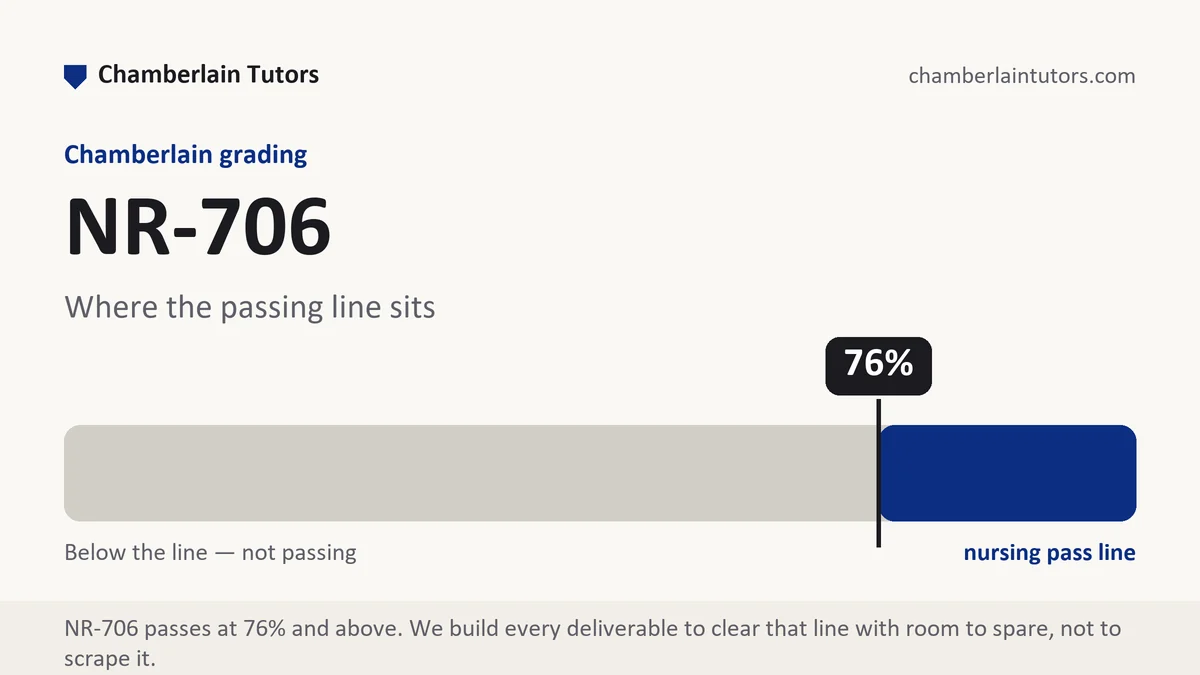
What NR-706 Week 8 asks for
The failure mode worth naming at the start is the assembled paper that reads like eight submissions stapled together. A committee reviewing a proposal does not want a chronology of how you learned things; it wants the argument in the order that supports a decision. That means the recommendation and its cost sit near the front, the evidence sits behind it in the order a skeptic would ask for it, and the material from earlier stages is compressed to whatever load it has to carry rather than reproduced at its original length.
Two obligations tend to appear in a closing stage that were previously in the background. The first is privacy and security. Any change to how data is captured, moved, stored or displayed has consequences for who can see it, how access is authorized, what is logged, what leaves the organization and what happens if a device or an account is compromised. A doctoral submission is expected to write those consequences at the level of the design rather than to recite a regulation.
The second is sustainability, and it is where most student recommendations quietly fail. Say who owns the change once the project ends, what is added to whose workload permanently, what the annual cost looks like, which committee reviews the measure a year from now, and what happens at the next system upgrade. A change that depends on the continued attention of the person who proposed it is not sustainable, and writing the handoff explicitly is the mark of an author who has watched improvements decay.
If your section pairs the final paper with a presentation or an executive summary, treat that as a different genre rather than a compressed version of the same document. Executives read for the decision, the cost, the risk and the ask. A summary that opens with background has spent its most valuable paragraph on the least valuable content, and translating scholarly work for a practice audience is itself a doctoral competency.
The NR-706 Week 8 method, step by step
Six moves for assembling a session's work into a recommendation that could be approved.
-
Write the recommendation as one sentence and put it first
Change this element, at this point in this workflow, for this population, owned by this role. If you cannot compress it to a sentence, the proposal is still a collection of ideas rather than a decision.
-
Rebuild the evidence in the order a skeptic would demand it
The problem and its size, the current-state finding, the data quality constraint, the design rationale, the anticipated adoption issues. Compress each to the shortest form that still supports the claim, and cite forward to your appendices rather than repeating.
-
Cost it honestly, including the invisible costs
Build hours, testing, training time removed from the floor, ongoing maintenance, and the workload permanently added to a role. Underestimating here is the most common reason real proposals fail after approval.
-
Write the privacy and security analysis at the level of your design
Who gains access, how authorization is granted and revoked, what is logged, whether data leaves the organization, and what the exposure looks like if a component fails. Name the safeguard for each risk rather than asserting compliance.
-
Attach the evaluation plan and the review point
Carry your measures forward with a date at which someone decides to continue, modify or stop. A recommendation with no stopping rule is a permanent commitment made without saying so.
-
Write the sustainability handoff by name
Owner after go-live, the committee that reviews it, the annual cost line, who maintains the content, and what triggers a re-review at upgrade. Two specific paragraphs here outperform a page of general commitment to continuous improvement.
A layout that makes a final recommendation approvable
Our frame for a closing informatics recommendation, sized for roughly 1,800 to 2,200 words. It is our own outline rather than anything the university issues, and your week's rubric outranks it wherever the two disagree.
| Section | What belongs in it | Word target |
|---|---|---|
| Recommendation and ask | The change in one sentence, the decision requested, the approximate cost and the approval body. | 160 to 200 |
| Problem and its size | The decision harmed by missing information, quantified, with the source of the number stated. | 200 to 250 |
| Evidence from current state | Workflow and data quality findings compressed to what the recommendation actually rests on. | 300 to 360 |
| Design and implementation | The intervention specified, its placement, the sequence of build, test, pilot and spread, and the support model. | 350 to 420 |
| Privacy, security and risk | Access changes, logging, data movement, the failure scenarios and a named safeguard for each. | 250 to 300 |
| Evaluation and sustainability | Measures, review point, stopping rule, permanent owner, annual cost and upgrade re-review trigger. | 280 to 340 |
Evidence craft for a closing recommendation
Cite forward as well as backward. Your own earlier findings are evidence and should be presented as such, with the method that produced them named in a clause. An audit of forty records conducted in March carries weight only if the reader can see where it came from.
Write regulation as obligation, not as recitation. Say what a requirement obliges your design to do: this access must be role based, this transmission must be encrypted, this disclosure must be logged. Statutory summary without application is the least productive paragraph in a closing paper.
Keep the cost figures labelled and conservative. Mark every number as measured, quoted or estimated, and prefer ranges to false precision. A proposal that overstates savings loses credibility in exactly the audience it was written for.
Preserve the distinction between improvement and research one last time. Your evaluation plan tests whether a local process changed. It is not designed to produce generalizable knowledge, and saying so plainly, along with the appropriate determination pathway if dissemination is contemplated, is a doctoral-level accuracy.
Match the reference list to a practice audience. Standards documents, published measure specifications, implementation frameworks and evaluation studies belong. Padding with tangential citations to reach a count is visible and reads as insecurity in a paper meant to persuade.
Five mistakes that cost points in this week's territory
- Chronological assembly. A paper organized by how you learned things rather than by what supports the decision buries its own recommendation.
- Compliance by assertion. Saying a design will be compliant, without naming the access, logging and transmission decisions, is not a privacy analysis.
- No permanent owner. A change that reverts to nobody at the end of the session has no sustainability case, whatever the closing paragraph promises.
- Benefits without costs. A proposal with only upside is read by any experienced reviewer as incomplete rather than attractive.
- Ending with a summary of the paper. The closing paragraph should tell the reader what to do next, not restate the six sections above it.
Before you submit
- The recommendation appears as a single sentence in the first paragraph
- The problem carries a number with its source and window stated
- Implementation is sequenced with build, test, pilot, spread and a support model
- Each privacy or security risk has a named safeguard attached
- The evaluation plan includes a review date and an explicit stopping rule
- A named role owns the change after the project ends, with an annual cost line
Assembling the final NR-706 recommendation?
Send the rubric and your earlier submissions out of Canvas. A premium original draft comes back in 24 to 48 hours ordered for a decision-making reader, costed honestly and closed with a sustainability handoff, and revisions run until the grade lands.