NR-703 Applied Organizational and Leadership Concepts is a three-credit doctoral course that grades diagnosis rather than aspiration. The catalog frames it as applying organizational and leadership concepts to build systems that support relationship-based care and better outcomes. What that means on the page is that you describe a real organization as a system, find where the system produces the result nobody wants, and use a named leadership or organizational concept to explain why. Reflection on your own leadership style is background here, not the assignment.
What NR-703 actually grades
The heavy rows in this course reward a diagnostic chain: structure produces behavior, behavior produces outcome. A grader wants to see you name a structural feature such as span of control, handoff design, staffing model, reporting line or incentive, then trace it to what people actually do, then trace that to a measured result. Papers that stop at describing the organization have completed the setup and skipped the analysis.
The second thing this course grades is whether relationship-based care is treated as a mechanism or a slogan. Used well, it is a claim that the continuity and quality of the relationship between a patient and a known caregiver changes outcomes, which makes it something you can design for and measure. Used badly, it becomes a paragraph of warm adjectives that no rubric row can score. The difference between those two treatments is usually the difference between a mid-range grade and a strong one.
How we help in NR-703
Our doctoral bench writes organizational analysis the way an executive reader wants it: the problem stated with a number, the structural cause argued, the framework doing visible work, and the recommendation costed and owned. Drafts come back with the diagnostic chain marked so you can defend each link in a discussion thread.
Deliverables run the standard promise: a premium original draft in 24 to 48 hours, targeted at the A band of your course's actual scale, through the eight-person pipeline with both QA passes and the floor check, revised free until it lands.
In NR-703 right now?
Send the week and the rubric from Canvas. First premium sample free, floor-checked, back in 24 to 48 hours.
Read the rubric before the prompt
Organizational prompts are broad on purpose, which makes the rubric the only reliable guide to scope. Copy the criterion rows into a blank file and sort them into three piles: rows that ask you to describe, rows that ask you to analyze, and rows that ask you to recommend. Almost every guide in this course carries all three, and almost every struggling paper spends its length on the first pile.
Then attach word counts. Take a 2,500-word paper with four scored rows weighted 44, 24, 20 and 12 percent. The multiplication hands you 1,100 words, 600, 500 and 300. Write those numbers next to your headings before drafting. In NR-703 the 1,100-word row is normally the analysis row, which means the organizational description that felt like the paper deserves roughly the same space as your recommendation section, and no more.
One rule keeps the budget honest. Any sentence that would survive being moved to a different hospital belongs in the description pile, and the description pile has a ceiling. Sentences that only make sense at your named unit, with its staffing pattern and its numbers, belong in analysis. If you cannot fill the analysis budget with setting-specific sentences, the problem is that the problem has not been bounded tightly enough yet.
The shape of an organizational analysis
Most graded writing in NR-703 is an organizational or leadership analysis of a unit, service line or system. The parts below each do one piece of work, and a grader sees immediately whether it was done.
| Part | What it has to prove | How a thin version looks |
|---|---|---|
| The unit as a system | Inputs, workflow, decision rights and reporting lines, described so a reader who has never visited can picture the flow. | An organizational chart summarized in prose. |
| The undesired result, measured | One outcome with a number, a denominator and a time window, plus the benchmark you are comparing it to. | A statement that morale or quality is a concern. |
| The structural cause | A specific feature of how work is organized, argued as the source of the behavior that produces the result. | Blame assigned to individual attitudes or effort. |
| Framework doing work | An organizational or leadership concept whose own terms explain the mechanism, applied step by step. | A model named in the introduction and abandoned. |
| The relationship mechanism | How continuity, trust or known-caregiver contact would change the behavior you diagnosed. | An assertion that patient-centered care improves outcomes. |
| The change approach | Sequence, sponsor, resistance anticipated, and what gets decided by whom. | A list of steps with no owner attached to any of them. |
| Metrics and accountability | What will be measured, at what interval, and who reports it to whom. | A promise to evaluate effectiveness. |
Evidence and citation craft in organizational writing
Organizational papers fail evidence rows in a distinctive way, because so much of the material is internal and unpublished. Four habits fix most of it.
Label internal data as internal, and describe how it was produced. Unit dashboards, engagement survey results and incident counts are legitimate evidence when you say where the number came from, what period it covers and who compiled it. Presented bare, they read as anecdote. Never publish identifiable patient or staff detail in coursework; describe roles rather than people.
Check the instrument behind any survey number. Engagement, safety climate and burnout scores come from instruments with published properties. Cite the instrument, not only the vendor report, and say whether the response rate was high enough to carry the conclusion you are drawing from it.
Keep leadership research in the verb tense its design earned. Most published leadership evidence is cross-sectional and correlational. That buys was associated with and predicted. It does not buy improved or caused. Where your guide sets no recency rule, treat sources older than five years as needing a justification in the sentence, with foundational organizational theory the obvious exception.
Rates need denominators and windows, including workforce rates. Turnover is the classic trap: a figure means nothing until you say turnover of which roles, over what period, out of how many budgeted positions. Write that 14 of 96 budgeted registered nurse positions turned over across the last twelve months, then convert if you want a percentage.
What separates a pass from a strong pass here
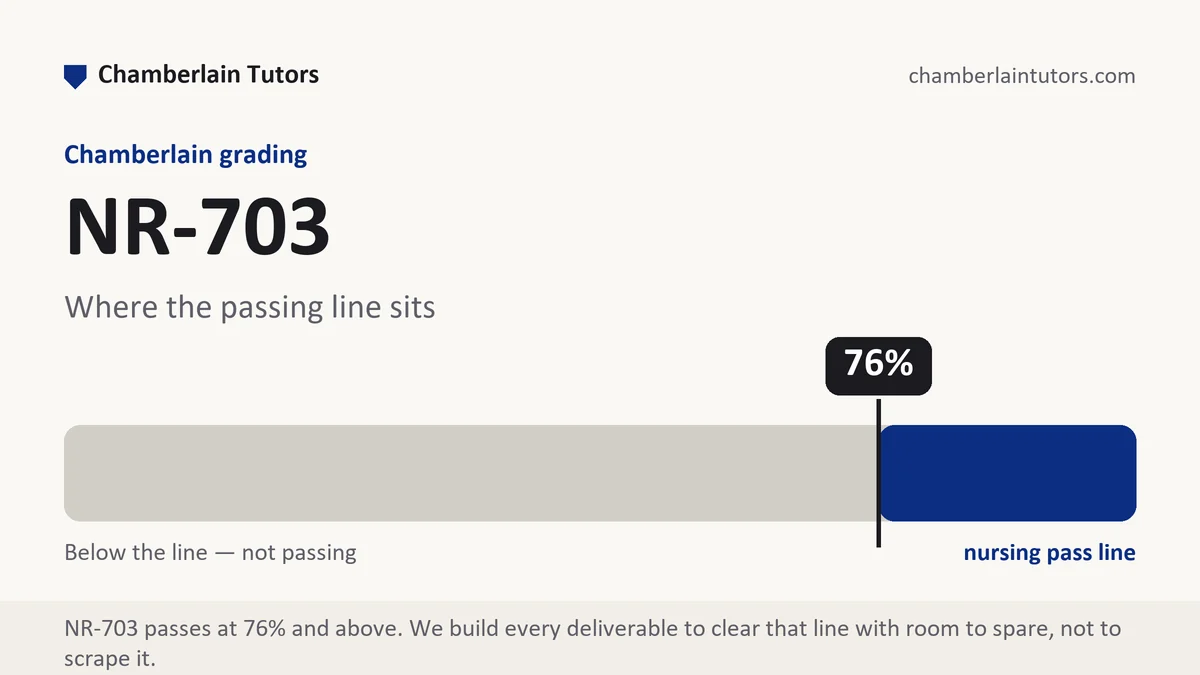
A passing NR-703 paper describes an organization competently, names a recognized leadership model and recommends something reasonable. It is also the paper thirty classmates wrote. Chamberlain holds its core nursing courses to a 76 percent floor with no supplementary route back from a weighted average that has weakened, a session of competent-and-generic submissions leaves no margin for the week when work goes badly.
The strong version differs in three ways. It commits to one diagnosis rather than listing four contributing factors, because a diagnosis can be argued and a list cannot. It writes the recommendation at executive altitude, meaning cost, sponsor, sequence and the decision the reader is being asked to make, rather than a set of activities. And it names what would prove the diagnosis wrong: the measure that would move in the opposite direction, the objection a chief nursing officer would raise first. Anticipating that objection in the paper is what makes the analysis read as doctoral rather than earnest.
Six mistakes that cost points in NR-703
- Writing a personal leadership philosophy. Your style is not the unit of analysis. The organization is. Reflection belongs only where a row asks for it.
- Describing instead of diagnosing. A thorough tour of the department with no causal claim fills the page and empties the analysis row.
- Naming a change model without using its steps. If the model has phases, the paper should visibly move through them with content in each.
- Recommending without a cost or an owner. A recommendation nobody is assigned and nothing is budgeted for is a wish, and doctoral graders read it as one.
- Posting a leadership case in one draft. Chamberlain board posts cannot be edited after submission. Write it elsewhere, remove anything identifiable, then paste.
- Ending on inspiration. A closing paragraph about transforming culture replaces the metrics row that was worth real points.
Questions NR-703 students ask
Can I write about my own workplace, and how do I keep it anonymous?
Which leadership framework should I choose?
What if I cannot get access to the organizational data I need?
Where NR-703 sits in Chamberlain's programs
Open the exact program map for sequence, credit, and option context. The current student schedule and syllabus remain authoritative after transfer evaluation, electives, state rules, and approved plan changes.
The weeks, one by one
Week 1
NR-703 opens by asking a practicing clinician to stop describing a workplace and start diagnosing one. Read the full Week 1 manual.
Week 2
The second stage of NR-703 is where the diagnostic chain gets its first link built properly. Read the full Week 2 manual.
Week 3
Culture is the hardest thing to write well in a doctoral organizational course because it invites adjectives, and adjectives cannot be scored. Read the full Week 3 manual.
Week 4
This is the stage the catalog description points at directly: building systems that support relationship-based care and better outcomes. Read the full Week 4 manual.
Week 5
The fifth stage of NR-703 usually asks you to apply a named leadership theory to the organizational problem you have been building, and the grading turns on one question: does the theory explain something you could not have said without it. Read the full Week 5 manual.
Week 6
The sixth stage of NR-703 moves from diagnosis to change, and the doctoral standard is that resistance is analyzed rather than overcome. Read the full Week 6 manual.
Week 7
By the seventh stage of NR-703 the diagnosis is built and the recommendation has to be paid for. Read the full Week 7 manual.
Week 8
The closing stage of NR-703 asks for one document that carries the whole session: the organization diagnosed, the concept doing visible work, the change designed, the recommendation costed, and the measurement that would tell anyone whether it worked. Read the full Week 8 manual.