In the MSN-PMHNP sequence, NR-668 is PMHNP capstone. Students search the code mid-panic more than any title, so this page answers the code: here is the honest read and the service behind it.
What NR-668 actually grades
The PMHNP capstone with board-review intensity, integrating the track in writing while certification preparation demands its own hours. PMHNP-BC sits at the end of it.
How we help in this course
Capstone writing runs staged through the pipeline; board preparation runs as organized coaching beside it. The split keeps both moving, and the certification sit stays entirely yours.
The service terms match the whole site: 24 to 48 hour delivery, A-band targeting on your scale with the floor math shown, two independent QA passes, free revisions until the target is met.
How the capstone's written work gets built
Chamberlain keeps NR-668 syllabi inside Canvas, so nothing below is tied to a week number. It is tied to whichever scoring guide is sitting under your current assignment. The capstone asks you to synthesize the track rather than add to it, and its written work runs to a small family of forms: case studies, chart reviews, practice critique, and a capstone product that has to show your own clinical management thinking rather than describe the specialty back to faculty. The method below is built for that family.
In NR-668 right now?
Send the week and the rubric from Canvas. First premium sample free, floor-checked, back in 24 to 48 hours.
Splitting the capstone from the boards it points at
NR-668 integrates the PMHNP track in writing while certification preparation demands its own hours, and PMHNP-BC waits at the end. Run together, the two halves starve each other; run split, both finish. The desk stages the capstone's written components through the pipeline on a dated plan, while board preparation proceeds beside it as structured coaching: drills, organized practice questions, study plans sized to your calendar. Neither half is allowed to borrow weeks from the other. Faculty feedback is treated as a scheduled event rather than a surprise, with revision windows built into the plan from the start.
What stays yours, stated plainly
The certification sit is entirely yours, on your name and no one else's, and every service promise on this page stops at that door. What crosses the door with you is the preparation: material organized, weaknesses drilled, the capstone's writing already banked at the A band so the final stretch belongs to review rather than rescue. Clients describe the last month as strangely calm, which is what a working split should feel like.
How the staged weeks actually run
Each staged section returns inside 24 to 48 hours of its scheduled hand-off, floor-checked against the specialty scale that still governs the capstone, ahead of every Mountain-Time cutoff. The staging plan is built at intake, free, from your syllabus and calendar; send both in chat and the capstone's whole shape comes back mapped before you commit to anything. The mapping itself costs nothing.
Count the verbs before you count the words
Capstone guides look like the guides you have been reading for two years, and they are not. Their rows ask you to synthesize, evaluate, and critique, and those verbs price differently from the ones that have been paying your grades so far.
So budget verbs before you budget words. Go down the criterion column and sort every row into two piles by the verb in its top band. One pile is analysis: analyze, evaluate, synthesize, critique, justify, appraise. The other is description: describe, identify, summarize, list, outline. Add the points in each pile. That ratio is the ratio your finished document should have.
Worked through: say the analysis rows total 65 points, the description rows total 35, and your ceiling is 2,000 words. You owe roughly 1,300 words of analysis and 700 of description. Now hold each planned section against that. If a section opens with 300 words setting up a chart review and closes with 120 words on what the review means, you have inverted the ratio in the exact place the guide pays most. The repair is not to write more, it is to move the boundary: compress the setup, extend the interpretation.
The ratio doubles as a triage tool at eleven at night. When the ceiling is tight and something has to go, cut description first, every time. A thin setup with sharp analysis outscores a thorough setup with thin analysis, because only one of those two piles is where the capstone's points live.
What a practice critique has to contain
The chart review and the practice critique are the same document with different emphasis, and one or both sits under most capstone products in this specialty. Here is what a reader checks for.
| Component | What a reader checks for |
|---|---|
| Purpose and practice question | One sentence naming the practice behavior you examined and why it was worth examining in your setting rather than in general |
| Scope and sampling frame | How many records, drawn how, from which setting, across what dates. It goes before any finding, because it governs every number that follows |
| The standard being measured against | The guideline, criteria, or protocol you compared practice to, cited by name, issuing body, and edition |
| Findings as counts | Raw numbers first and percentages second, with no percentage allowed to hide a small denominator |
| Gap analysis | Where practice and standard diverged, and your read on why, kept visibly separate from what you observed |
| Practice change proposed | A change sized to the setting you actually work in, with the role that would carry it named |
| Measure and re-check | What number would tell you the change worked, over what window, collected by whom |
| Limits stated plainly | Single site, single reviewer, retrospective, whatever applies. Naming limits earns points; hiding them gets caught |
| Synthesis back to the role | What this says about your practice as a psychiatric mental health provider, which is the row the capstone exists for |
That last row is the one students shortchange. A critique ending at the finding is a report. The capstone wants the sentence after the finding: what you now do differently, and on what grounds.
Evidence craft in a retrospective review
Retrospective work comes with a ceiling on what it can claim. Writing above that ceiling surrenders an evidence row you had otherwise already won.
Start with the standard, not the sample. A critique is only as solid as the thing it measures against, so name the guideline, its issuing body, and its edition before you present a single count. A comparison against an uncited standard is an opinion with arithmetic attached to it.
Counts before percentages, always. Fourteen of 50 records is a finding. Twenty-eight percent standing alone is a claim quietly borrowing the authority of a much larger study. A small denominator is not a weakness once it is visible; it is what lets a reader calibrate, and the rows about scholarly rigor can tell the difference. Give every number its window too, since records from March through May and records across two years support different arguments.
Then keep the verbs honest. A chart review can show that something was documented more often, was associated with, or preceded. It cannot show that something reduced or improved an outcome, because the design was never built to. Reserve those words for studies that can carry them. And when you recommend a change, cite the evidence for the change itself separately from the evidence that a gap exists, because those are two different claims and capstone rubrics score them in two different places.
What faculty see in a strong capstone deliverable
A passing deliverable reports what the review found and recommends something reasonable. Faculty read a great many of those.
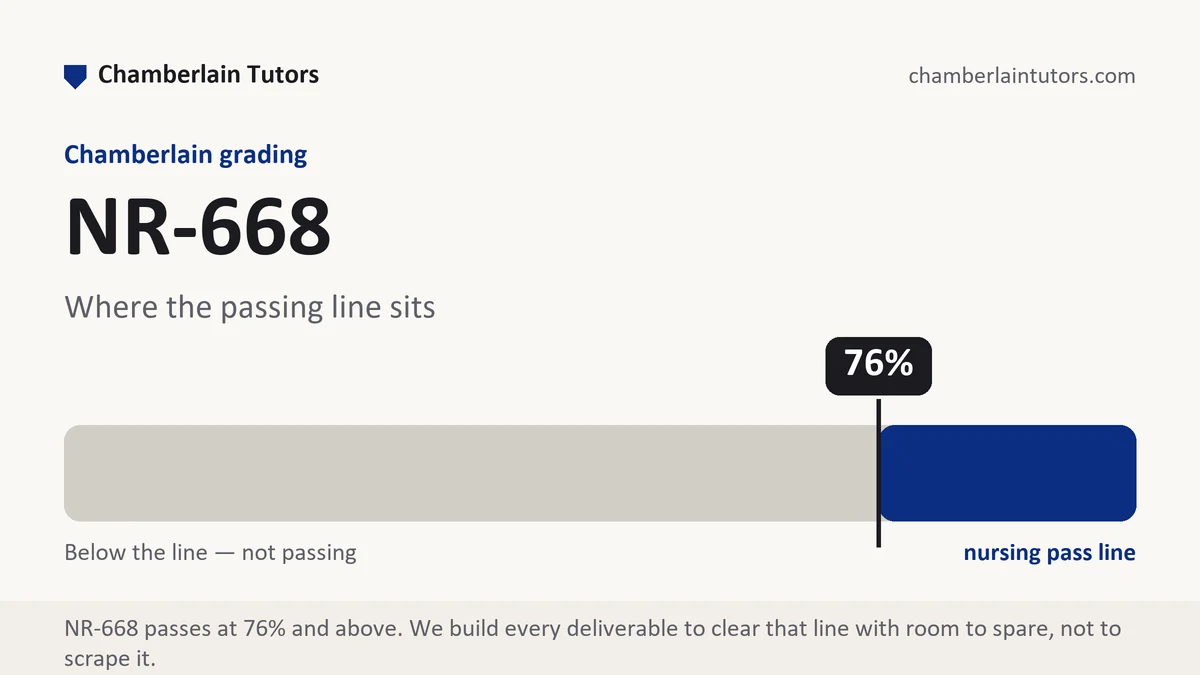
A strong one is recognizable on the first page, because the scope and its limits arrive before the findings instead of after, which tells a reader the writer knew what their data could and could not do from the beginning. It keeps observation separate from interpretation, so the grader can see which sentences are evidence and which are your read on it. Its recommendation is sized to a real setting, with a role attached and a number that would prove it worked, rather than a generic call for more education. And it closes on the role rather than the chart: what this writer will do differently as a provider, argued from the finding instead of announced next to it. Below 84 on the specialty scale there is nothing to catch you, so the margin these habits buy is not decoration.
Six mistakes that cost points in the capstone
A percentage with the denominator hidden
Write six of 20 rather than 30 percent when the sample is small. The honest form reads as rigor; the rounded one reads as a number you hoped nobody would check.
Measuring practice against a standard you never named
If the comparison point is not cited, the gap you found is an assertion. Name the guideline and its edition before the first count.
Surveying the specialty instead of examining your practice
A capstone that could have been written before you started clinical hours has missed its purpose. The evidence it wants is yours.
Letting board study and the written work draw on the same hours
Both expand to fill whatever is available. Date the deliverables first, then fit study around fixed blocks, or the last month becomes a collision.
A recommended change with no measure and no owner
Every proposal needs a number that would show it worked and a role that would carry it. Without both it reads as a wish.
Treating a preceptor's habit as the standard
How your site does it is your finding, not your benchmark. The benchmark is published, and the whole critique turns on keeping those two apart.
Three questions students send about 668
How many records is enough for a review at this level?
The practice I am critiquing is my preceptor's. How do I write that without it becoming personal?
Can you take certification prep off my plate?
The weeks, one by one
Week 1
NR-668 Week 1 is the stage where the psychiatric mental health capstone stops being a schedule and becomes a written plan: what you intend to learn across the precepted hours, in which setting, measured how, and inside which boundaries of your own developing authority. Read the full Week 1 manual.
Week 2
Having said what you intend to learn, you now have to characterise the psychiatric population you are learning on, and the service that reaches them: who arrives, through which door, carrying which unmet needs, and what the community around the clinic makes likely. Read the full Week 2 manual.
Week 3
NR-668 Week 3 is where the capstone starts grading your clinical reasoning directly, through a written account of a de-identified psychiatric encounter that has to carry an assessment, a differential, and a formulation the reader can follow from evidence to conclusion. Read the full Week 3 manual.
Week 4
NR-668 Week 4 asks you to defend a medication decision in writing: why this agent for this presentation, why not the obvious alternative, what you will watch and at what interval, and what would make you stop. Read the full Week 4 manual.
Week 5
NR-668 Week 5 is the point where the capstone stops treating medication as the whole of psychiatric care. Read the full Week 5 manual.
Week 6
NR-668 Week 6 takes the capstone into the writing that matters most when something goes wrong: a documented risk assessment and a safety plan that a colleague reading the record at two in the morning could act on. Read the full Week 6 manual.
Week 7
NR-668 Week 7 is where the capstone points at the certification exam waiting on the other side of it. Read the full Week 7 manual.
Week 8
NR-668 Week 8 closes the psychiatric mental health capstone with the one document that has to argue rather than report: a synthesis showing what the whole practicum produced, evidenced from the artefacts you have been building since the opening week, and assembled into a portfolio a reader could. Read the full Week 8 manual.
Where NR-668 sits in Chamberlain's programs
Open the exact program map for sequence, credit, and option context. The current student schedule and syllabus remain authoritative after transfer evaluation, electives, state rules, and approved plan changes.