NR-668 Week 6 takes the capstone into the writing that matters most when something goes wrong: a documented risk assessment and a safety plan that a colleague reading the record at two in the morning could act on. This is documentation as clinical reasoning, and it is graded on defensibility rather than on length. Your section may print this as NR 668 or NR668; it is the same course. Chamberlain publishes no syllabi outside Canvas. The placement here is our teaching judgment from the course's catalog arc; your section's rubric decides what your week actually asks.
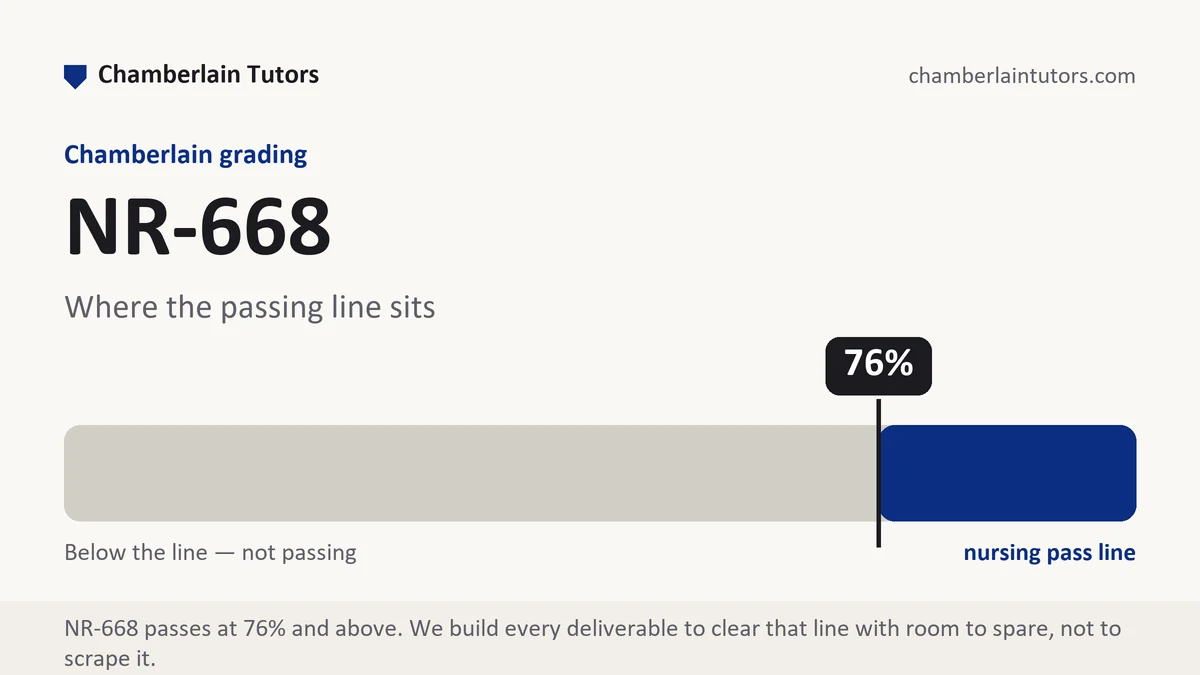
What NR-668 Week 6 asks for
The territory is risk written as a judgement with reasons attached. A capstone reader is checking whether you can move past the two failure modes that dominate student risk writing. The first is the checklist without a conclusion, where every factor is dutifully recorded and no clinical judgement is ever stated. The second is the conclusion without the factors, where a paragraph declares low risk and nothing in the record shows how that was reached.
What belongs in between is a structured account: what was asked and what was answered, static factors that raise baseline risk, dynamic factors that are moving now, protective factors that are genuinely present rather than assumed, access to means, and a formulation of risk that names the circumstances under which it would rise. Then a plan that responds to that formulation, including a safety plan built with the patient in their own words, the removal or restriction of means where possible, who is contacted, what the follow-up interval is, and what triggers escalation.
Ethical and legal reasoning usually sits alongside this at capstone level: confidentiality and its limits, duty to protect obligations that vary by jurisdiction, capacity, involuntary evaluation processes and documentation standards. Write those in general professional terms and attribute anything jurisdiction specific to the authority that sets it. The deliverable at this point is often a documentation exercise or a case analysis against a template, sometimes with a posted ethical discussion. If your section runs a discussion this week, draft it outside Canvas first. And the boundary holds here as everywhere: we help with writing about a case you were part of, never with the live clinical decision or the record itself.
The NR-668 Week 6 method, step by step
Six moves that turn a difficult encounter into documentation that would hold up.
-
Record the questions and the answers, not a summary of them
What you asked about thoughts, intent, plan, timing, means, rehearsal and previous attempts, and what the patient said, close to their words. A summarised risk inquiry loses the specificity that later readers depend on.
-
Sort factors into static, dynamic and protective
Static factors set a baseline and do not move. Dynamic factors are what changed recently and what could change again. Protective factors count only where they are current and real. Keep the three groups visibly separate, because only one of them is modifiable this week.
-
Address access to means directly
Ask, record the answer, and record what was agreed about restriction, including who else is involved and what was actually done rather than what was recommended. This is the single most consequential paragraph in the document.
-
State a risk formulation, not a risk score
One paragraph saying the level of concern now, the reasons behind it, and the specific circumstances that would raise it. Categories alone do not tell a covering clinician what to watch for; conditions do.
-
Build the safety plan with the patient in it
Warning signs the patient recognises, coping steps they will actually use, named people and settings that help, contacts including a crisis line, and the means restriction step, all recorded in language they agreed to rather than in template language.
-
Close the loop with interval, escalation and consultation
When they are seen next, what would bring that forward, who was consulted and when, and what the supervising clinician decided. A record that omits the consultation omits the part that makes the decision defensible.
A layout and word budget for a risk documentation exercise
The frame our tutors use for a risk write-up of roughly 1,100 to 1,400 words. It is our own outline rather than a university form or a clinical instrument, and your week's rubric outranks it wherever the two disagree.
| Section | What belongs in it | Word target |
|---|---|---|
| Context of the assessment | Why risk was assessed now, in what setting, with what prompted the inquiry, in three or four sentences. | 90 to 120 |
| The inquiry as conducted | Questions asked and answers given across thoughts, intent, plan, timing, means and history. | 220 to 270 |
| Factor analysis | Static, dynamic and protective factors in three labelled groups, with the evidence for each. | 230 to 280 |
| Risk formulation | Current level of concern, the reasoning, and the named conditions under which it would rise. | 170 to 210 |
| Safety plan and means | Warning signs, coping steps, supports, contacts, and what was actually done about access to means. | 230 to 280 |
| Disposition and ethics | Interval, escalation trigger, consultation recorded, and the confidentiality or duty considerations engaged. | 160 to 200 |
Evidence craft for risk writing
Be precise about what instruments can do. Structured risk tools support a clinical judgement and do not replace it, and their predictive performance at the level of an individual is limited. Where you cite a tool, name it, say what it was validated to do, and say explicitly that your judgement rests on the formulation rather than on the score.
Attribute legal obligations to their source. Duty to warn and duty to protect requirements, involuntary evaluation criteria and reporting rules differ by jurisdiction and change over time. Name the state or the professional body whose rule you are describing, give the year of the source, and avoid writing a national statement about something that is not national.
Quote sparingly and only where wording matters. A short direct quotation of what a patient said about intent is clinically meaningful and belongs in the record. Long quoted passages of narrative are not, and they carry re-identification risk that summary does not.
Keep base rates in proportion. Population level statistics about suicide or violence describe groups, not the person in front of you, and using them to argue an individual conclusion is a reasoning error a capstone reader will mark. Cite them for context and let the formulation do the work.
Five mistakes that cost points in this week's territory
- A completed checklist with no judgement. Recording every factor and never stating a level of concern leaves the clinical reasoning rows with nothing to grade.
- Protective factors asserted rather than checked. Family support and future plans count only where the encounter produced evidence that they exist and are currently active.
- Means never mentioned. A risk document that does not address access to means will read as incomplete regardless of how carefully everything else is written.
- A generic safety plan. Template phrases the patient did not choose are not a plan they will use at midnight, and graders can spot the difference immediately.
- Consultation left out of the record. Supervision happened; if the document does not show it, the decision looks as though a student made it alone.
Before you submit
- Questions asked and answers received appear, not a summary of the conversation
- Static, dynamic and protective factors sit in three labelled groups
- Access to means is addressed with what was agreed and what was done
- A formulation states current concern and the conditions that would raise it
- The safety plan uses the patient's own warning signs and supports
- Interval, escalation trigger and consultation are all recorded
Writing NR-668 risk documentation this week?
Send the de-identified case and the rubric out of Canvas. A premium original draft comes back in 24 to 48 hours with the factor analysis structured and the formulation defensible, and revisions run until the grade lands.