NR-622 finishes the nurse educator concluding graduate experience: 1.5 theory credits, 1.5 practicum credits and 72 practicum hours in which the scholarly project started in NR-621 is completed and written up. The deliverable is a report about teaching that actually took place, and the rows that decide the grade are the ones asking you to judge your own objectives against evidence, one objective at a time, instead of concluding in general that the session went well.
What NR-622 actually grades
The first strand is the artifact and its delivery. A grader has to be able to see what you built, how long it ran, who received it and under what conditions. Modules, lesson plans, evaluation tools and teaching guides are usually attached rather than described, and the prose then explains the choices inside them rather than repeating their contents.
The second strand is the evaluation, judged objective by objective. This is where most points move. Each objective you wrote in the planning course has to be answered with the evidence you collected: met, partly met or not met, with the item or observation that supports the verdict. A report that gives one overall impression of success has left the heaviest row blank.
The third strand is the educator role, written as analysis rather than diary. What did teaching this group teach you about learner evaluation, about pacing, about the difference between what you planned and what a room does? Reflection rows in this course reward specific decisions and their consequences, and they penalize feelings without evidence.
How we help in this course
Firm limits, stated plainly. We do not complete practicum hours, contact a mentor, school or unit, sign placement paperwork, fill an hour log, teach a session or evaluate a learner for you. Nor can we manufacture results, because the evaluation data has to come from what you did.
What we build is the report. Send the scoring guide, the objectives you committed to and the evaluation data you gathered, and a premium original draft returns in 24 to 48 hours: results tied to objectives one by one, small numbers reported honestly, and a reflection that reads as professional analysis. Both quality passes and the floor check run before delivery, and revision stays free until it lands.
Writing this course's deliverables from the rubric
No Chamberlain syllabus is published for this course, and the scoring guide is attached to each assignment inside Canvas rather than issued up front, so no honest week by week grid exists. What transfers is the method below: how a completed education project is budgeted, structured, evidenced and checked. Read it with your own guide open, and start with any row your guide names that this page does not.
In NR-622 right now?
Send the week and the rubric from Canvas. First premium sample free, floor-checked, back in 24 to 48 hours.
The passing line, and the clock on a finishing course
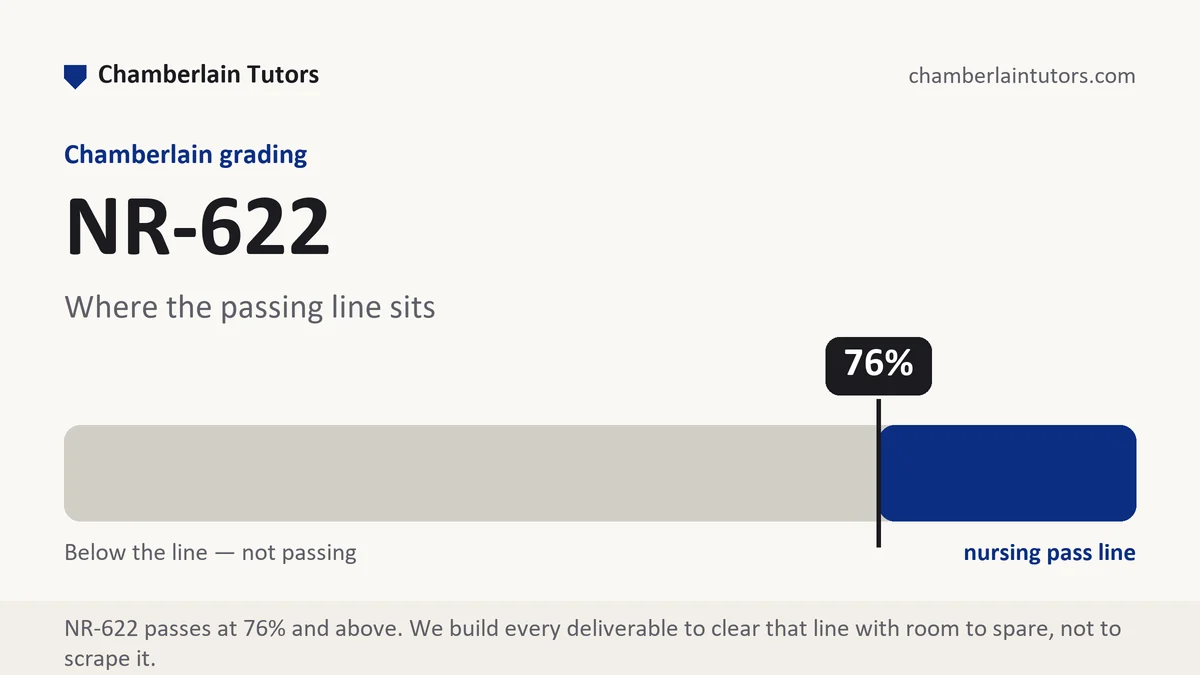
Core nursing courses pass at 76 percent. The nurse practitioner specialty scale with no C band belongs to NP specialty courses rather than this track, so 76 is your line. The grade is a weighted average and supplementary work cannot repair it, which matters more in a finishing course than anywhere else, because there is no later session to recover in.
Sixteen week semesters split into two eight week sessions with up to six starts a year. The scheduling risk in NR-622 is that teaching and evaluation both have to happen before the writing can be finished, and each depends on other people's diaries. Fix delivery dates in week one and treat them as immovable. If a session slips past the midpoint of the session, you are writing the report about something that has not happened yet, which is the worst position in the course.
Posts on the discussion board cannot be edited once submitted, and in this course the boards often carry early results. Check the count and the denominator in a document before pasting, because a corrected number in week seven that contradicts a permanent post in week four is a problem you cannot delete.
Turn the criterion rows into a section plan
Pull the rows into a blank file in printed order and reduce each to its verb: implement, evaluate, analyze, revise, reflect. Those become the headings, in the guide's own sequence, so nothing has to be hunted for.
Then convert weights into words. Suppose the final report is capped at 2,600 words and the guide carries five rows weighted 35, 20, 20, 15 and 10 percent. The budget comes out at 910 words, 520, 520, 390 and 260. The trap in this course is the last number. Reflection is the row students most enjoy writing, and a 260 word row routinely receives 900 words while the 910 word evaluation row gets a paragraph. Draft in weight order, heaviest first, and cut the reflection to its budget before submitting rather than after.
Check what sits outside the count. Education reports carry attachments, so a module, an objective table, an evaluation instrument and a sample of learner responses may all be appendices. If they are excluded from the count, move them out of the prose and spend the words on judgment instead of description.
The shape of a completed education project report
Most graded writing in NR-622 is one report presented in several formats: a final paper, an executive summary, a presentation script, a dissemination piece for faculty or staff. These parts recur, and each is one a grader checks for.
| Part | What it has to establish | How the thin version reads |
|---|---|---|
| Objectives restated | The objectives exactly as written in the plan, so the reader can hold the report to them. | Reworded objectives that quietly became easier to meet. |
| The artifact | What you built, its format and length, and where the reader can see it. | A paragraph praising the module without showing it. |
| Delivery account | Dates, setting, how many learners attended out of how many were invited, and any change forced on the day. | The planned session described as though it ran perfectly. |
| The evaluation instrument | What each item measured and which objective it maps to, plus how and when it was administered. | A survey mentioned but never connected to the objectives. |
| Results, objective by objective | Counts with denominators for each objective, kept separate rather than pooled into one score. | An overall average presented as evidence that learning occurred. |
| Judgment on each objective | Met, partly met or not met, with the specific evidence and what the shortfall suggests. | A conclusion that the objectives were achieved. |
| Revisions and handoff | What you changed after seeing the data, who owns the material now, and what would keep it in use. | A recommendation to repeat the session in future. |
| Role analysis | Two or three teaching decisions examined, with what each cost and what you would do differently. | A closing page on how rewarding the experience was. |
Draft the judgment section before the results section. Deciding what verdict the evidence supports tells you which numbers actually need reporting, which usually shortens the results by a third.
Evidence craft when the group is small
Education projects run on tiny samples, and the analysis rows are checking whether you report that honestly rather than dressing it up.
- Counts before percentages, always. Write that 9 of the 14 learners who attended returned the post evaluation. With fourteen people a single response is seven percentage points, and a bare percentage invites a reader to believe something the base cannot support.
- Response rate is a denominator too. Say how many were invited, how many attended and how many responded. Each drop-off changes who your results describe, and naming the three numbers is the appraisal move.
- Report item by item, not by total. A total score hides the one item everybody missed, which is usually the most useful finding in the whole project and the one that drives your revision section.
- Verbs the design can pay for. One group, no comparison, no randomization. Scores were higher after the session and learners reported are honest. Improved learning and increased safety are not.
- Name the ceiling. Where learners already scored near the top before the session, say so plainly and report what little room existed. A ceiling effect explained is analysis; an unexplained flat result looks like a failed project.
- Free-text comments are illustration, not measurement. Quote two or three briefly, label them as comments, and never convert three remarks into a percentage.
What separates a passing report from a strong one
A passing NR-622 report describes the session, presents an average, concludes that the objectives were met and closes with a warm reflection. Nothing in it is false. Nothing in it is testable either, and rows written to score evaluation rather than description hold it in the middle.
Strong reports carry a verdict on every objective, including the one that did not land, and they say what the evidence for each verdict was. They show a revision made because of the data rather than in spite of it, which is the clearest signal that the evaluation was real. And the role analysis names decisions: why the pace was wrong in the second half, why an item confused learners, what you would rewrite before running it again. That specificity is what makes a capstone read like the work of an educator rather than a student describing one.
Six mistakes that cost points here
- Objectives that changed between the two courses. Restate them exactly. A softened objective is the fastest way to lose the reader's trust in the whole report.
- Pooling everything into one score. If the report cannot say which objective was weakest, the evaluation row has nothing to score.
- Percentages on single digit groups. Sixty-seven percent of a group of three is two people. Write it as two of three.
- Reflection that outgrows its weight. A 900 word reflection under a 260 word row is unpaid writing, and it usually replaces the analysis that was worth points.
- Identifying learners or the site. No names, no photographs of learners, no reproduced records, and confirm what the school or unit permits before including internal material.
- No revision at all. A project that reports data and changes nothing implies the evaluation was decorative, and graders read it that way.
Questions NR-622 students ask
Only nine learners completed my evaluation. Is that enough for a capstone?
How do I write the reflection without it turning into a diary?
My learners already knew most of the content, so scores barely moved. What do I write?
Where NR-622 sits in Chamberlain's programs
Open the exact program map for sequence, credit, and option context. The current student schedule and syllabus remain authoritative after transfer evaluation, electives, state rules, and approved plan changes.
The weeks, one by one
Week 1
A nurse educator walks back onto a 34-bed medical surgical unit in the first days of the second concluding experience carrying a plan written in the future tense, and the whole of this course consists of converting that document into a record written in the past tense with evidence attached. Read the full Week 1 manual.
Week 2
Twelve nurses from a telehealth triage service sit through a forty minute session on documenting call disposition, and by the following morning the educator who taught it can already no longer remember whether the second scenario ran before or after the break. Read the full Week 2 manual.
Week 3
An education project planned for a medical surgical unit with 46 nurses on the roster reaches 19 of them, runs twice instead of three times, and loses its skills station to a room that was reassigned on the morning of the second session. Read the full Week 3 manual.
Week 4
Somewhere on a kitchen table there is a pile: nine paper checklists from a medical surgical skills station, a spreadsheet of pre and post items from a telehealth cohort that answered on their phones between calls, and a page of scribbled observation notes. Read the full Week 4 manual.
Week 5
The heaviest row in a completion report is almost always the one asking whether the objectives were achieved, and it is answered by adjudication rather than by summary. Read the full Week 5 manual.
Week 6
Eleven nurses on a telehealth triage service scored a mean of 6.4 out of ten before a teaching session and 8.1 after it. Read the full Week 6 manual.
Week 7
Reflection rows are where confident students lose marks, because the habit most nurses bring to reflective writing is narrative and the row is asking for analysis. Read the full Week 7 manual.
Week 8
The final week of a concluding experience is an assembly and consistency problem, not a writing problem, and the students who lose points here are usually the ones who assumed the hard work was over. Read the full Week 8 manual.